

Arborist Services in Bayou Vista, TX
Tree Risk Assessment and Structural Stability Planning in Bayou Vista, Texas
Bayou Vista, TX is a canal-oriented coastal city in Galveston County near Jones Bay, Highland Bayou, State Highway 6, and Interstate 45. Tree management in Bayou Vista is shaped by salt air, coastal wind, compact root zones, and waterfront target exposure, local development patterns, and the way trees interact with homes, docks, bulkheads, decks, walkways, drives, and neighboring structures. Tree care in this area should remain diagnostic because the same property may contain trees with very different exposure, rooting conditions, and risk profiles.
Important local references include SH 6, I-45, Jones Bay, Highland Bayou, canal streets, and waterfront residential corridors. Properties may include man-made canals, bulkheads, boat access, compact waterfront lots, and water-facing homes. These features influence how roots establish, how canopy expands, and how failure consequences should be evaluated when trees are near occupied or frequently used areas.
We provide arborist-led services in Bayou Vista focused on documented tree risk assessment, structural stability planning, Plant Health Care, objective-based pruning, and removal planning when preservation is no longer reasonable. Not every tree needs pruning. Not every tree needs removal. The correct recommendation depends on documented structure, root function, and site-specific targets.
Local Tree and Property Conditions in Bayou Vista, TX
Bayou Vista properties are commonly associated with narrow residential lots where homes, drives, decks, utilities, and canal improvements often limit rooting space. In these conditions, trees may develop canopy forms that are appropriate for the site but still require periodic structural review as limbs extend toward targets. Evaluation should consider the tree's current relationship to the property, not only its general size or species.
Soil and root conditions are central to tree performance in Bayou Vista. The area is commonly associated with modified coastal soils that may shift between saturation, compaction, and rapid drying depending on lot elevation and drainage. Local water and drainage influences include Jones Bay, Highland Bayou, the canal system, and Galveston Bay influence. These factors may affect oxygen availability, root growth, anchorage, and the timing of safe work, especially after heavy rainfall or during extended dry periods.
Species and canopy composition may include coastal-tolerant ornamental trees, palms where appropriate, live oak, yaupon, and other species selected for salt and wind tolerance. Each species responds differently to pruning, compaction, moisture stress, and wind exposure. The same visible symptom can have different causes, which is why recommendations should be made after field evaluation rather than from canopy appearance alone.
Evaluation Philosophy in Bayou Vista
Professional evaluation in Bayou Vista should document what the tree is doing, how the site is behaving, and whether the observed condition creates a manageable concern or an unacceptable risk. The assessment should connect structural defects, root-zone limitations, drainage, exposure, and target proximity before any pruning or removal recommendation is made.
- Structural attachment integrity under salt air, coastal wind, compact root zones, and waterfront target exposure
- Root-zone performance in soils associated with modified coastal soils that may shift between saturation, compaction, and rapid drying depending on lot elevation and drainage
- Canopy load and clearance relative to homes, docks, bulkheads, decks, walkways, drives, and neighboring structures
- Drainage, construction, or site-use conditions tied to Jones Bay, Highland Bayou, the canal system, and Galveston Bay influence
Priority Services in Bayou Vista, TX
Tree Risk Assessment:
Tree risk assessment in Bayou Vista commonly addresses trees near homes, docks, bulkheads, decks, walkways, drives, and neighboring structures. Inspection should consider branch attachment strength, decay indicators, lean, root support, and how salt air, coastal wind, compact root zones, and waterfront target exposure may influence loading during storm conditions. Recommendations may include monitoring, targeted pruning, or removal where the documented condition cannot be reasonably mitigated.
Plant Health Care and Root-Zone Management:
Plant Health Care in Bayou Vista should be practical for water-influenced properties. Root-zone support may include soil condition review, mulch correction, irrigation evaluation, and protection from compaction where space allows. The objective is durable function under salt air, coastal wind, compact root zones, and waterfront target exposure, not artificial growth that the site cannot sustain.
Structural Pruning:
Structural pruning should target documented defects rather than reduce the canopy by habit. In Bayou Vista, pruning may address overextended limbs, weak attachments, or clearance conflicts near water-facing structures. Excessive thinning can increase wind movement through the remaining canopy and may reduce vitality, so cuts should be tied to a clear objective.
Removal Planning and Tree Disposition Guidance:
Removal planning in Bayou Vista should account for narrow access, nearby structures, utilities, water edges, soft ground, and protection of adjacent landscape features. Removal is recommended only when structural reliability cannot be reasonably improved or when site limitations make continued retention unreasonable.
Environmental Considerations in Bayou Vista
Environmental considerations in Bayou Vista are closely connected to Jones Bay, Highland Bayou, the canal system, and Galveston Bay influence, regional heat, seasonal rainfall, and Gulf Coast storm patterns. These conditions may influence root oxygen, soil strength, canopy loading, and stress response. A tree can appear full from a distance while still carrying structural concerns, and a tree with an uneven canopy may remain acceptable if the condition is stable and targets are limited.
Preservation-first management remains the priority when mitigation is feasible. Periodic evaluation is most valuable before construction, after significant weather events, when canopy begins to overhang important targets, or when root-zone conditions change. The best recommendations are specific, limited to what the tree and site require, and aligned with long-term structural reliability.
Recent Work in Bayou Vista, TX
Case Study #8881: Palm Biostimulant Treatment, Bayou Vista
Property Context:
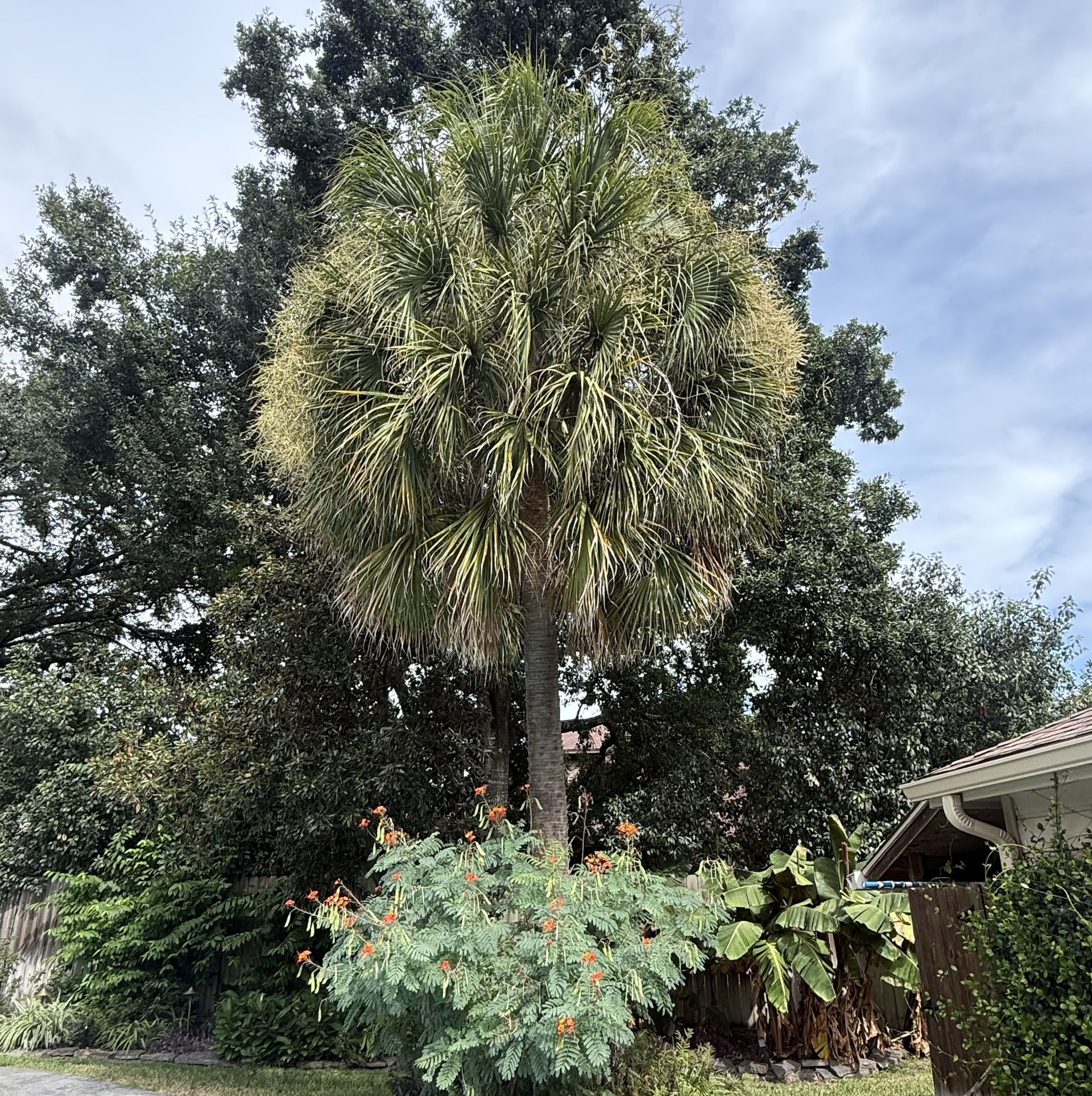
At a residence in Bayou Vista, palm trees across the front and back yard required supportive care to improve vitality and maintain stable performance. The treatment scope included all palms on the property and the surrounding soils and grasses to ensure effective root-zone coverage.
Evaluation Findings:
Assessment supported a proactive approach focused on root-zone function and overall palm performance. Because the terminal bud is the single growing point in palms, treatment placement and coverage around the crown area was prioritized to support function and reduce stress during active growth periods.
Intervention:
An organic palm biostimulant treatment was performed for all palm trees in the front and back yard, including surrounding soils and grasses for effective root-zone coverage. Per arborist instructions, the treatment was applied with heavy spray coverage around the terminal bud of each palm to ensure thorough contact in the crown region while also supporting below-ground function through the treated root zones.
Outcome (Observable):
Following treatment, palm performance stabilized and overall vigor improved across the property. Subsequent monitoring documented improved appearance and growth response consistent with successful biostimulant support and effective coverage around the terminal buds and root zones.
Communities We Serve in Bayou Vista
Eric Putnam BCMA Inc. provides arborist-led tree care, Plant Health Care, and professional tree evaluations throughout Bayou Vista. Our Bayou Vista service area includes properties in communities such as:
- New Bayou Vista
* If your neighborhood is not listed, contact our office to confirm service availability for your property *
Nearby Cities We Serve
Eric Putnam BCMA Inc. also provides professional tree care and arborist services in communities near Bayou Vista. Select a city below to learn more about our services in that area.

Request an Arborist Evaluation in Bayou Vista, TX
If you have questions regarding canopy stability, structural defects, root-zone stress, or long-term tree health in Bayou Vista, request an evaluation with a certified arborist. Recommendations are based on documented findings and site-specific conditions.
Book an Appointment
Get a quote
Contact Us
Liriope’s Muse - Expert Tree Care Tips