

Removal of Diseased Dead Limbs
Diseased Deadwood Requires a Different Approach
Removing dead limbs affected by disease is not the same as routine or cosmetic deadwood removal. Diseased limbs may contain fungal spores, bacteria, infected vascular tissue, decaying wood, or other contaminated material. If cuts are placed incorrectly or contaminated equipment contacts healthy tissue, the pruning may create additional pathways for disease development. Because of these risks, diseased deadwood removal must be approached as part of the tree’s overall disease-management plan.
In simple terms: The location of every cut, the sanitation of the equipment, and the experience of the crew can affect the tree’s ability to contain the disease.
What Makes Diseased Deadwood Different?
Contaminated Tissue
Diseased deadwood may contain fungal spores, bacteria, infected vascular tissue, or other material that can be transferred during pruning.
Living and Dead Boundaries
The crew must determine where viable tissue ends and confirmed dead tissue begins before selecting the location of each cut.
Disease Transmission
Pruning tools, ropes, equipment, gloves, and wood debris can carry contaminated material to healthy parts of the tree or to other trees.
Compartmentalization
The location of the pruning cut can affect the natural boundary the tree has begun forming between living and diseased tissues. (CODIT)
Nature's Symphony
Tree compartmentlizing a pruning wound
How Diseased Deadwood Is Removed
The living tissue boundary is identified
The qualified arborist or trained tree crew carefully examines the affected limb to identify the final visible indication of living tissue.
The crew measures into the dead portion
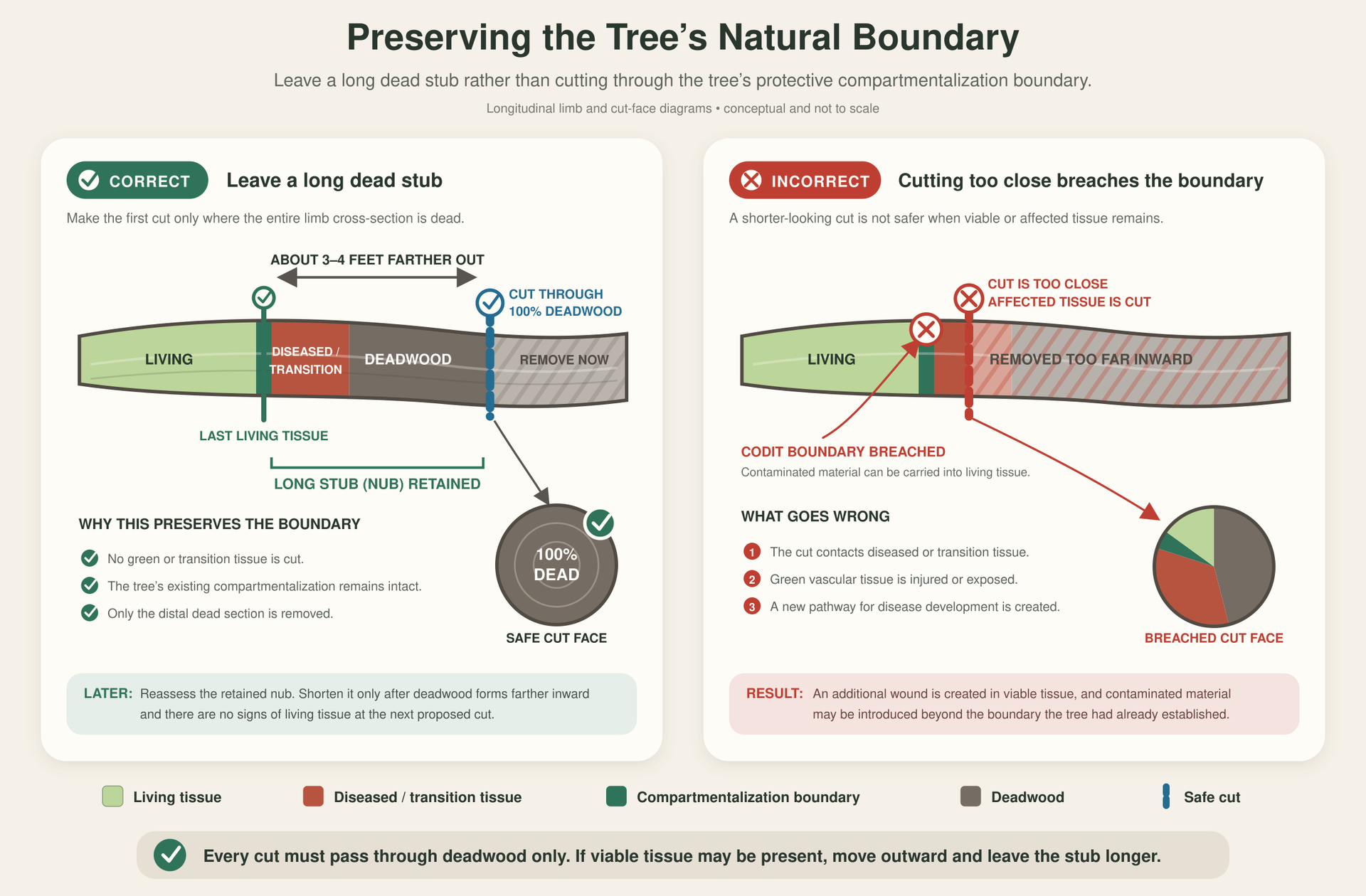
After locating the boundary, the crew measures approximately three to five feet outward into the confirmed dead portion of the limb whenever the branch structure allows.
The cutting location is confirmed
The selected location is examined to verify that the pruning cut can be made through dead tissue without unnecessarily entering viable wood.
The cut is made through confirmed dead tissue
The final cut is made within the dead portion of the limb. Under these conditions, the cut should not pass through green, living tissue.
Preserving the Tree’s Natural Boundary
Trees respond to injury and disease by attempting to separate affected tissues from healthy tissues. This process is known as compartmentalization, or CODIT. Placing the pruning cut within the dead portion of the limb helps preserve the natural boundary the tree has already begun forming between the living and dead tissues. Cutting through green, viable wood could carry contaminated material into living vascular tissue, injure healthy tissue, and create an additional pathway for disease development. The objective is to remove the diseased deadwood without disrupting the protective boundary the tree is attempting to establish.
Preventing Disease Transmission During Pruning
Strict sanitation is essential when removing diseased deadwood. Chainsaws, handsaws, pruning tools, ropes, and related equipment must be thoroughly cleaned and disinfected before work begins and again as necessary throughout the pruning process. The crew must also handle contaminated limbs and debris carefully to reduce contact with healthy portions of the tree and surrounding vegetation.
An incorrectly placed cut or contaminated tool could spread disease, injure viable tissue, and substantially reduce the tree’s ability to contain the affected area. A lawn or landscape service may be capable of removing ordinary dead branches, but diseased deadwood requires professionals who understand disease transmission, tissue identification, proper cut placement, and equipment sanitation.
Questions About Recommended Pruning?
If Eric Putnam BCMA Inc. has recommended the removal of diseased, dead limbs, contact our team with any questions about the cutting locations, sanitation requirements, or the role of pruning in the tree’s disease-management plan.
To understand how we support trees following pruning, visit our How Tree Biostimulants Work page.
For information about compartmentalization, read our CODIT: A Tree’s Healing blog.
Frequently Asked Questions
Is diseased deadwood removal the same as routine pruning?
No. Diseased deadwood may contain fungal spores, bacteria, infected vascular tissue, or other contaminated material. Its removal requires careful placement of cuts, equipment sanitation, and an understanding of disease transmission.
Why should cuts not be made through living wood?
Cutting through viable wood could carry contaminated material into living vascular tissue, injure healthy tissue, and create an additional pathway for disease development.
Where should the pruning cuts be made?
The crew must identify the final visible indication of living tissue and place the cut within confirmed dead tissue. When the branch structure allows, the cutting location should be approximately three to five feet outward from the final visible indication of living tissue.
Why must the tools and equipment be disinfected?
Pruning tools, ropes, and related equipment can carry contaminated material between cuts or between trees. Proper cleaning and disinfection help reduce the risk of disease transmission.
Can a lawn or landscape service perform this work?
A lawn or landscape service may be capable of removing ordinary dead branches. Diseased deadwood should be removed by qualified arborists or properly trained tree-care professionals who understand disease transmission, sanitation, tissue identification, and proper cut placement.
Will removing diseased deadwood cure the tree?
Not necessarily. Pruning removes affected dead material but cannot reverse damage that has already occurred within the tree. Its purpose is to reduce disease pressure, avoid unnecessary injury to viable tissue, and support the tree’s ability to compartmentalize the remaining affected areas.
Why might additional treatments be recommended?
Additional plant health care treatments may be recommended to improve root-zone function, biological activity, nutrient uptake, stress recovery, and overall tree vigor. The appropriate treatment will depend on the tree’s condition and the nature of the disease.