

How the Biostimulant Works
Healthy Trees Depend on the Soil Around Their Roots
A tree depends on the biological system surrounding its roots for water, mineral nutrients, oxygen, and protection from harmful organisms. When that underground environment is not functioning properly, the tree may have difficulty acquiring resources and responding to stress.
Our biostimulant is intended to support this living system by improving soil structure, encouraging beneficial microbial activity, and strengthening the relationship between the soil and the tree’s absorbing roots.
In simple terms: The treatment supports the soil and beneficial organisms that help the tree’s root system function effectively.
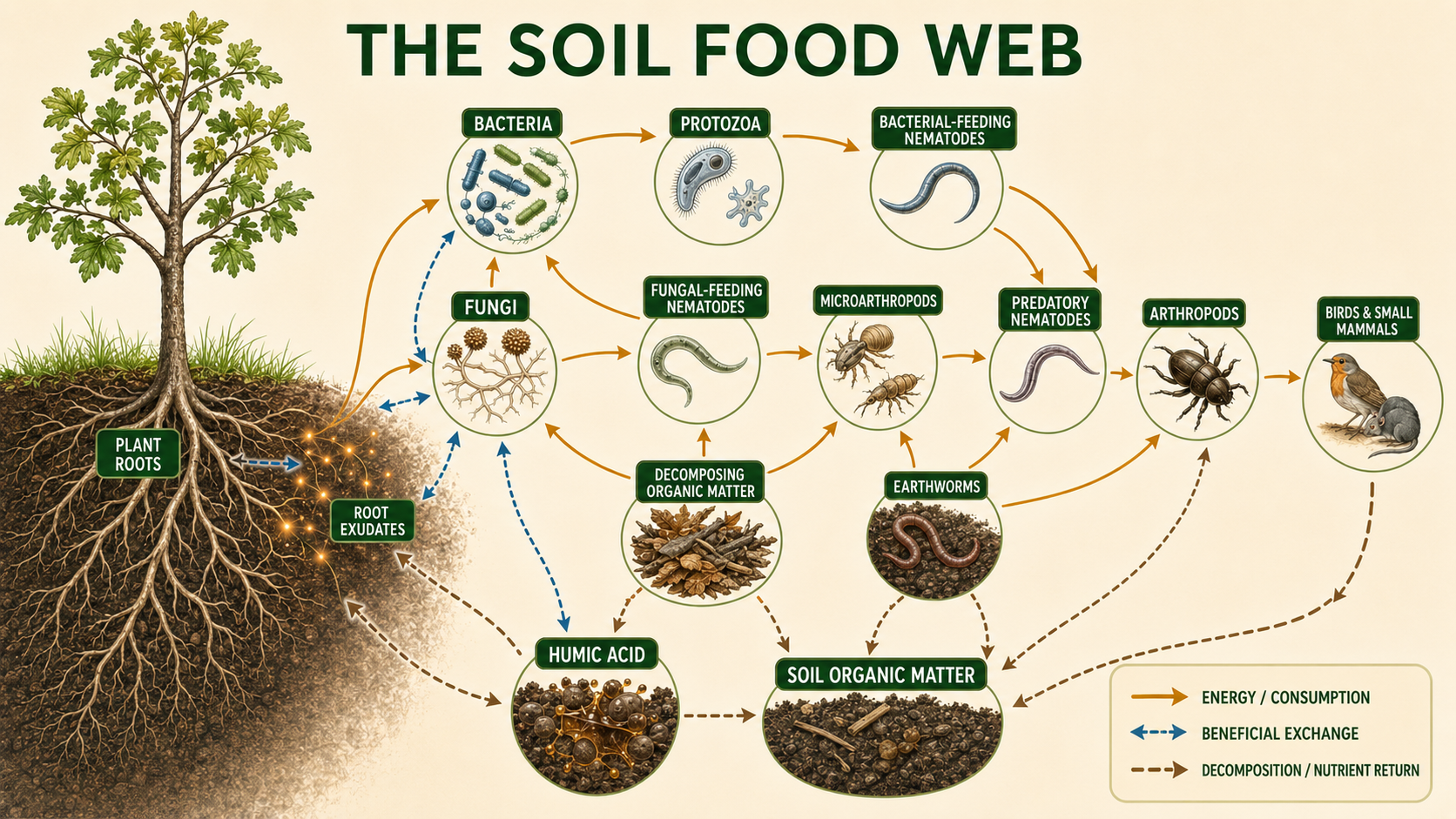
Soil Food Web
This is a diagram of the Soil Food Web
What Is in the Biostimulant?
Humic Acid
Provides carbon and supports soil aggregation, nutrient availability, water movement, and the soil’s ability to exchange and retain nutrients.
Molasses
Provides readily available carbohydrates that serve as an immediate food source for beneficial bacteria and other soil microorganisms.
Beneficial Fungi and Bacteria
Help cycle nutrients, improve soil structure, and compete with organisms associated with disease and decay.
Mycorrhizal Fungi
Form connections with the tree’s fine absorbing roots and extend into the surrounding soil, increasing the tree’s effective absorbing area.
How It Works

- Soil particles form larger aggregates
-Humic acid and natural polymers produced by beneficial fungi help bind smaller soil particles together. - More pore space develops
-Larger soil aggregates create additional space for air and water to move through the root zone. - Beneficial microorganisms receive support
-Molasses provides readily available energy for bacterial activity, while humic acid primarily supports the fungal side of the soil food web. - The tree gains greater access to resources
-Mycorrhizal fungal filaments extend beyond the tree’s physical roots, increasing access to water and mineral nutrients.
Improving the Physical Soil Environment
Humic acid and beneficial fungi support soil aggregation in complementary ways. As smaller soil particles become bound into larger aggregates, additional pore space becomes available for air and water movement.
This begins shifting the soil away from compacted, oxygen-deficient conditions and toward a more aerobic environment.
Supporting the Living Soil Community
Beneficial fungi and bacteria help cycle nutrients, improve soil structure, and compete with disease-causing organisms for available space and resources.
Mycorrhizal fungi also create a biological connection with the tree’s absorbing roots. Their filaments extend into areas of soil beyond the physical root system and help the tree access water and mineral nutrients that might otherwise remain unavailable.
More Than a Simple Fertilizer
The biostimulant does not depend on one ingredient to perform every function. Its components work together to support soil structure, air and water movement, beneficial microbial activity, nutrient acquisition, root protection, stress recovery, and natural disease suppression.
Its purpose is to support the biological environment on which the tree depends.
Questions About a Recommended Treatment?
If Eric Putnam BCMA, Inc. has recommended a biostimulant treatment for your tree, contact our team with any questions about the recommendation or its intended purpose.
For information about when this service may be recommended, visit our Biostimulant Treatment page
To learn more, read our Blog:
Why we spray the whole yard
Frequently Asked Questions
Is the biostimulant simply a fertilizer?
No. The biostimulant is much more than a simple booster or fertilizer. It is intended to rebuild the biological system that supports nutrient acquisition, root protection, stress recovery, and natural disease suppression.
What are the primary components?
The biostimulant consists primarily of humic acid, molasses, and beneficial microbial components.
Why is humic acid included?
Humic acid provides carbon and helps improve nutrient availability, soil aggregation, water movement, and the soil’s ability to exchange and retain nutrients.
Why is molasses used in the treatment?
Molasses provides carbohydrates that serve as an immediate food source for beneficial soil bacteria and other microorganisms.
How do beneficial microorganisms help the tree?
Beneficial fungi and bacteria help cycle nutrients, improve soil structure, compete with disease-causing organisms, and biologically restrict many organisms associated with decay and disease.
What do mycorrhizal fungi do?
Mycorrhizal fungi form symbiotic connections with the tree’s fine absorbing roots. Their fungal filaments extend beyond the physical root system, increasing the tree’s effective absorbing area and helping it access water and mineral nutrients.