

Liriope’s Muse: Tree Care Tips from a Master Arborist
TRUSTED TREE CARE SERVICES SINCE 1970
Liriope's Muse: Why We Spray The Whole Yard
A question we get time and time again is “Why are you spraying my entire yard with the bio stimulant when you are only here to treat this one tree?” We love being asked this as it gives us the opportunity to teach about the complex Mycorrhizal ecosystem and soil food web hidden beneath the grass's surface, working in a symbiotic unison with the tree for defense, protection, nutrient absorption, water uptake, PH balancing, and overall support for the tree's health.
When we administer a biostimulant treatment, we soak every surface of the plant from leaves, to bark, to rootzone… which, unbeknownst to many, can extend 10s of feet past the canopy of your tree. And those Mycorrhizal roots we were speaking of? They extend out even further than the tree's own roots, meaning a single established tree's root system may not only cover the entire front yard but may even extend to the back yard, and neighbors' yards too. So, in many cases, when we are hired to administer a biostimulant treatment, you may find us treating the front and back yards.
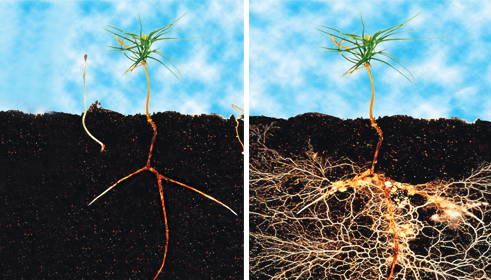
*The photo above from rootrescue.com shows the difference in a root system without Mycorrhizal connections(left)
and a root system with a healthy Mycorrhizal colony.*
What is Mycorrhiza?
“Myco” - “rhiza” literally means “fungus” - “root” and describes the mutually beneficial relationship between the plant and root fungus. These specialized fungi colonize plant roots in a symbiotic manner and extend far into the soil, creating vast network connections and reaching places the plants' roots could never on their own. The Mycorrhizal fungal filaments in the soil are true extensions of the root system they inhabit and are more effective in nutrient and water absorption than the roots themselves.
According to mycorrhizae.com, more than 95 percent of terrestrial plant species form a symbiotic relationship with beneficial mycorrhizal fungi, and have evolved this symbiotic relationship over the past several hundred million years. These fungi predate the evolution of terrestrial plants, and it was the partnership with mycorrhizal fungi that allowed plants to begin colonizing dry land and to create life on Earth as we know it.
How is this fungal symbiosis established?
As roots grow and push through the soil, they release ‘exudates’ in the form of carbohydrates that the Mycorrhiza are attracted to and feed on. Once the roots are inoculated with the mycelia, the process is essentially self-sustaining. As the roots grow they release their exudates, feeding the fungi which allows them to continue to grow releasing spores and hyphae further extending their network.
Benefits of Mycorrhiza
Defense
Mycorrhizal connections defend the trees in many ways, the main being their ability to produce antibiotic-like compounds for the tree to shield it from harmful fungi and other soil-borne pathogens. These antibiotic-like compounds include antifungal metabolites, phenolic compounds, and organic acids that immobilize soil-borne pathogens, outcompete them for nutrients, and stimulate the plant's own immune system. They also work as a literal shield, covering the roots and being their first line of defense.
Protection
Those same antibiotic-like compounds help to protect the tree during many types of environmental stressors, including drought, heavy salinic soil conditions, extreme temperatures, heavy metal exposure, soil pH changes, and more!
Nutrient Efficiency
Oftentimes, plants that have a nutrient deficiency don’t lack the nutrient because it is not present in the soil, rather it is most likely due to unhealthy roots and Mycorrhizal connections. Every nutrient that a plant needs to carry out its biological processes can be found in the soil, but the problem is when they become ‘locked out’ or unabsorbable to the plant on its own.
The Mycorrhizal hyphae release enzymes into the soil that break down and ‘unlock’ tightly bound nutrients in the soil, such as nitrogen, potassium, phosphorus, zinc, copper, and other micronutrients. These hyphae then absorb and deliver these essential nutrients directly to the plant's roots for absorption.
Another way fungal hyphae improve nutrient absorption and efficiency is by extending the tree’s root system farther into the surrounding soil. Further, because hyphae are much smaller than roots, they can also access tiny soil pores that roots themselves cannot reach.
Water Absorption
The mycorrhizae extend well beyond the tree’s root system, allowing the roots to tap into moisture reserves far beyond their reach. The fungal hyphae absorb moisture in the soil and transport it back to the tree's root zone, making the trees far more tolerant to drought stress and improving their water-use efficiency.
Root Growth
As mentioned above, Mycorrhizal hyphae have the ability to access nutrients and water far beyond the plants root system and deliver them directly to the plants vascular system, this heavily encourages root growth and promotes faster plant establishment.
The mycorrhizal connections themselves can drastically increase the tree's biomass and absorptive area by as much as 100- or 1000-fold.** That’s exponential!
Other Key Players
Beneficial fungi are not the only organisms supported by our biostimulant treatments. In fact, these treatments help feed the soil food web as a whole. By reintroducing organic matter into soils that have become depleted or biologically inactive, we help encourage the return of soil life. Nematodes, earthworms, bacteria, fungi, and other small soil organisms all play essential roles in nutrient cycling, soil aeration, soil structure, and overall soil health. Which, in turn, provides the perfect environment for a tree to thrive.
Our biostimulant treatment is not as much for the tree as it is for the ecosystem surrounding it; without a healthy and thriving microflora or soil food web, your tree cannot thrive either. So, don’t be too surprised next time you see us spraying the grass across the yard from the tree you asked us to treat, because we are treating the most important part.
Resources I found helpful in my research:
https://mycorrhizae.com/how-it-works/
The Potential Role of Arbuscular Mycorrhizal Fungi in the Restoration of Degraded Lands - PMC **
https://njaes.rutgers.edu/FS1384/
https://extension.okstate.edu/fact-sheets/mycorrhizal-fungi
https://mycorrhizae.com/how-it-works/
Liriope’s Muse - Expert Tree Care Tips