

Liriope’s Muse: Tree Care Tips from a Master Arborist
TRUSTED TREE CARE SERVICES SINCE 1970
Liriope's Muse - Freaky Friday: Soapy Trees?
In this week's installment of freaky Friday, we are talking about the interesting, and not formally named, physiological phenomenon of soapy trees…
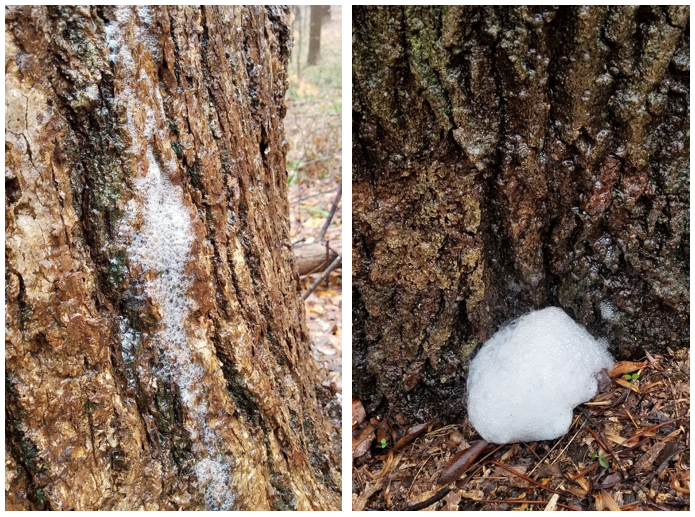
* The photos above, captured by the Bradywine Conservatory, show the natural soaps accumulating down the bark and at the base of the tree *
Ever notice soap piles at the base of your tree(s) after a good, hard rain? Don’t be alarmed, this is just a result of stemflow solute transport... In other words, during long dry periods, various particulates, salts, plant chemicals, and air pollutants accumulate on the tree's bark surface. When rain collects in the tree's canopy and flows down the branches and stem, these ingredients mix together, are agitated by the texture of the tree's bark, and concentrate towards the base of the tree, resulting in foamy piles of soap around the base of the tree.
These bubbles are completely harmless to the health of your tree. Put simply, soap is just a mixture of salts and acids, both of which can naturally accumulate over time on the surface of your tree, and when mixed with flowing water (stemflow), it makes for the perfect all-natural and basic soap!
While it may look odd, it is just another reminder that trees are constantly interacting with their environment, collecting and redirecting water, nutrients, dust, and atmospheric particles in ways we do not always notice.
So, the next time your tree looks like it took a bubble bath during a storm, there is no need to panic. Your tree is not leaking soap, and it does not need to be rinsed off. It is simply showing off one of the many strange and fascinating ways trees move water through their canopy and down to the soil below.
Arborist Advisory:
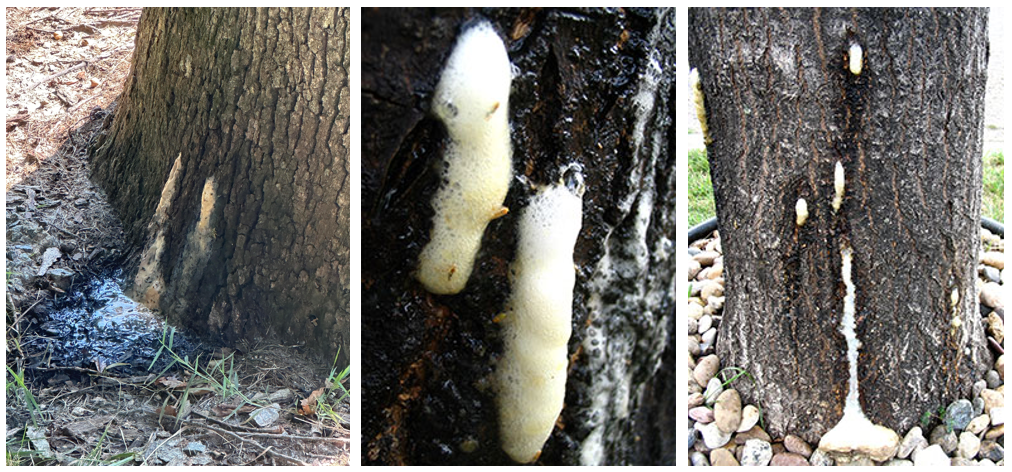
Stemflow solute transport is completely harmless; however, it should not be confused with Bacterial Slime flux! This natural soap should have no scent to a slightly earthy scent, be white in color, have the texture of bubble bath(leaving no residue after touching), and only last just a few hours to a couple of days after a heavy rainfall.
Some red flags to look out for are:
- Strong and foul odor emitting from the bubbles (like alcohol, fermentation, or rot)
- Black or darkened staining around the bubbles
- Has a slimy texture
- Located near a wound/pruning site
- Did not appear after a rain
- Bubbles that persist longer than just a couple days
- Tree presenting with an overall loss of vigor
*Pictured below are photo examples of bacterial slime flux, the center and right photo ere captured by J. Walla from Colorado State University*
Resources:
https://extension.colostate.edu/resource/bacterial-wetwood/
https://www.sciencedirect.com/science/article/pii/S0307904X2030322X
https://www.brandywine.org/conservancy/blog/soapy-trees-sometimes-trees-need-shower
https://bygl.osu.edu/node/1595
Liriope’s Muse - Expert Tree Care Tips