


Why We Never Use Trunk Injections
Protecting a Tree Should Not Begin With Drilling Into It
Many arborists and tree companies use trunk injections. Eric Putnam BCMA Inc. does not use trunk injections under any circumstances because we consider the practice inherently damaging and potentially deadly to trees. Every trunk injection requires drilling through the protective bark and directly into the living cambial and vascular tissues. The tree must then expend energy to compartmentalize each individual injection wound. These wounds do not simply disappear after the chemical has been introduced.
In simple terms: Every trunk injection creates a permanent wound that the tree must expend energy attempting to contain.
What Is Affected by a Trunk Injection?
Protective Bark
The bark is the tree’s first line of defense. Drilling through it creates a direct opening into the living tissues underneath.
Living Cambium
The cambium produces new vascular tissue and supports the continued growth of the trunk and roots. Every injection passes through this living layer.
Vascular Tissues
The vascular system transports water, mineral nutrients, and carbohydrates throughout the tree. Drilling and repeated injections can disrupt these pathways.
The Trunk Base
Injection ports are typically installed near the base of the trunk, where moisture, soil organisms, fungal spores, and disease pressure are greatest.
Nature's Symphony
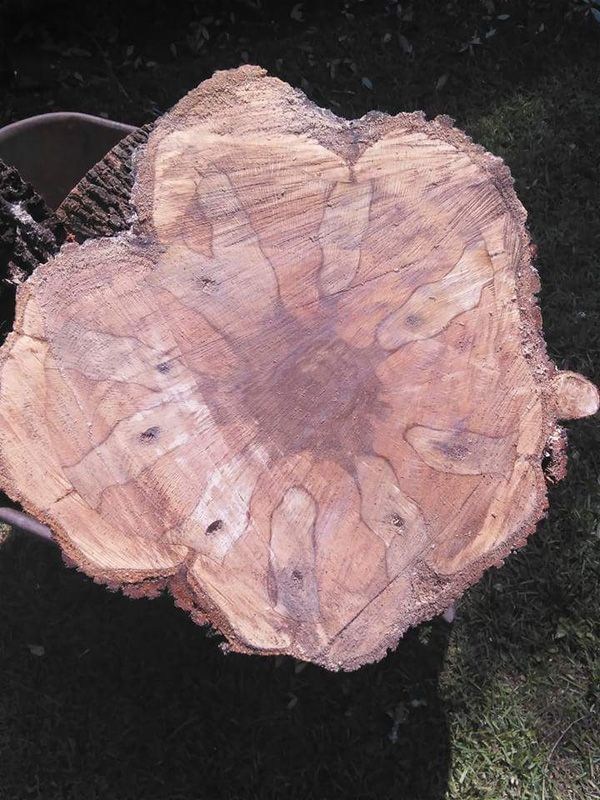
Cross section of a tree that was injected
How Injection Damage Develops
The protective bark is drilled
A hole is created through the tree’s natural protective barrier and directly into living tissue.
Material is introduced into the tree
The treatment is delivered into the cambial and vascular tissues rather than being absorbed through the tree’s natural biological processes.
The tree responds to the wound
The tree must expend energy attempting to close and compartmentalize the injury. The drilled tissue does not regenerate or simply return to its previous condition.
Additional wounds accumulate
When injections are repeated, new holes are created near previous injection sites. The tree must then manage an increasing number of wounds around the base of its trunk.
Creating Direct Entry Points Into Living Tissue
Injection ports are typically installed near the base of the trunk. This area connects the trunk to the tree’s structural root system and is commonly exposed to moisture, soil organisms, fungal spores, bacteria, and other sources of disease pressure.
Even when the drill bit and injection equipment are disinfected, the tree’s bark cannot be made sterile. Fungal spores, bacteria, organic debris, and other microorganisms present on or within the bark can be carried directly into the newly drilled hole. Once one or more of these contaminants enter the injection wound and become established within the living tissue, the tree may no longer be able to successfully close or compartmentalize (CODIT) the wound. The injection site can then remain an active pathway for internal decay, vascular disruption, and continued fungal or bacterial colonization.
Reusing equipment from tree to tree creates an additional risk of transferring pathogens between properties and individual trees.
The Long-Term Effects of Repeated Injections
Based on our long-term field experience, more than half of repeatedly injected trees may experience serious decline or mortality within approximately five to ten years.
Repeated injections can lead to internal decay columns, localized cambial death, vascular disruption, fungal colonization, and the eventual failure of the tree to close or compartmentalize the accumulating wounds.
Unfortunately, the connection between the injections and the later decline is rarely acknowledged. By the time the tree begins showing extensive decay, vascular disruption, cambial dieback, or structural deterioration, the decline is often attributed to drought, insects, age, disease, or another secondary factor.
Research behind our approach
Repeated wounds in American elm. Dissection of 80 elms found discoloration associated with injection wounds. Trees injected over successive years sometimes had severe internal injury. (Discolored and Decayed Wood Associated with Injection Wounds in American Elm | Arboriculture & Urban…)
The injected material matters. In small American elms, chemical treatments produced larger columns of discolored wood than water injections; the studied fungicide was particularly injurious. (https://auf.isa-arbor.com/content/isa/11/5/137.full.pdf)
Some injury is hidden from view. In preliminary observations of injected maple and ash, external bark cracks understated the extent of cambial injury found through dissection. (https://www.nrs.fs.usda.gov/pubs/jrnl/2005/ne_2005_smith-k_003.pdf)
Application method affects visible wounds. Among 365 treated green ash trees, trees treated with a sealed plug system had more observed external wounds than those treated with an open system. Many wounds in the sealed group were associated with improper plug application. (https://www.rainbowecoscience.com/content/pdf/tree-injection-research/TI-Research-Observation-External-Wounding.pdf)
Injected material affects wound response. In five-year-old sweet orange trees affected by citrus greening, oxytetracycline injections led to slower wound closure and more internal discoloration than water injections. Wound response also varied by injection location and season. (https://link.springer.com/article/10.1007/s00468-023-02440-2)
Drilled and drill-free injection in sweet orange. In two trials involving young sweet orange trees affected by citrus greening, the drill-free system caused more trunk injury than the drilled system under the methods tested. The systems delivered different antibiotic doses, so this should not be presented as proof that drill-free methods are generally more damaging. (https://www.mdpi.com/2311-7524/11/8/976)
Injected formulation and trunk injury.
In two trials involving citrus-greening-affected ‘Valencia’ orange trees, a formulation containing an adjuvant was associated with wider and longer wounds and more bark cracking, without improving antibiotic performance. Oxytetracycline treatments also improved fruit yield and quality. The authors could not isolate the effect of pH from the effect of the adjuvant. (https://www.mdpi.com/2079-6382/15/9/892)
* Disclaimer: This does not apply to Oak Wilt, which might require trunk injections *
Questions About a Recommended Treatment?
If Eric Putnam BCMA Inc. has recommended a treatment for your tree, contact our team with any questions about the recommendation, how it will be applied, or its intended purpose.
To understand how we do treatments, visit
How We Apply Our Tree Treatments page
For information about
CODIT,
read our Blog:
CODIT: A Trees Healing
Frequently Asked Questions
Does Eric Putnam BCMA Inc. use trunk injections?
No. We do not use trunk injections under any circumstances because we consider the practice inherently damaging and potentially deadly to trees.
Does the injection hole heal?
The tree attempts to compartmentalize the wound, but the drilled tissue does not regenerate or simply return to its previous condition. The tree must continue managing the injury after the treatment has been introduced.
Does disinfecting the equipment eliminate the risk?
No. Although drill bits and injection equipment can be disinfected, the tree’s bark cannot be made sterile. Microorganisms and organic material on or within the bark may be carried into the newly drilled hole.
What can happen after repeated trunk injections?
Repeated injections can lead to internal decay columns, localized cambial death, vascular disruption, fungal colonization, and the tree’s eventual failure to close or compartmentalize the accumulating wounds.
Why might injection-related decline be overlooked?
Serious decline may not become visible for several years. When symptoms eventually appear, people often attribute them to drought, insects, age, disease, or another secondary factor rather than the earlier injection wounds.