
Liriope’s Muse: Tree Care Tips from a Master Arborist
TRUSTED TREE CARE SERVICES SINCE 1970
Liriope’s Muse – Arborist Observation: Bacterial Slime Flux
Bacterial “Slime Flux”, known formally as Bacterial Wetwood, is something that our arborists come across frequently in the field, however recently with this year's El Nino weather conditions we have observed an increase in its prevalence.
As alluded to in its name, bacterial wetwood occurs when wet areas develop in the heartwood or sapwood of trees (often as a result of some sort of injury/wound) and become colonized by an assortment of harmful bacteria. As these bacteria feed and multiply, mostly under anaerobic (oxygen-lacking) conditions, they produce gases such as carbon dioxide, nitrogen gas, or methane. These gases build pressure within the tree as the bacteria break down and ferment, causing movement of interior liquids to the exterior of the trunk, where they escape through pruning wounds, injuries, branch crotches, and cracks in the bark.
This ‘oozing’ leads to streaked, discolored, water-soaked areas on the tree’s trunk. The ooze itself has only a faint smell, but is not colored or off-textured, as it is mainly comprised of water and lightly fermented sap, but it is the bacteria, yeasts, and other fungi (in the atmosphere and present on the bark) that colonize the sugary liquid that are responsible for its characteristic black streaking, slimy appearance, and very rancid smell.
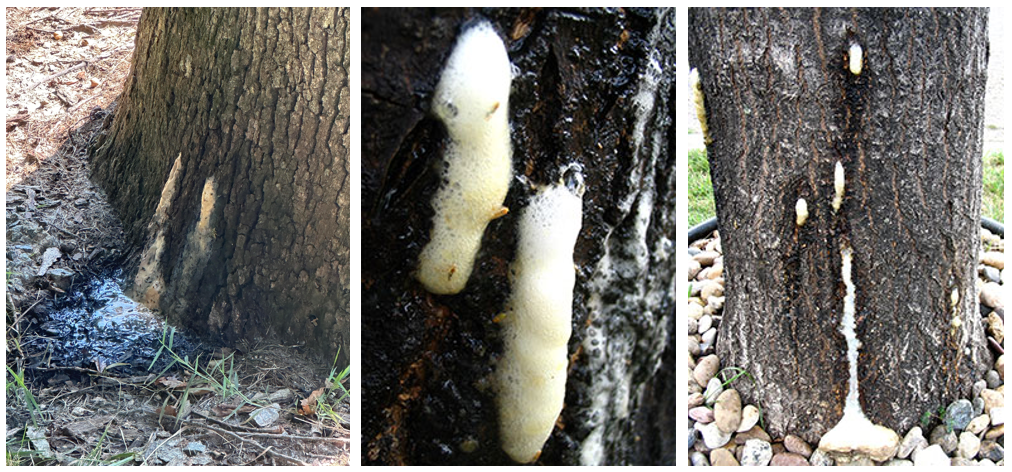
*Pictured Above are photo examples of bacterial slime flux, the center and right photo ere captured by J. Walla from Colorado State University*
What does this mean for my tree?
According to the Colorado State University Forrest Service Extension, Wetwood slime is toxic to the tree’s cambium, the tissue between the inner bark and wood that produces new cells. The slime can prevent or retard callus formation when the tree has been wounded or destroy the cambium at the base of a pruning cut. Foliage, young shoots and grass have even been known to die if slime flux drips on them. Root tissue also can exhibit wetwood symptoms, in the form of brown streaks extending from the diseased trunk into the center core and sometimes the outer wood of roots. Radial cracks may also occur in wetwood-affected trees, often developing during winter months. If these cracks extend to the cambium, they serve as avenues for gas to escape and slime to ooze.
In short, if left to fester in your tree, it can inhibit the healing of wounds and kill any new growth it comes into contact with, severely stressing the tree. Alone, Slime Flux will not kill your tree, but the stress it inflicts on the tree makes it more susceptible to a secondary, more lethal factor that will kill your trees, such as a pest. So, it needs to be addressed as soon as it is identified.
What we can do for your tree:
The bacteria responsible for Bacterial slime flux can only live and reproduce in anaerobic conditions, so our motive is to reintroduce oxygen back into the environment by changing the conditions within the tree back to aerobic (with oxygen), and we do this by administering our biostimulant treatment to the tree.
Our biostimulant treatment contains Humic Acid, a highly versatile and helpful naturally occurring biochemical. Humic acid works to convert conditions in both the tree and in the soil from anaerobic to aerobic in 2 main ways. The first way is via electron shuttling, and the second is by feeding the healthy aerobic bacteria in the environment.
Humic acids work on a molecular level as an ‘electron shuttle’ during anaerobic digestion. They can act as electron acceptors or electron donors during microbial metabolism, significantly impacting electron flow, digesting(or breaking down) the anaerobic compounds, allowing them to accept oxygen molecules. This process is known as Bioelectrochemical anaerobic digestion (BEAD) and not only helps in the case of reverting trees to their natural aerobic conditions, but has also proven to be a promising solution to breaking down and reverting anaerobic conditions in public waterways and sewage.
The second way humic acids help revert the environment to oxygenated conditions is by feeding the healthy aerobic bacteria(aerobes) present in the surrounding environment, encouraging their growth and abundance. Aerobes yield significantly more energy (ATP), multiply faster, consume shared food sources, physically crowd out the anaerobic populations, and bring with them oxygen, which creates a toxic and inhospitable environment for the anaerobic bacteria, which is lethal.
In short, while small anaerobic pockets can occur naturally in soils and aquatic systems, prolonged anaerobic conditions are not desirable within living tree tissues or throughout the active root zone. Healthy trees, roots, and beneficial soil microorganisms depend on oxygen to function efficiently, recover from stress, and defend against decline. By supporting microbial activity, nutrient cycling, and more balanced soil conditions, humic acid is a practical, naturally derived tool for helping restore a healthier aerobic environment. Its use in biological remediation, soil management, and water treatment further demonstrates that this is not simply a tree-care theory; it is a well-established approach for improving oxygen-limited environments.
Resources:
Slime flux -
https://plantclinic.nmsu.edu/documents/slime-flux-_od-2__final.pdf
https://csfs.colostate.edu/wp-content/uploads/2024/01/Bacterial-Wetwood-Fact-Sheet-2.910.pdf
Humic Acid as an 'electron shuttle' -
https://www.sciencedirect.com/science/article/abs/pii/S1385894725059650
https://journals.asm.org/doi/10.1128/aem.64.8.3102-3105.1998
Anaerobic V.S. Aerobic Bacterias -
https://study.com/learn/lesson/video/aerobic-vs-anaerobic-bacteria-overview-differences-functions.html
Liriope’s Muse - Expert Tree Care Tips