

Liriope’s Muse: Tree Care Tips from a Master Arborist
TRUSTED TREE CARE SERVICES SINCE 1970
Liriope's Muse - Freaky Friday: Clumsy skunk or grasshopper?
In this week's installment of freaky Friday, we are talking about the interesting life of the Eastern Lubber Grasshopper, it’s clumsy nature, stinky defense, and large appetite.
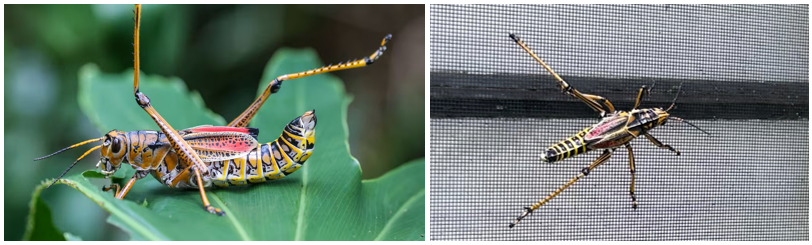
*The photo on the left was captured from Douglas R. Clifford of the Tampa Bay Times, and the photo on the right was captured
by an arborist in the field*
Recently, one of our team members in the field came across an interesting grasshopper we thought was worth sharing, the Eastern Lubber Grasshopper! This large, flightless grasshopper’s name is derived from the old English word “Lobre”, fittingly meaning lazy or clumsy. Despite having wings their massive size renders them unable to fly, or jump… instead these little guys get around by feebly walking/crawling across substrates and your garden plants. When threatened, lubber grasshoppers spread their small wings, hiss, and can spray a foul-smelling foam from their breathing tubes (spiracles).
To read more in depth about their life cycles, characteristics, distribution, predators, and history, I recommend THIS ARTICLE by the University of Florida.

*The photo above shows many nymphs feeding on a young citrus tree. This photo was captured by John Capinera of the University of Florida*
What their presence means for your garden:
These grasshoppers’ appetites are just as impressive as their enormous size. When present in large numbers, they can feed aggressively and cause serious damage to ornamental beds, vegetable gardens, and newly planted landscape material in a very short period of time. They are not selective feeders and will chew leaves, tender stems, flower buds, blooms, and other soft plant tissue, often leaving plants ragged, heavily defoliated, or stripped completely to the ground after only a night of feeding. While a healthy, established plant may recover from limited damage, repeated feeding or a large group of grasshoppers can quickly weaken young plants, reduce flowering, stunt new growth, and make an otherwise healthy garden look severely damaged overnight.
They are known to feed on more than 100 types of plants, which means few gardens are completely safe once an active population becomes established. Their preferred plants commonly include amaryllis, crinum lilies, cannas, and daylilies, but they may also move onto vegetables, herbs, flowering annuals, shrubs, and other soft-leaved ornamentals when food is available. Their presence is a sign that the garden should be monitored closely, especially around prized plants, newly installed material, and areas where multiple grasshoppers are gathering together.
Most sources recommend a more conservative Integrated Pest Management (IPM) approach, as they are typically found in delicate or food gardens. I recommend you read the University of Florida’s approach as it appears to be the most effective. You can find it in this article, scroll down to the “Management” section: https://ask.ifas.ufl.edu/publication/IN132
Liriope’s Muse - Expert Tree Care Tips