
Liriope’s Muse: Tree Care Tips from a Master Arborist
TRUSTED TREE CARE SERVICES SINCE 1970
Liriope's Muse - Arborist Observation: Black Twig Borer
Our Board Certified Master Arborist, Eric Putnam, was the first to observe a black twig borer (Ambrosia Beetle) infestation in our service area, ironically it was located in his front yard of all places. Check out this blog if you’d like to hear the interesting story: Liriope’s Muse: The Mystery in the BCMA’s Front Yard.
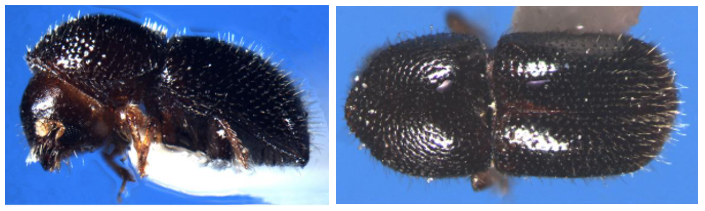
The images above are from J.R. Baker from North Carolina University and are close up images of the black twig borer
Biology & Attack Habits
The Black Twig Borer, Xylosandrus compactus, as its name suggests, is a very small (just 1/16 of an inch at maturity), shiny, black tree-boring beetle. This beetle is a member of the ambrosia family.
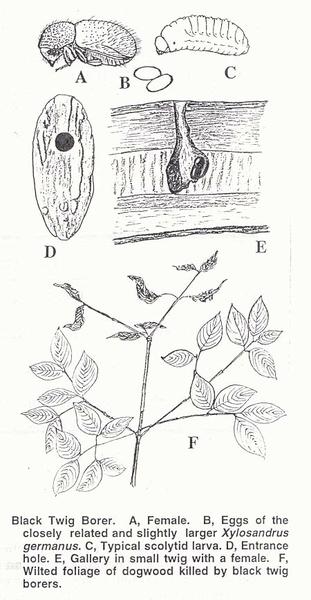
The black twig borer is notable among ambrosia beetles because, unlike many others, it attacks healthy plant material. Female beetles typically bore into small twigs (<5/16 in) and tunnel into the pith. In larger twigs, they may extend their galleries approximately ½ to 1½ inches into the wood. Twig entrance holes are about 1/32 inch in diameter and are typically found on the bottom side of the twig.
Smaller twigs (<5/16 in) are usually attacked by a single female and often die as a result of the damage. Larger twigs (up to 7/8 in) may be colonized by multiple females (20 or more) and can either die back or develop localized cankers around the infestation site spanning up to 9 inches. Wilting or dieback (flagging) symptoms commonly become visible within just a few weeks after the initial attack.
Once inside the twig, the female creates a brood chamber where a cluster of eggs are deposited. The eggs are extremely small, ovular, white, and translucent.
The beetle also introduces the fungus Fusarium solani, which produces the white “ambrosia” growth that breaks down the plant tissues for the developing larvae to feed on. During the growing season, development from egg to adult typically takes about 28 to 30 days, while development slows considerably during colder months.
Activity generally begins as temperatures warm in the spring and continues through the fall, and the beetles overwinter as adults inside infested stems. After emerging, adult females may reinfest nearby twigs very quickly (within 30 minutes of emergence), allowing damage to progress throughout the canopy if populations are not addressed.
Something of note about the Black Twig Borers, related to their mating, is that they are capable of laying eggs without fertilization, termed parthenogenesis. However, unmated females can only lay male eggs, and these males will spend their full lifecycle in the brooding chamber of a twig with their sole purpose being reproduction.
Host Trees
In the Southeastern Gulf coastal region, the black twig borers drill into the thin twigs of magnolia, dogwood, live oak, laurel oak, and many other plants, from shade trees to ornamentals. They attack seemingly healthy plants causing random wilting and flagging in the trees canopy, while these pests won’t be the sole killer of a tree they will surely be the catalyst of the trees mortality spiral that if left unchecked will lead to its demise.
However, elsewhere around the world, such as in Brazil, Cuba, Indonesia, Japan, and Sri Lanka, they are serious pests of the coffee, orchid, and avocado plants, killing them and causing serious economic losses.
Management
Like with most boring beetles, the black twig borer bores deep into the twigs of trees, bringing along a symbiotic fungi that helps to break down the lignin of the tree so that it can be eaten by their offspring. This destroys the trees essential water conductive and transportation tissues in that area. Unfortunately, this combination makes it difficult to reach them using only one method.
According the University of Florida Ag Extension, it is recommended that all plant material containing the pests be pruned and disposed of properly, while simultaneously treating the tree with a pyrethroid and a treatment to boost the vigor of the tree and promote its recovery.
We use the University of Florida’s recommendation and add to it to further the effectiveness of our treatment. We begin with our biostimulant, which will give the tree a boost of vigor to begin compartmentalizing the attack, to this treatment we add two kinds of pesticides. One being a contact pyrethroid as recommended, in our case, we use Tengaurd SFR (Permethrin 36.8%). This pesticide kills all present pests on the surface of the tree immediately upon contact, and remains on the surface of the tree killing any future arrivals for at least 60 days. The second pesticide that we use is Merit 75WSP (Imidacloprid 75%). This is a systemic pesticide, meaning it is absorbed through all parts of the tree and translocated throughout the entire tree from the roots to the shoots, making every part of it toxic to the pests attempting to feed on its tissues. This pesticide can reside in the tree's tissues for a minimum of 12-16 months.
The tricky part is that since the beetles are deep in the branch, the contact cannot reach them, and most already have an established and hollowed out galleries, absent of conductive tissues, or have fungus-infected tissues that are ineffective at transport, meaning the systemic cannot reach them either. This is why the University of Florida recommends the removal of all infected twigs, but we forgo that step in the process as it is labor-intensive and will cost the customer more, so instead we wait for the female to leave her declining colony to begin another one. When she emerges and lands on another branch, the residual pyrethroid should kill her, but in the event it does not, the toxic plant tissues surely will when she attempts to bore into another branch and begin another colony. So we rid the tree of the pests by breaking the cycle and boosting its health. This may sound intimidating, but it works in the case of the Black Twig Borers as they will not kill an established tree, only cause cosmetic damage and stress it out, which, if left unchecked, can be the catalyst to its mortality spiral that we mentioned previously.
If you think your tree may have Black Twig Borers, or a borer of some kind, give us a call, and we
can have one of our certified arborists out to take a look at your trees for free!
The diagram above from the University of North Carolina shows the lifespan and development of the black twig borer
Resources I found helpful during my research:
https://content.ces.ncsu.edu/black-twig-borer-1
https://ask.ifas.ufl.edu/publication/IN577
Liriope’s Muse - Expert Tree Care Tips