

Why Ball Moss Can Be Harmful to Trees
Our Concern Comes From Field Experience and Expert Research
At Eric Putnam BCMA Inc., our field experience has led us to consider ball moss a potential contributor to tree decline. We take its presence seriously when evaluating affected branches and overall tree health.
Published research provides additional reasons to investigate its effects. Studies have documented harmful interactions in certain host species, including changes to branch tissues, reduced shoot survival, and inhibition of plant growth under experimental conditions.
These effects are not universal. The tree species, growing conditions, amount of ball moss, and type of interaction all matter.
Ball Moss Does Not Have to Feed on a Tree to Affect It
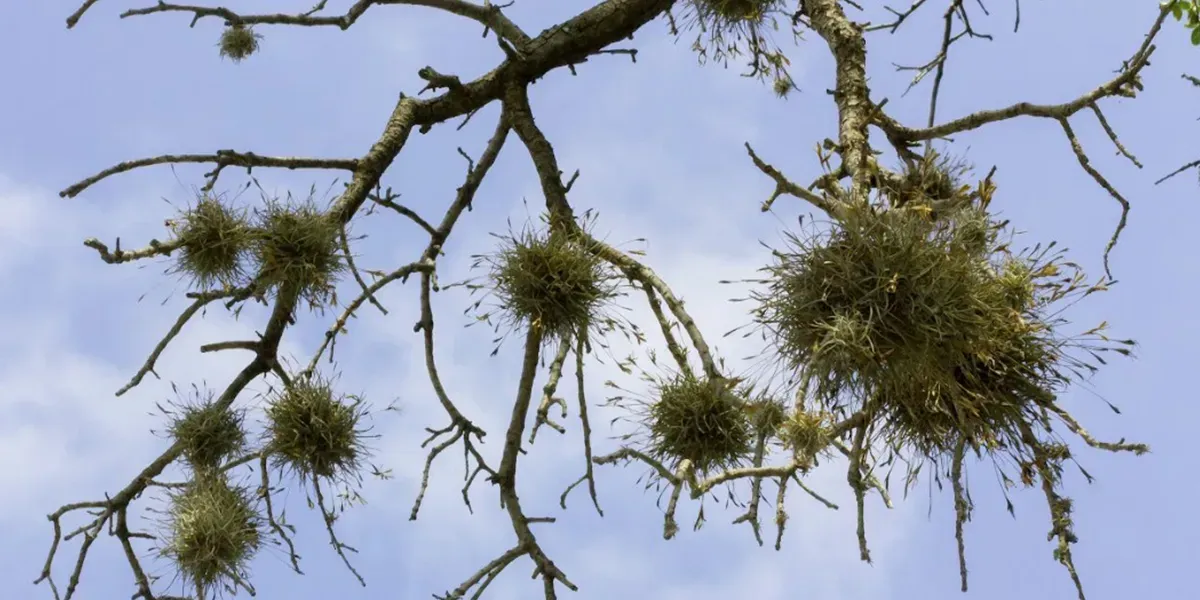
Ball moss, Tillandsia recurvata, is a flowering plant in the bromeliad family. It is an epiphyte, meaning it grows on another plant for support. Unlike mistletoe, it does not obtain water and nutrients through a feeding connection to the tree’s vascular system. It absorbs moisture and nutrients through specialized structures on its leaves.
However, that distinction does not answer every question about its effects on a host tree. Researchers have investigated physical, anatomical, and chemical interactions that may influence the plants supporting it.
Understanding Allelopathy and Phytotoxicity
Allelopathy describes chemical interactions through which one plant influences another. Phytotoxicity means that a substance can injure plants or interfere with their development. Experiments have shown that preparations made from ball moss can inhibit germination or root development in certain plants. These findings demonstrate phytotoxic potential and provide a scientific basis for investigating allelopathy.
The distinction is how exposure occurs. An extract prepared from ground plant material does not necessarily reproduce what a living branch encounters beneath intact ball moss. Research supports concern about chemical effects. Research has not established that ball moss routinely releases a toxin that poisons mature landscape trees.
How Ball Moss May Affect Host Plants
Physical and Anatomical Interactions
Research on mesquite has documented changes in bark and underlying tissues associated with ball moss attachment. One study also reported lower hydraulic conductivity in colonized branches, indicating reduced water movement in the branches examined.
These findings identify a potential pathway for injury beyond shading or added weight. They do not establish that the same response occurs in every tree species.
Effects on Shoots and Foliage
Some studies have documented reduced shoot survival or changes in leaf production associated with epiphyte presence. Other experiments have found no adverse effect under the conditions tested.
This variation reinforces the need to evaluate each tree rather than assume all hosts respond the same way.
Potential Chemical Effects
Ball moss extracts and leachates have inhibited other plants in experimental trials. Research involving ball moss material in soil has also documented effects on seedlings and shoots, with outcomes differing among host species.
These findings warrant consideration, but chemical activity in an experiment does not identify the cause of decline in an individual landscape tree.
What Our Field Experience Contributes
Our perspective comes from seeing what happens to affected trees over time. We have evaluated struggling trees carrying heavy ball moss, developed treatment plans, and followed those trees as their health improved. Across our fieldwork, the recurring association between substantial ball moss accumulation and declining tree health, together with the recoveries we have helped achieve, has given us reason to take that relationship seriously.
We do not assume ball moss is responsible simply because it is present. We investigate other causes of decline and consider the whole tree before recommending care. Because our treatments may address several problems together, recovery does not isolate ball moss as the cause or prove a particular chemical pathway. Our experience does, however, support including ball moss management in a recovery plan when the tree’s condition, our observations, and the available research justify it.
Ball Moss and Other Causes of Decline
A tree can have ball moss and also experience drought stress, root injury, soil compaction, drainage problems, disease, or previous pruning damage. A sound evaluation considers those possibilities together. Ball moss abundance alone does not prove chemical injury, and managing ball moss does not replace addressing other limitations affecting the tree.
How We Evaluate Affected Trees
Our evaluation considers:
- Tree species and overall condition.
- Ball moss coverage and its distribution.
- The location of dead or declining branches.
- Foliage density and recent shoot development.
- Visible changes around attachment areas.
- Root conditions, soil limitations, and environmental stresses.
- Whether management can be performed without unnecessary injury.
Recommendations should explain what the proposed work is intended to accomplish and what limitations remain.