

Liriope’s Muse: Tree Care Tips from a Master Arborist
TRUSTED TREE CARE SERVICES SINCE 1970
Liriope's Muse - Arborist Observation: Brittle Cinder
Our arborists are very familiar with Brittle Cinder, or as we like to call it “the Black Fungus of Death”. We most often observe it on hackberry trees and we find that once the fruiting bodies emerge, its collapse is imminent – with collapse occurring within just a few months, or less.
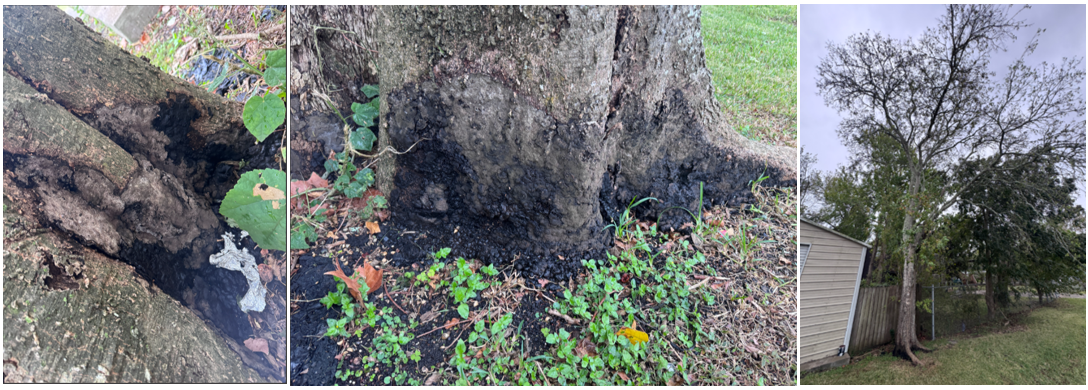
*The photos above were captured in the field by our Arborist Shane Krajnik TX-352315A. They show an advanced case of Brittle Cinder fungus (Kretzschmaria deusta) on a Hackberry (Celtis occidentalis). You can see that even the canopy is exhibiting symptoms of decline signaling that this tree has a severe amount of rot.*
Brittle cinder fungus (Kretzschmaria deusta) is a devastating soft rot fungus known to decay the lower trunk and root collar (buttress roots) of trees. The disease breaks down both the cellulose and lignin in the tree’s wood, causing the afflicted wood to become brittle and loose its structural integrity, leading to the potential for sudden tree failure.
Symptoms and Identification
Brittle Cinder gets its name from the appearance of the fungus’ fruiting body, as it has a burnt or scorched appearance in its sexual stage(also known as teleomorph). The fungus typically appears as irregular patches on the lower trunk and buttress roots of a tree, often close to the soil line. In some cases, it may even extend several feet above the ground along a crack or wound in the tree. According to the Missouri Botanical Garden, in spring and early summer, the disease enters its asexual stage (also known as anamorph) and is a light gray color with a whitish border. The remainder of the year, the fruiting body appears as a bumpy, blackened or charred crust (sexual stage) that has a "crisp" sound when broken off and crumbles easily when crushed underhand. The fungus may also exude clear to amber-colored droplets through a process known as guttation, in which liquid is released onto the surface of the fungal growth. The droplets resemble maple syrup in both appearance and texture.
Because this disease primarily affects the roots, buttress roots, and lower trunk of the tree, the canopy may not show symptoms even when decay is advanced. Trees afflicted with brittle cinder have been known to collapse before showing any canopy warning signs, making this disease particularly concerning. The fungus breaks down the wood that supports the tree, leaving it brittle and prone to sudden failure. Meanwhile, the tree may continue to transport enough water and nutrients to maintain a green, seemingly healthy canopy. This means that a full canopy and healthy-looking leaves do not necessarily indicate a structurally sound tree. That said, as the rot intensifies, the canopy may eventually display general signs of systemic decline such as chlorosis, scattered flagging, or an overall loss in density – given it hasn’t collapsed yet…
Spread and Management
The brittle cinder fungus is like staph in humans, it’s everywhere in the soil just waiting for the perfect opportunity to colonize a host. Wounds on the lower trunk or roots of the tree, even on an otherwise healthy tree, provide an open door for this opportunistic fungus. Trees who are stressed and weakened also are susceptible. So, the best prevention is to keep your tree healthy and safe from damage.
Unfortunately, there is no cure for brittle cinder once a tree is infected, and no treatment can restore the strength of wood already lost to decay. The appearance of fruiting bodies is a serious warning that the decay is extensive and the tree is terminal. Removal is often recommended, particularly where failure could endanger people, buildings, vehicles, or frequently used areas. The urgency depends on the extent of decay and the conditions surrounding the tree, rather than the presence of fruiting bodies alone. A green canopy should never be taken as reassurance that an infected tree is structurally sound.
If you suspect brittle cinder, keep people and pets away from the tree and arrange an assessment from an ISA Certified Arborist as soon as possible. Early recognition and timely action can help prevent a hidden decay problem from becoming a devastating tree failure.
Contact us today for a free estimate!
Recources:
https://www.bartlett.com/dynamic/pdf/technical-reports/Brittle%20Cinder%20Fungus.pdf
Liriope’s Muse - Expert Tree Care Tips