

Liriope’s Muse: Tree Care Tips from a Master Arborist
TRUSTED TREE CARE SERVICES SINCE 1970
Liriope's Muse - Planting Space History: Eric Putnam’s Work With Moon Trees
The chances are if you live in the Houston area – or are a space nerd like me – you are probably familiar with moon trees. If not, you're in for a treat as I will be diving into the history of moon trees, their significance, and Eric Putnam’s personal experience with them !
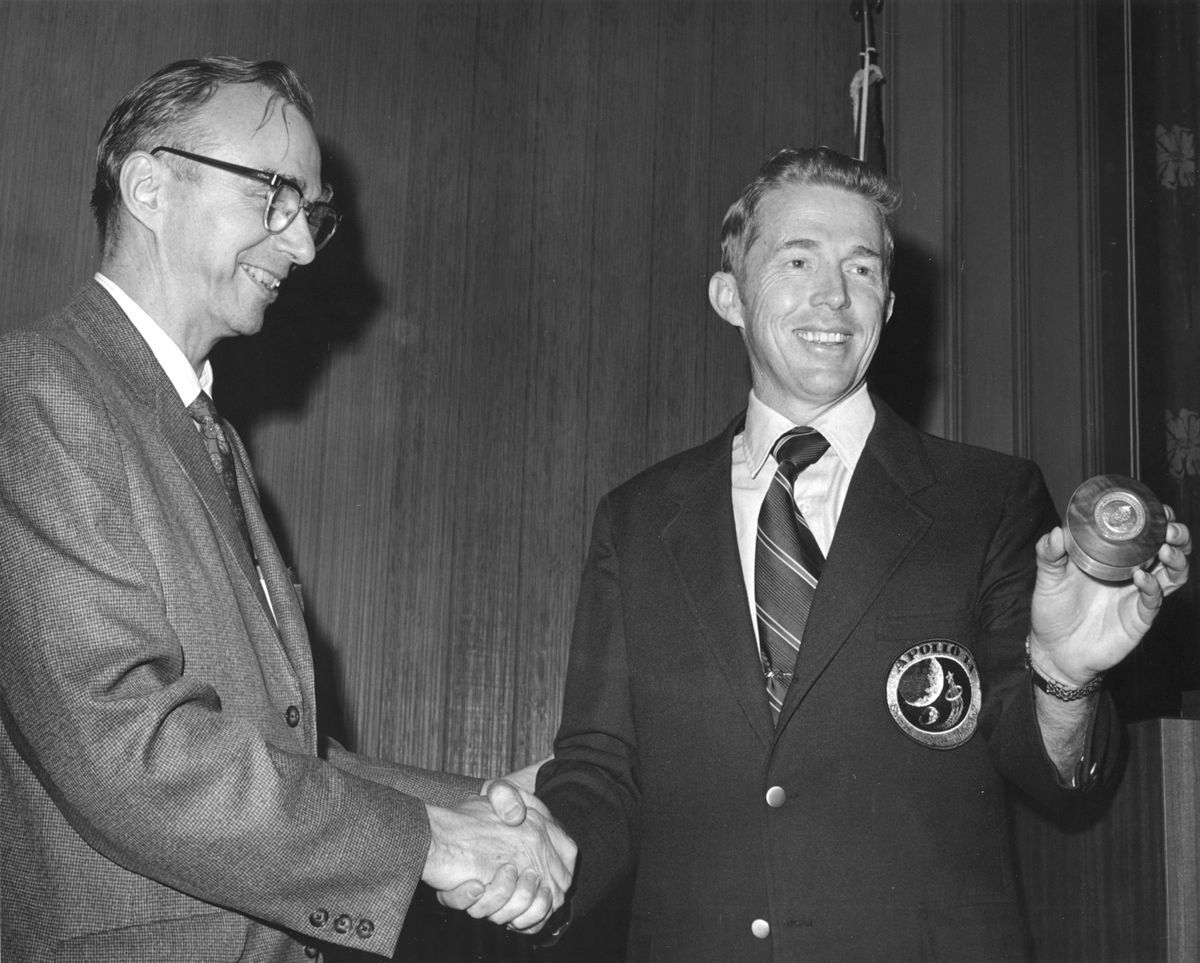
Astronaut Stuart Roosa (right) with Associate Chief of the U.S. Forest Service Art Greeley (left) in Washington, DC. Roosa holds "moon tree" seeds which accompanied him into space on the 1971 Apollo 14 lunar mission.
Photo courtesy of the Forest History Society, Durham, NC
What are the Apollo 14 Moon Trees?
Apollo 14 Moon Trees, like the name alludes to, are trees that came from seeds that orbited the moon on the Apollo 14 mission!
The Apollo 14 mission launched on January 31, 1971, lasted 9 days and 2 minutes, and was one of triumph for the United States for many reasons. It came with loads of new safety technology, it was the first mission to explore the lunar highlands, it collected lots of crucial information through samples, photos, and various measuring instruments, it was the 3rd successful human landing on the moon, and much more. There were many things that happened on this flight that aren’t frequently covered, one of them being the 2000+ seeds that were brought to orbit the moon!
Aboard the ship was Alan Shepard and Edgar Mitchell, who walked on the moon, and Stuart Roosa, a former U.S. Forest Service (USFS) smoke jumper, who orbited above in the command module providing support to the team. Roosa was a part of a joint NASA/USFS project, led by Stan Krugman of the Forest Service, that organized the bringing of thousands of seeds to the moon! The seeds were chosen from five different types of trees: loblolly pine, sycamore, sweetgum, redwood, and Douglas fir. (Control seeds of each species were kept on earth for later comparison.) The seeds were classified and sorted into little bags, then sealed and stored in a metal canister that was kept in Roosa’s personal kit throughout the trip.
However, tragically upon their return to Earth during the decontamination procedures the bags of seeds burst open and were scattered about the chamber and exposed to vacuum. It was believed after this the seeds would no longer be viable, but Stan Krugman (of the Forest Service) decided to collect as many as he could and attempted to germinate them in Houston, Tx. To his wonder it proved successful and the seeds actually began sprouting and growing, but they did not survive long as the facilities were ‘inadequate’ to support them.
So according to NASA, a year later the remaining seeds were sent to the southern Forest Service station in Gulfport, Mississippi (sycamore, loblolly pine, and sweetgum) and to the western station in Placerville, California (redwood and Douglas fir) to attempt germination. Many of the seeds were successful and grew into viable trees!
When the initial moon trees were planted with their control trees, there was no noticeable difference in 40 years of growth! Meaning after their trip to the moon and exposure to vacuum, they survived and were unaltered! From the original moon trees, many cuttings have been taken and successfully propagated (via rooting or grafting depending on the species) these are referred to as second-generation moon trees.
- For those not familiar with propagation, when you take a cutting from a tree and successfully root/graft it, it is genetically identical to the parent plant. Think of it like a clone.
There weren’t very many moon trees planted compared to the number of seeds brought into space, but they still managed to make a large impact. Because these trees were southern and western climate species, not all states – or countries – were able to receive one. Most were given away in 1975 and 1976 to many state forestry organizations to be planted as part of the nation’s bicentennial celebration, planted in universities, or various Nasa Centers across the US. A loblolly pine was planted at the Whitehouse, one tree was planted in the international forest of friendship, one at Valley Forge in Philadelphia, and one was even presented to the emperor of Japan at the time! They are in 40 states and many countries including Brazil, Switzerland, and France. But if you’d like to know their exact locations (of the original and second-generation moon trees) NASA has compiled the most comprehensive list including ones living and dead here: https://www.nasa.gov/history/moon-trees/
Eric Putnam BCMA Inc.’s Experience with Moon Trees
Our Board Certified Master Arborist, Eric Putnam (TX-0198B), has had the opportunity to plant 6 second-generation moon trees in Texas, 3 Loblolly Pines and 3 Sycamore trees in his career. He also helps to provide these trees with maintenance and health assessments as needed to ensure these Living Historical Treasures thrive for generations to come!
At the time of writing this blog, 10/29/2026, Eric is working with Gary and Sandra Mossman to plant another second-generation Sycamore moon tree at Mossman Elementary in League City, Tx in this coming week and is in talks about planting yet another at a local junior high!
Moon Tree Project – Armstrong Park – El Lago, Texas
November 12, 2024
(Our most documented planting)
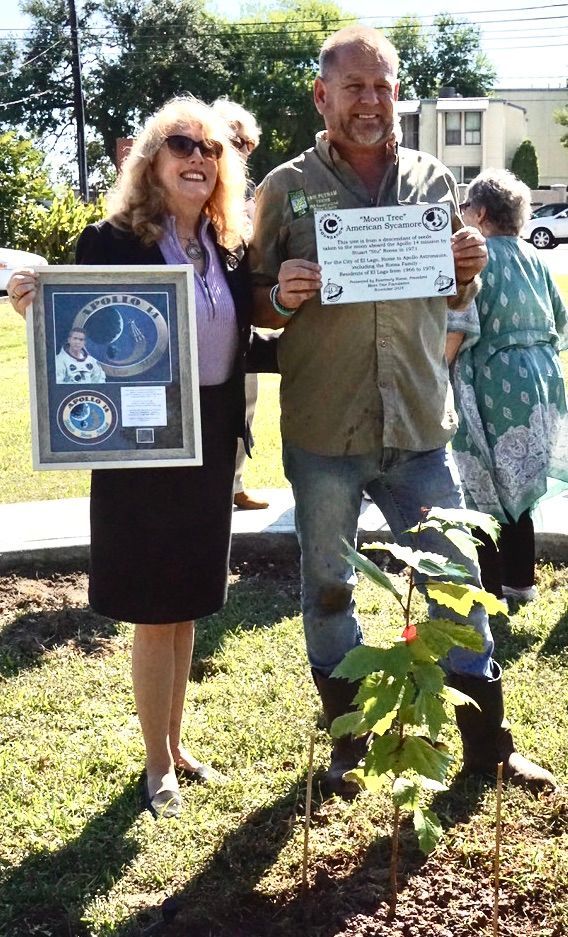
Above, Rosemary Roosa (Stu Roosa's Daughter) is pictured with Eric Putnam (the Board-Certified MAster Arborist that planted the tree)
The photo was taken by Al Ong

Above, is Eric Putnam BCMA (TX-0198B) planting the American Sycamore Moon Tree
This photo was taken by Jean Raffetto
Eric had the privilege to work with Rosemary Roosa (Stuart Roosa’s daughter) and the community of El Lago, Texas to plant a second-generation American Sycamore Moon Tree! The community of El Lago, Texas, was once home to many of NASA’s astronauts, including two of its most notable residents, Neil Armstrong and Stuart Roosa himself!
The tree was planted in Armstrong Park in El Lago on November 12, 2024. This park is dedicated to the memory of the former residents Neil Armstrong (the first man to walk on the moon), Stuart Roosa (the astronaut who carried the seeds to the moon and back), all other astronauts who made EL Lago their home, and all of the men and women, contractors and subcontractors who contributed to the success of the NASA Space Program.
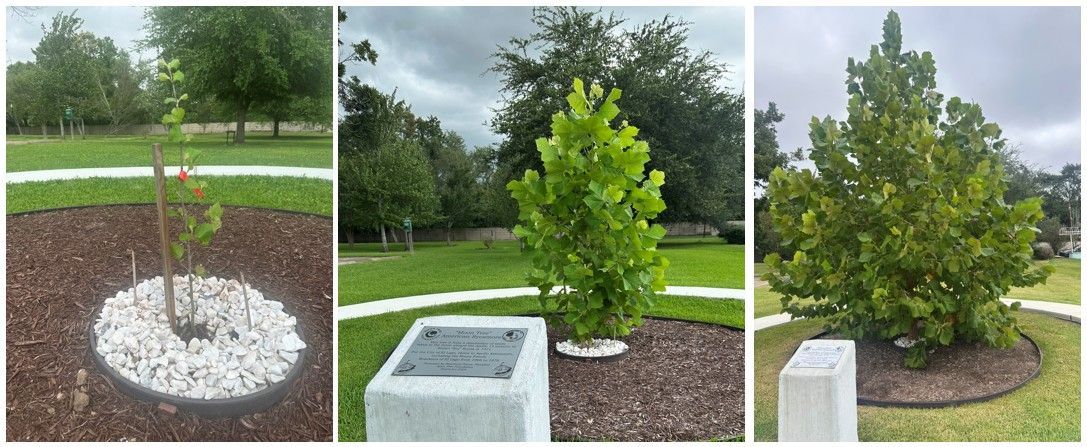
Below are 3 photos showing the trees exponential growth since its planting!
from left to right: the day of planting 11/12/2024, a year later on 08/05/2026, and the tree now 10/28/2026
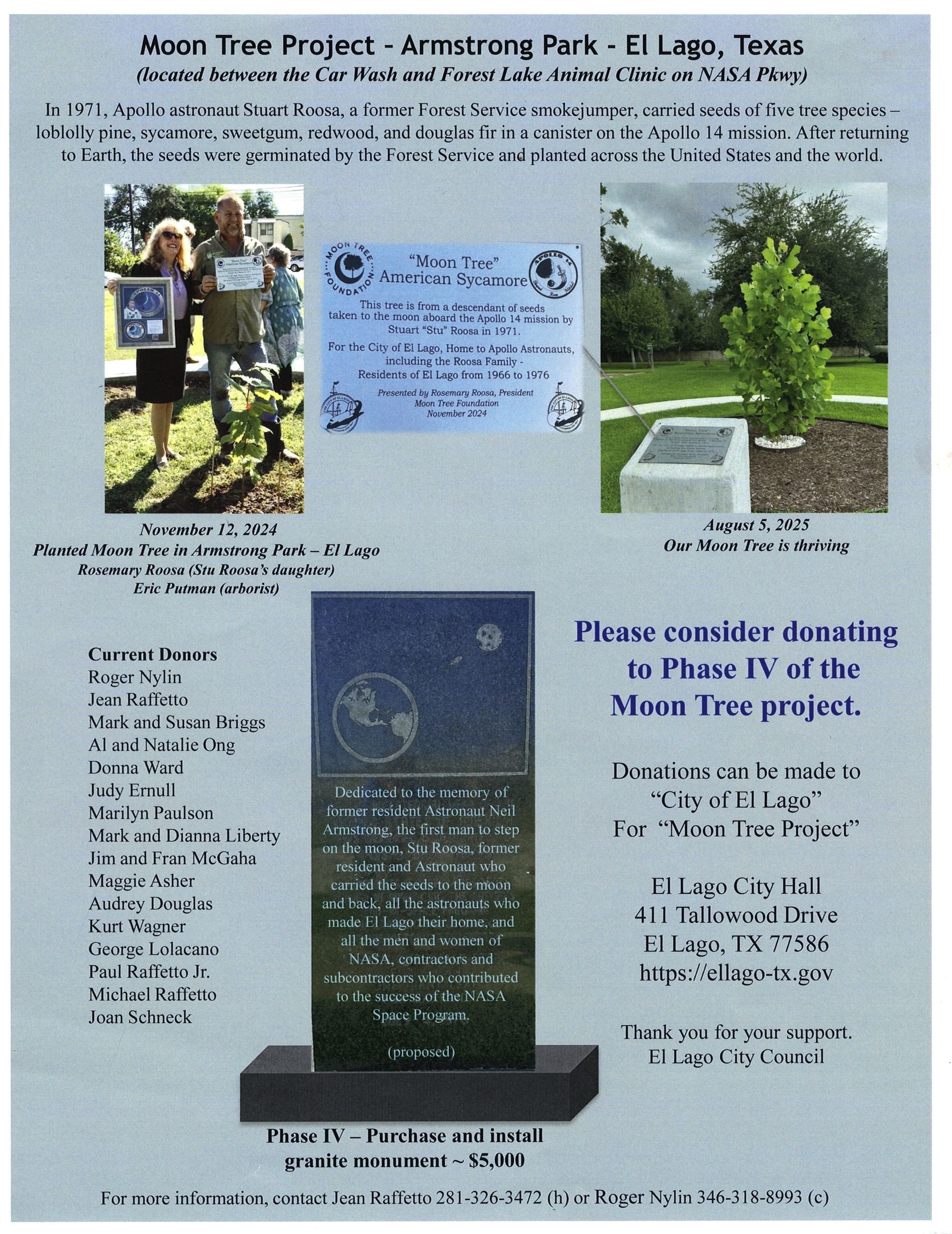
The resource I used during my research: https://www.nasa.gov/history/moon-trees/
Liriope’s Muse - Expert Tree Care Tips