

Liriope’s Muse: Tree Care Tips from a Master Arborist
TRUSTED TREE CARE SERVICES SINCE 1970
Liriope's Muse - Palm trees: Immortal tree imposters?
There’s a lot to unpack in this week’s blog title. Palm trees? Immortal? Tree imposters? Put bluntly palm trees are not trees – they are grass, and as far as we can comprehend scientifically, are immortal… So find a cozy spot and buckle up because we are about to discuss all things palm trees and you’re sure to never look at them the same again!
Before we dive into the mortality of these tropical grasses, check out this interesting blog Liriope’s Muse: Are trees immortal? Where we discuss the science behind trees, and uncover that they too are immortal beings!
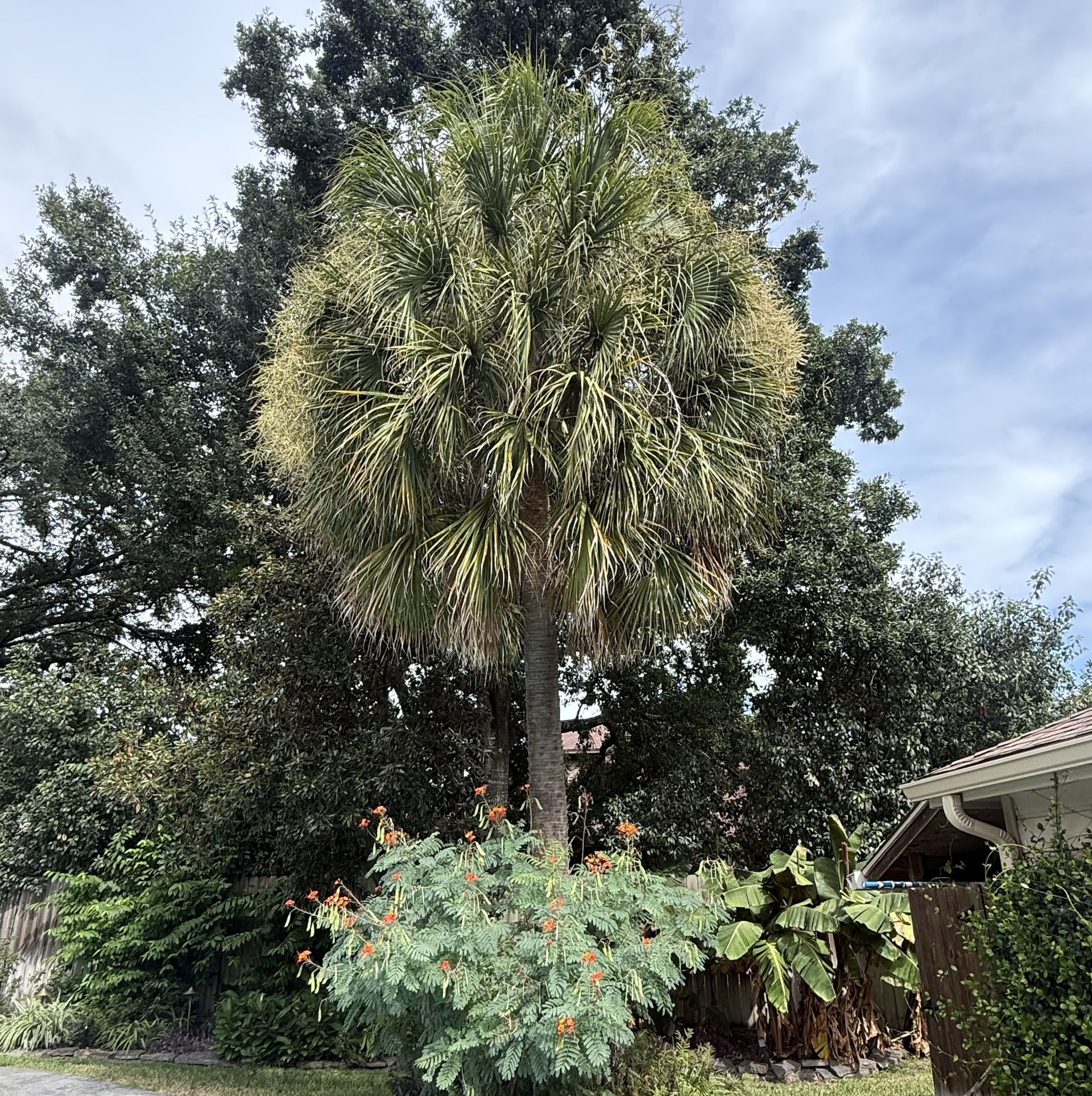
Palm trees are not trees?
Palm trees are members of the Arecaceae family, and are scientifically classified as grass. This is because, like grasses they are monocotyledons (or monocots). Meaning palm seeds contain only one embryonic leaf, called a cotyledon. Palms typically have fibrous root systems, leaves with parallel venation, and vascular tissues arranged in bundles scattered throughout the stem rather than in continuous rings. Palms also lack the vascular cambium responsible for producing annual growth rings, new wood, and most of the increase in trunk diameter seen in woody trees. They do not produce true bark or undergo conventional secondary growth like trees either.
In comparison, most broadleaf trees are eudicots(dicots) with two embryonic seed leaves, vascular tissues arranged in rings within the trunk and form a net-like pattern in the leaves, and contain a continuous vascular cambium, that produces xylem, or wood, toward the inside and secondary phloem toward the outside. This is known as secondary growth and is responsible for the outward or girth growth of the tree.
This is all very common knowledge to arborists, however what has always been rather perplexing to our arborists – and even our BCMA – is that if palms lack secondary growth, how do they still grow in girth as they grow in height?
Are palm trees really immortal?
According to the Cambridge Dictionary, Immortal is an adjective meaning “living or lasting forever” and by this definition, yes I’d say palm trees are essentially immortal. In a cellular sense – let me explain!
A living organisms’ longevity, or lifespan is determined by the duration in which its cells remain functional and metabolically active. In this regard, animals and plants differ significantly, and it has to do with how they are organized cellularly. Plants are able to continually develop tissues and organs as needed, whereas animals – and humans – have a fixed body plan and are not able to regenerate senescing organs. Further, plant cells do not show signs of aging overtime, like animal cells do. Animal cells experience physical wear and tear over time; each time that a cell divides the chromosome shortens, the mitochondria become less efficient, and cells become damaged and die. Eventually preventing the organs from being able to regenerate new tissues, this is what causes organs to lose functionality and mass. Plants do not experience this same cellular degradation. Thus, we see plants living drastically longer than animals – millennia even!
I go in depth on trees mortality in the blog linked above, but for context trees show no signs of aging on a cellular level. In fact, the only reported tree deaths that we are aware of come from some sort of human interference; whether it be unnecessary pruning, the introduction of a foreign pest/disease, or simply chopping the tree down. There has not been a single recorded case in history of a tree dying from ‘old age’ as we commonly hear occurring in animals – and the same goes for palms!
Like mentioned above, trees have secondary growth in which 2 types of cells are produced by the cambium layer, the xylem and phloem. The xylem cells are made of dead, hollow cell walls reinforced with cellulose and lignin, which together form the structural material known as wood. Unlike in an animal, these cells are meant to die once they hit maturity in order to provide the tree with strength and rigidity. The phloem cells are constantly living as they require energy and do all the active transport for the tree, however after a few centuries of production they are found to become woody and get covered by new phloem tissues. So, trees are essentially comprised of a dead supportive skeleton and a thin layer of living tissues on the outside. And while this still fits the definition of immortal, it doesn’t quite embody it as well as the palm does.
Palm ‘tree’ cells also show no signs of aging and further, THEY NEVER DIE. The cells in the trunk of the palm remain living from the day they sprout for the entire life of the tree.
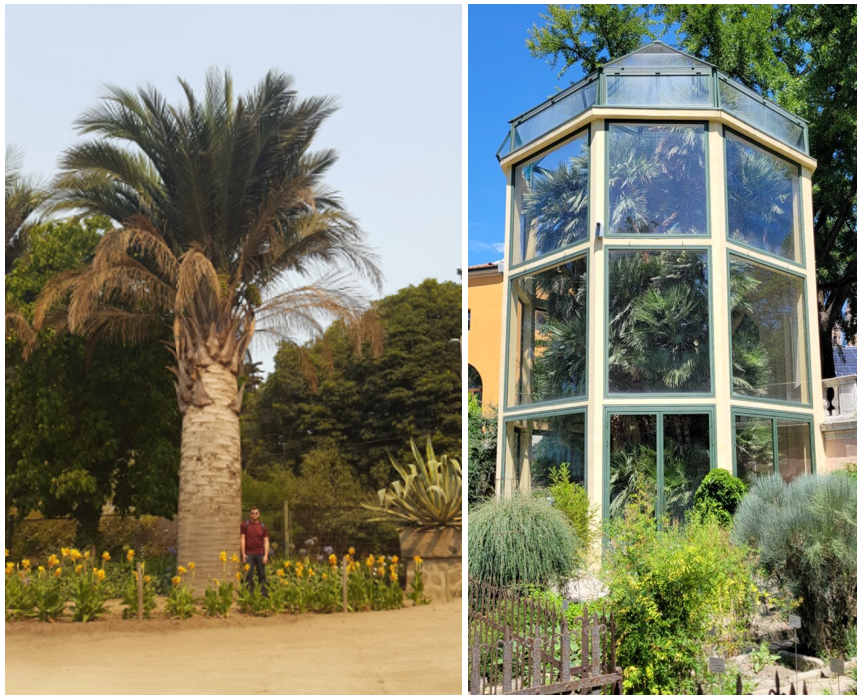
* the photo on the right is an example of the Chilean Wine Palm (Jubaea chilensis) and the photo on the left, by Goethe Haus, shows the
Goethe's Palm (Chamaerops humilis)*
How old do palms get?
Since palm trees lack secondary growth, or the woody growth that produces rings, it is essentially impossible to know how old a palm can grow to be. There are a few methods for dating palms such as measuring trunk thickness, growth rate, or number of leaf scars. However, all of these methods are unreliable measures of lifespan as they can all be altered by seasonal growing conditions and individual species growth rates/patterns.
In the wild, scientists believe the Chilean Wine Palm (Jubaea chilensis) to be the longest-living palm tree in the wild, with some specimines ‘believed’ to reach 1,000 to 1,500 years old. But there is no way to truly know how long a palm tree lives unless we were able to mark the date it naturally took root, and our human generations are able to monitor it – undisturbedly until it eventually succumbs to mother nature. Something that appears to be scientifically impossible anyway.
Currently the oldest known palm, named Goethe's Palm, is a European fan palm (Chamaerops humilis) living in Padua, Italy. It is 441 years old, and we only know this because its planting date was documented and preserved. The issue with planting a tree and monitoring it in captivity is that it will never have the potential to live as long or as well as a tree that is grown in its natural environment as it will inevitably be interfered with. Humans are imperfect and the chances that we would be able to keep up the exact growing environment that the palm would need to reach its potential over thousands of years and multiple generations of care is impossible. So for that reason alone, it is safe to say we will unfortunately never get to experience the true potential and immmortaly of a palm. At least not in this lifetime.
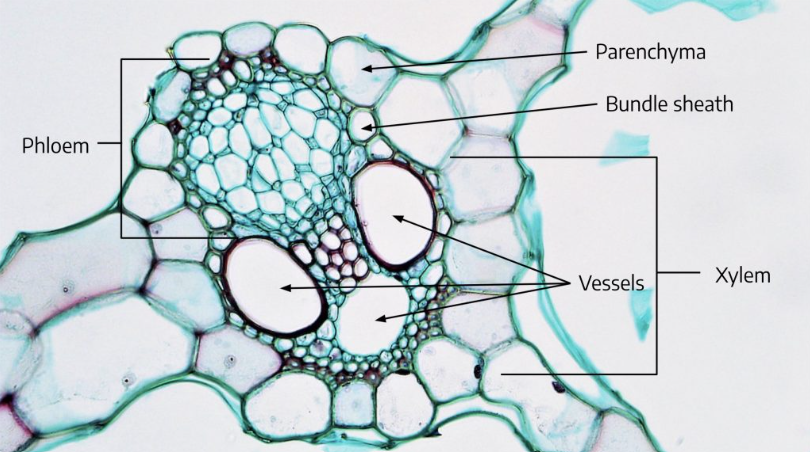
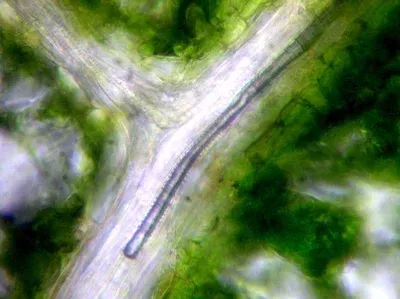
* the photo above, from Berkshire Community College Bioscience Image Library , depicts a monocot stem and its vascular bundles. *
Okay, but how do palm trees grow in girth?
This is a question that has puzzled our BCMA for decades, and is actually how we ended up stumbling on this adventure of a blog topic. As mentioned before, palms only have primary growth, so there is no addition of secondary vascular tissue. Instead, stem tissues are laid down in a series of interconnected vascular bundles – thus, the tissues at base of the palm are the oldest and the youngest at the top. (unlike in trees the oldest tissues are in the center and the newest are on the outside)
Remarkably despite the age of the palms cells, they all must remain living and metabolically active in order to provide support and transport water and nutrients throughout the tree. And rather than only being comprised of vascular tissues, palm cells are specialized into different tissues in the trunk: including vascular tissue, fibers, ground tissue, and starch storage. Within these cells are undifferentiated parenchyma cells or cells without tissue assignments, which as the tree grows can be assigned to new vascular bundles as needed by the tree, inevitably causing the tree to slowly grow in girth. Further, as the needs of the palm increases with its growth, the preestablished vascular tubes also grow in girth. But this is not all, upon extensive research and combing through many peer-reviewed papers, I found that palm stems contain an outer layer of meristematic cells known as the Primary Thickening Meristem that also contribute to the outward growth in girth. This topic is far too complex to completely cover in this blog, so stay tuned in the coming weeks for another blog solely about the widening in palm trees. A topic that has puzzled many arborists and tree care specialists for a long time.
Resources:
https://ask.ifas.ufl.edu/publication/EP473
https://bsapubs.onlinelibrary.wiley.com/doi/abs/10.1002/j.1537-2197.1983.tb06436.x
https://www.sciencedaily.com/releases/2012/12/121219092842.htm
Liriope’s Muse - Expert Tree Care Tips