

Liriope’s Muse: Tree Care Tips from a Master Arborist
TRUSTED TREE CARE SERVICES SINCE 1970
Liriope's Muse - Arborist Observation: Red Banded Thrip
This week we come to you with another addition to our arborist observation series like no other! This observation has turned into a large discovery not only for our company but for the whole state of Texas and arguably the whole Southeastern Gulf Coastal Region, too. Keep reading to hear our story of this discovery!
In the last couple of weeks our arborists, and even our BCMA, have been puzzled by a pest. We’ve observed multiple Sweetgum (Liquidambar styraciflua) trees presenting with wrasping feeding damage, tar-like spots, excessive and premature leaf drop, and other signs of life such as feces and hatched eggs, but not the pest itself. Initially, we thought it could’ve been lace bugs or chili thrips as they feed in a similar manner and leave similar damage and droppings, but our team knew that diagnosis didn’t quite fit, so we treated the trees in a way we knew would successfully target the pests and continued on.
It wasn’t too much later that our Arborist, Anderson Gonzales (TX-370011A), arrived at yet another Sweetgum tree presenting with damage consistent with what we’ve seen on other Sweetgums in the preceding weeks. Upon closer examination of many of the tree’s leaves, Anderson was able to observe and photograph* the eggs, nymphs, and fully mature insects and collaborated with another one of our experienced arborists, Shane Krajnik (TX-352315A), who helped in positively identifying the pest responsible for the damage. It was none other than the Red Banded Thrip, or Selenothrips rubrocinctus (Giard)! Initially, we did not understand the gravity of the diagnosis.
This discovery has turned out to be a tremendous discovery not only for Anderson and Eric Putnam BCMA Inc., but also for the broader arboricultural community. Until now, the Red Banded Thrip has only been documented in North America in South Florida and Mexico. Its identification in Southeast Texas represents a significant expansion of its known geographic range and may have important implications for trees throughout our region and neighboring states with similar climates. Immediately, we knew we needed to get into contact with the U.S. Department of Agriculture (USDA) and Texas A&M University Agriculture and Entomology extension and share this discovery!
At the time of writing this blog, 09/04/2026, we have had 3 confirmed cases of the red banded thrip in our service area with the furthest cases being a whooping 18.5 miles from each other!
Update #1 09/15/2026: On 09/10/2025 we contacted the TDA and spoke with Heena Mir, and she directed us to mail the samples directly to the USDA local identifier in College Station, Tx. So, on 09/14/2026 we overnighted the samples, and they arrived this morning (09/15) around 10:30 am. We received the confirmation from Xanthe Shirly at the USDA branch in College Station that same afternoon that they did in fact receive the samples at their regional location and, after performing testing of their own, sent the samples onward to the USDA National Taxonomist for final confirmation/diagnosis! We also dropped off specimen samples to our local Galveston County Texas A&M AgriLife Extension office in La Marque, Tx on 09/14/2026 with James Boone Holladay M.Ed.
At this time, we have discovered the red banded thrips dozens of more times in multiple other cities across our service area, so far the farthest two cases being 71.9 Miles apart. (The map with pinpoints of their exact locations can be found at the bottom of this blog!)
We’ve also discovered the Red Banded Thrips on the Common Persimmon, which may be a crucial discovery as red banded thrips in other documented regions have been known to target and devastate other fruit trees such as avocados, guava, and mango. So this relationship needs to be monitored closely.
Update #2 09/29/2026: We were informed by Mr. Holladay that our samples have been well-traveled, and we have received 2 formal ID’s on them. The first positive ID confirmation from Wizzie Brown, an Entomology Program Specialist with the Texas AgriLife Extension in Travis County, Texas, and a secondary confirmational ID from the Texas A&M University Department of Entomology in College Station, Tx! Moving forward, we hope to be working with Lindsey Stone, Regional Forest Health Coordinator with the Texas A&M Forest Service, to gather more information and create a fact sheet for the pest to upload onto the Texas Forestry Service (TFS) website for the public.
As of today(09/29), we have not yet received an ID confirmation back from the USDA national taxonomist or any other form of confirmation. So we will be following up and patiently awaiting their confirmation!
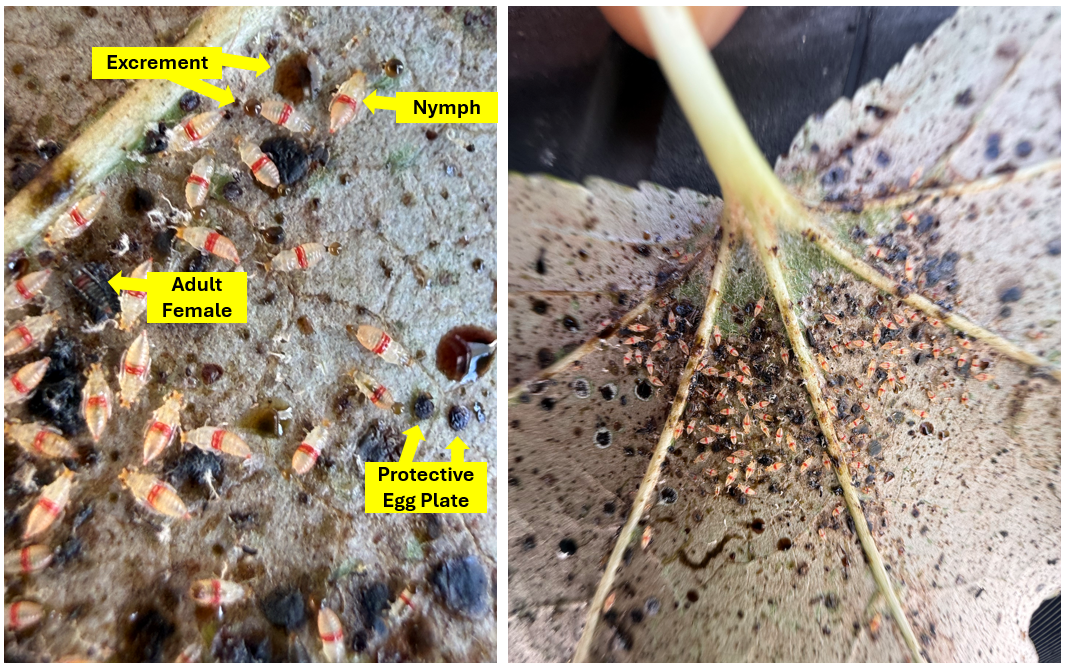
*The photos above were taken by one of our arborists, Anderson Gonzales (TX-370011A), in the field and show an active Red Banded Thrip
infestation on the underside of a Sweetgum Tree (Liquidambar styraciflua) leaf. This photo is remarkable as you can see multiple life
stages occuring at once *
Entomology
The Red Banded Thrip (Selenothrips rubrocinctus), first documented as the cacao thrip, as they were first identified in 1898 for causing a ‘blight’ to cacao populations in Guadeloupe, West Indies, are very similar to most insects in that the female thrip is larger, winged, and far more abundant than the males. The adult female Red Banded Thrip is about 1.2mm (0.05in) in length and has a dark brownish black color with the characteristic ‘red band’ underlay on its upper abdomen and dark wings. The males are seldom found and documented as they appear in far lower numbers than the females; all we know is that they are smaller than the females. (according to the University of Florida askIFAS).
The life cycle of the redbanded thrip is very short, lasting just 3-4 weeks, so there can be several different generations in just one season. ( This is similar to the lifecycle of White Flies, check them out here!)
Females can lay up to 50 eggs in their lifetimes. The eggs are inserted onto the lower side of the leaf and covered with a special protective fluid that goes on clear and as it dries, flattens out and hardens into a black disk-like cover. Which acts as the perfect camouflage and shield. The eggs hatch into nymphs in just 4 days.
The nymphs and pupa are light-yellow to orangeish in color and have a characteristic bright ‘red band’ striping their abdomens on the first three and last segments of their bodies. According to the University of Florida, after hatching, there are two nymphal stages lasting nine to ten days. Not much is documented about the first nymphal stage, but the fully grown second stage nymphs are about 1 mm (0.04 in) long. The two nymphal stages are followed by two resting stages (pre-pupal and pupal stages). The resting stages last three to five days before adults finally emerge.
Distribution
Redbanded thrips are a subtropical species believed to have originated in Northern South America. According to the University of Florida Ag Extension, Redbanded thrips have been formally documented in the following countries:
- Asia—China, Malaya, Philippine Islands, Taiwan;
- Africa—Bioko, Ghana, Ivory Coast, Nigeria, Principe Island, Sierra Leone, Tanzania, Uganda, Zaire;
- Australasia and Pacific Islands—Hawaiian Islands, Mariana Islands, New Caledonia, New Guinea, Papua, and Solomon Islands;
- North America—United States (South Florida), Mexico;
- Central America—Costa Rica, Honduras, Panama;
- West Indies;
- South America—Brazil, Ecuador, Guiana Peru, Suriname, and Venezuela.
Feeding damage
Red Banded Thrips have wrasping-sucking mouthparts, so they feed by ‘wrasping’ or puncturing the epidermis of the leaf or fruit and feed on the sap that is exuded from the wound. This type of feeding causes premature leaf drop, cupping/curling of the leaf, fruit injury, damage to the leaf cells it feeds on, and unsightly brown and black splotches of excrement on the leaf surfaces. But the most harmful of the symptoms is the excessive and premature leaf drop, which not only denudes trees but also inhibits their ability to photosynthesize.
Management
As mentioned, redbanded thrips primarily inhabit the undersides of leaves, where they feed on the sap or vascular fluids of the tree. Because their feeding location can make them difficult to reach with a single treatment method, our management approach combines contact and systemic insecticides. A contact insecticide, such as permethrin, provides immediate suppression of thrips that are present and directly exposed at the time of application. A systemic insecticide, such as imidacloprid, is absorbed by the plant and transported through its vascular system, providing longer-lasting protection against thrips that continue feeding after treatment or emerge later in the season. Using these two modes of action together helps reduce the existing population while extending protection beyond the initial application. And with all treatments, it is used in conjunction with our biostimulant treatment. It works as the carrier that aids in the treatment’s absorption and in short boosts the trees’ vitality to help it naturally ward of the pests and recover from the excessive leafdrop. (Learn more about our biostimulant benefits here)
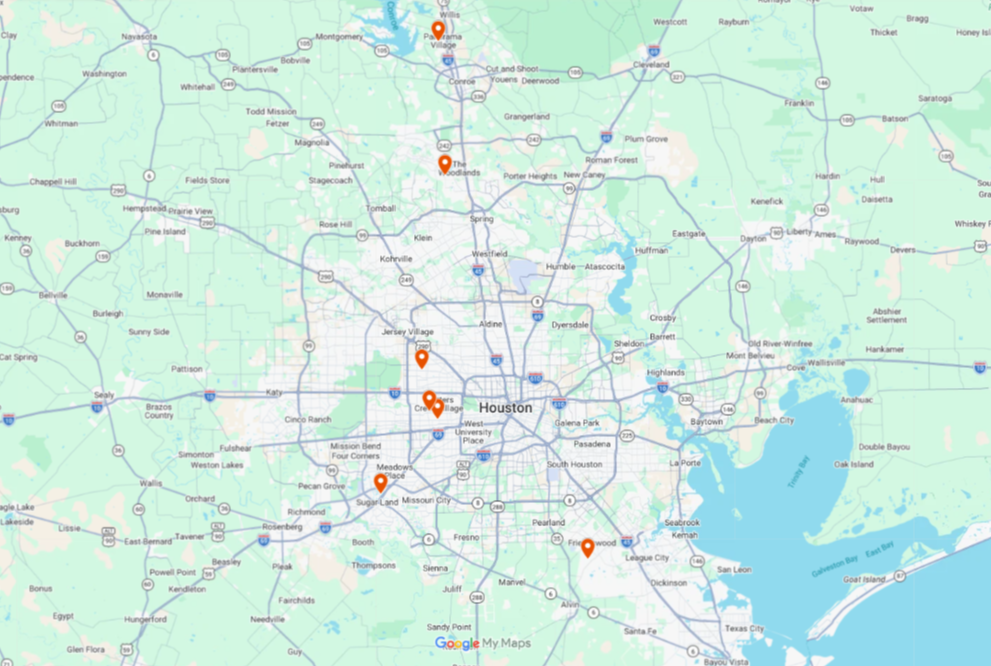
This map is up-to-date as of 10/01/2026.
It is worth noting that since starting this map, we've received dozens of other trees presenting with Red Banded Thrip infestations and have resorted to only updating points as we've found them to be in a new city or further than we've previously documented as a means to show its reach rather than numbers.
If your Sweetgum or Common Persimmon tree is looking unwell, experiencing excessive and premature leaf drop, or you notice signs of life on the undersides of its leaves, please do not hesitate to give us a call so that we can get the spread of this pest under control!
Resources:
https://ask.ifas.ufl.edu/publication/IN256
https://content.ces.ncsu.edu/redbanded-thrips-on-ornamental-plants
Liriope’s Muse - Expert Tree Care Tips