

Liriope’s Muse: Tree Care Tips from a Master Arborist
TRUSTED TREE CARE SERVICES SINCE 1970
Liriope's Muse - Bark Bandits: The Hidden Damage Caused by Squirrels
When you think of squirrels, you probably picture furry, arboreal acrobats, pesky birdseed bandits, attic invaders wreaking havoc on your wires, or, if you have ever crossed the wrong one, feral rodents with fluffy tails. Whatever your experience may be, the general consensus is that squirrels are mostly harmless creatures simply going about their business in nature. However as arborists, we see a completely different side to them.
In the field our team often comes across trees, especially pecans, with squirrel damage. Unfortunately, they are a big pests of trees in our service area. In this blog we will cover how to identify squirrel feeding damage, the dangers they pose to the health of your trees, and what you can do about them.
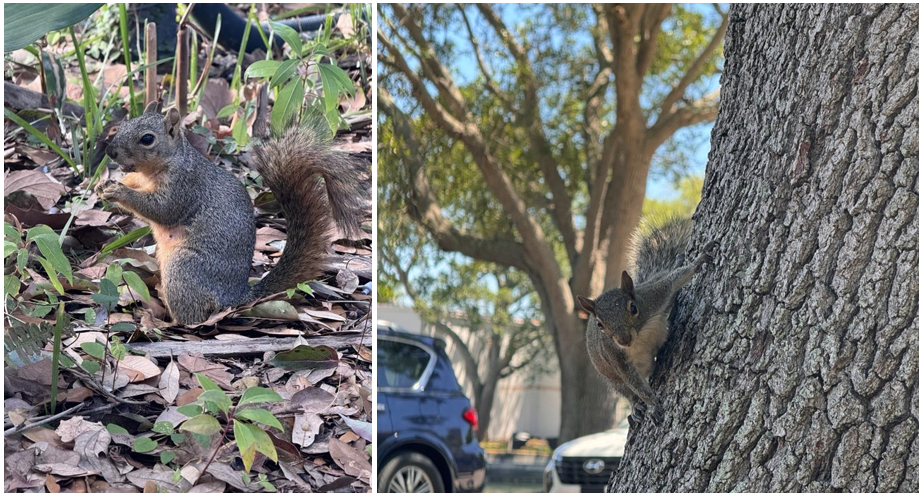
*the two photos above were captured by Shane Krajnik (TX-352315A) in the feild. The photo on the left is an Eastern Fox Squirrel (Sciurus niger) and the photo on the right is an Eastern Grey Squirrel (Sciurus carolinensis)*
The two most notorious culprits causing damage to trees are the Eastern Grey Squirrel (Sciurus carolinensis) and the Eastern Fox Squirrel (Sciurus niger), both of which are native to the greater Houston area (and most of the United States). However of the two, the Eastern Grey Squirrel wreaks the most havoc.
While native to the Eastern and Midwestern parts of the United States and lower central provinces of Canada, the Eastern Grey Squirrel can pose a serious threat to non-native areas as it is highly invasive. For example, it was introduced to the UK in late 19th century, and has since become well established. Its naturalization has had numerous negative impacts in the UK, most notably to its native biodiversity. Its introduction has caused the regional extinction of the UK’s native squirrel, the Red Squirrel (Sciurus vulgari) and other native species, via resource competition. Their local timber industries are suffering as a result of squirrel damage too. The squirrels are damaging the quality of the wood leading to a reduction in lumber production each year believed to cost the UK forest industry $13.3 million (10million Pounds) annually… you read that right. Each YEAR! And unfortunately, they are spreading across Europe and beginning to cause similar issues.
Thankfully, Eastern Grey Squirrels don’t cause the same level of distruction in our area. They don’t effect our biodiversity nor our timber industry to any noted degree.
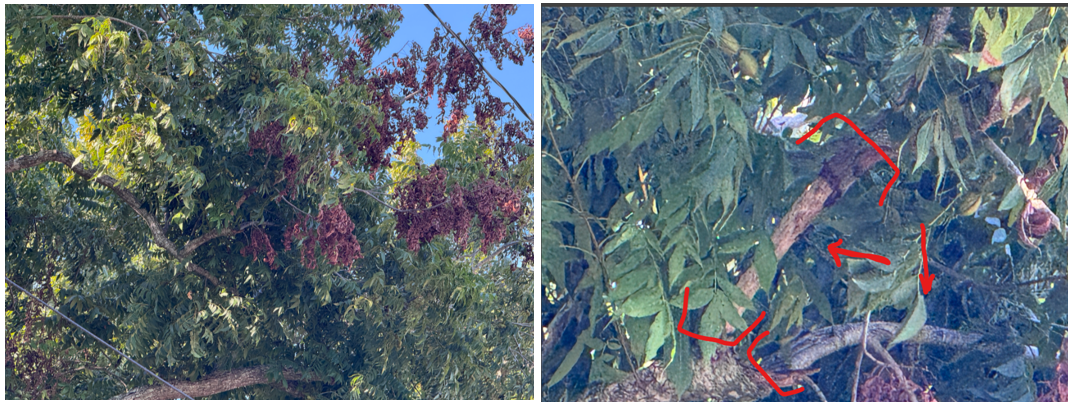
*The photos above, taken by Shane Krajnik (TX-352315A), show squirrel damage. The photo on the left shows canopy flagging and the photo on the right shows two branches who's bark have been stripped.*
Symptoms of Squirrels in your tree’s Canopy:
Common symptoms of squirrel presence in your tree’s canopy include: areas of stripped bark on your trees branches, flagged branches or branch tips scattered throughout the trees canopy, small twigs, bark, and eaten acorns/pinecones littering the ground beneath the tree, dreys (squirrel nests) in the canopy, and obvious activity such as scurrying around on branches or sharp barking and alarm calls.
Squirrel Damage:
There are two main types of Squirrel damage: branch clipping and bark peeling. Branch clipping is the least damaging of the two, it occurs when a squirrel chews of the tips of branches (typically ones no longer than 2-3 feet) leaving jagged ends behind. This not only litters your yard but stresses out your trees and opens small doors for pests to enter throughout its canopy.
Bark peeling is the most damaging of the two as it exposes the trees sensitive and essential growth and nutrient conductive tissues(Phloem and Xylem). If the tree’s conductive tissues are damaged, the tree can no longer transport nutrients and water to the connected branch, resulting in the characteristic flagging (sudden branch die off) that we observe in the canopy. The loss of branch use is harmful to the tree as it creates a reduction in its photosynthetic capacity. So, the continuous bark stripping leading to flagging throughout the trees canopy can cause the tree to become severely stressed. Additionally, it can cause trunk/branch girdling as a result of the tree attempting to heal itself. Bark stripping completely exposes the inner tissues of the tree creating a wound that is an open door for pests, diseases, and rot to enter.
Saplings and young trees are especially vulnerable to bark stripping, as severe stripping can stunt growth, cause top-dieback, or kill the tree before it ever reaches maturity.
That said, Branch clipping and bark peeling alone is not likely to kill a mature established tree, but it can severely stress it and leave large open wounds making it highly vulnerable to diseases and pests that will kill your tree.
Why do squirrels damage trees?
It is believed they snip off the branch ends to collect for drey (nest) construction, to file down their teeth, or to feed on the tree’s nutrient rich sap or buds.
It’s not clear as to why exactly squirrels strip the bark off of trees, there are many sound hypothesis out there such as they do it to file down their ever-growing front teeth, find a water source, or feed on the sweet sap of the tree. Equally there are some not so sound, such as the squirrels feeling the bark to relieve their stress/anxiety or pregnant female squirrels gnawing bark in response to their pain…
The hypothesis I found to be most believable is a newly emerging explanation known as the "Calcium Hypothesis” that began as long ago as 1943. Essentially it concludes that the squirrels strip the bark of the tree due to a trace mineral deficiency, believed to be calcium. This is because bark stripping is a behavior found in other mammals deficient in calcium including the Malabar Giant Squirrel (Ratufa indica). So, it wouldn’t be arbitrary to assume this is what is occurring in the Eastern Grey Squirrel and Eastern Fox Squirrels – there just is not solid evidence proving this idea. Further, the study notes that it is known that squirrels have a ‘natural propensity’ for calcium disorders such as Metabolic Bone Disease (MBD) which directly results in a ‘calcium-seeking’ urge that is satisfied by consuming the phloem of trees. And if that wasn’t conclusive enough, Eastern Grey Squirrels have been linked directly to ‘calcium-seeking’ behaviors as they are known to gnaw on bone, antlers, and calcium carbonate rocks… So, it wouldn’t be too far of a stretch to say they are seeking calcium in the form of a tree’s phloem, would it?
What can you do about these arborial nuisances?
There are many laws and regulations in the state of Texas protecting squirrels. The most humane option, and the one we prefer, is to relocate the squirrels. According to the Cornell Law School, “If you live-trap and relocate nuisance squirrels, Texas Parks and Wildlife Department regulations (31 TAC § 65.116) require that:
- The traps do not inflict physical injury.
- Traps are labeled with your contact/owner info.
- You have prior written permission from the owner of the property where the squirrels are being released.”
When one of our ISA Certified arborists diagnose a tree with Squirrel damage, we will first assess the health of tree and see if any intervention is necessary at the time. If there is significant damage to the tree or the tree is young, we will provide a biostimulant treatment to help give the tree a boost of vigor to close/compartmentalize its wounds. If we suspect that your tree will be extra vulnerable to a pest, whether it be due to the species or pest presence in your area, the arborist will prescribe a preventative pest treatment. Additionally, while our crew is spraying your trees, they will attempt to spray out and break up the nests to encourage the squirrels to relocate. If our tree crew is requested to come out and remove the unsightly flagging branches, we will direct them to physically remove the nest while they are up in the canopy. We prefer to remove the nests as it encourages the squirrels to move on to another tree, it’s never as certain of a removal as trapping and relocating or lethal methods, but it’s a rather passive way to encourage them out of your tree without harming them.
If you suspect squirrel activity in your tree(s) canopy give us a call or contact us to have an arborist come out for free and assess the extent of the damage and the health of your tree.
Resources:
https://www.law.cornell.edu/regulations/texas/31-Tex-Admin-Code-SS-65-116
https://www.sciencedirect.com/science/article/pii/S0378112716300421
https://extension.umd.edu/resource/squirrel-damage-trees-and-shrubs/
Blogs that relate:
Canopy Flagging Explained:
Liriope's Muse - Canopy Flagging: Your Tree Is Trying to Tell You Something
A Trees Way Of Healing:
Liriope’s Muse - Expert Tree Care Tips