

Liriope’s Muse: Tree Care Tips from a Master Arborist
TRUSTED TREE CARE SERVICES SINCE 1970
Liriope's Muse - Canopy Flagging: Your Tree Is Trying to Tell You Something
Flagging occurs when a branch or twig suddenly dies, causing the leaves to turn brown, wilt, and remain attached. The dead leaves often stand out against the rest of the healthy green canopy, almost like a “flag” warning you that something is wrong.
This typically occurs as a result of sudden branch or twig death. Common causes may include:
- A living branch breaking or becoming damaged
- Borers tunneling into the twig or branch
- Herbicide exposure or chemical damage
- Drought or extreme heat stress
- Certain fungal or bacterial diseases
- Vascular diseases that interfere with the movement of water
- Root damage or other mechanical damage
- Lightning strikes
Under normal conditions, leaves do not simply die and fall off all at once. As a tree prepares to shed a leaf, it changes the balance of hormones within the leaf and forms what is called an abscission layer at the base of the leaf stem. This layer slowly separates the leaf from the branch while sealing the wound where the leaf was attached. Once that process is complete, the leaf falls naturally.
With flagging, the branch or twig dies so suddenly that the tree does not have enough time to complete this natural process. Water can no longer reach the leaves, causing them to rapidly wilt and turn brown. Because the abscission layer was never properly formed, the dead leaves may remain firmly attached to the branch for weeks or even months.
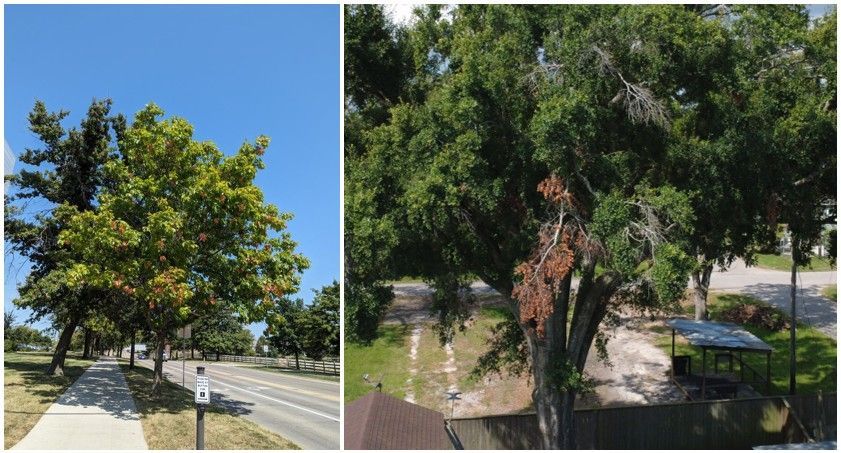
The photo above to the left is from Iowa State University and shows scattered flagging throughout the canopy as a result of drought response, the photo on the right was captured during a drone led ariel inspection by our Arborist, Shane Krajnik TX-352315A, this photo shows an example of a single flagged branch as a result of it snapping during a weather event.
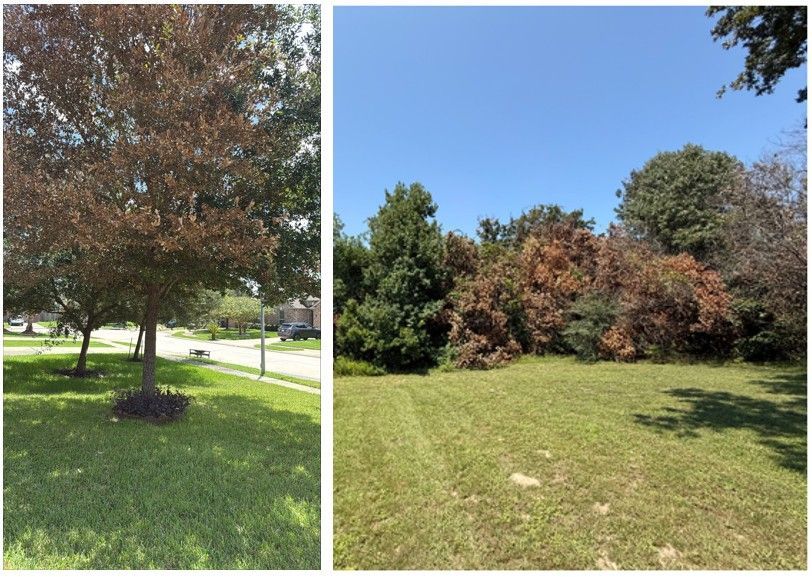
The photo above to the left was captured by our Arborist, Bill Dry TX-378274A, it is an example of a partial canopy flagging due to a lightning strike. The photo on the right was captured by our Arborist, Anderson Gonzales TX-370011A, it shows multiple Laurel trees with partial canopy flagging as a result of laurel wilt brought on by ambrosia beetles.
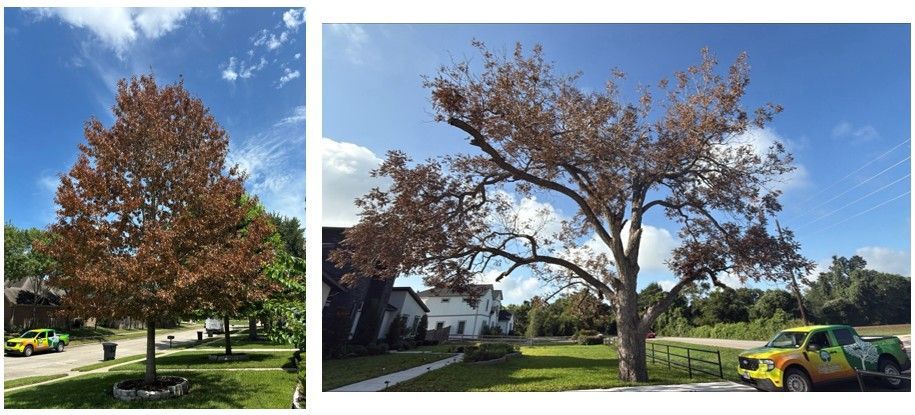
The photo above on the left was taken by our Arborist, Patrick Calleja TX-389650A, it shows a fully flagged canopy of a red oak group tree that has suddenly died due to severe acute herbicide exposure. The photo on the right captured by our arborist, Bill Dry TX-378274A, shows a fully flagged tree as a result of severe root severance and construction damage.
The location and pattern of flagging provides insight about what is happening. A single flagged twig may be related to an isolated injury or a twig-boring insect. Flagging scattered throughout the canopy may indicate a larger insect infestation, disease, root damage, drought, or a chemical-related problem. If an entire side of the tree begins flagging, the issue may involve major root damage, vascular disruption, or injury to a larger branch. And if the entire canopy is flagged that signals sudden tree death from factors such as strong herbicide exposure, lightning strike, embolism(drought), certain fungal infections, or aggressive boring insects.
Flagging does not always mean that the entire tree is dying, but it is a clear sign that something is wrong and should not be ignored. The sooner the cause is identified, the better the chance of correcting the problem or limiting additional damage.
If your tree is sending you red flags, reach out to your local ISA Certified Arborist as soon as possible. A Certified Arborist can assess the affected branches, identify the likely cause, and determine whether the tree needs treatment, corrective pruning, additional testing, or continued monitoring.
Our team of knowledgable ISA Certified Arborists are here to help! If you notice flagging in your tree's canopy, Click Here or give us a call to schedule a free estimate with one of our arborists as soon as possible, so we can assess the health of your tree!
Liriope’s Muse - Expert Tree Care Tips