


Liriope’s Muse: Tree Care Tips from a Master Arborist
TRUSTED TREE CARE SERVICES SINCE 1970
Liriope's Muse - Widow-makers: The Ticking Time Bombs Lurking In Your Trees Canopy
The famed idiom ‘widow-maker’ came from the logging industry but is widely used in all of the arboriculture industry.
Originating from the early English forestry settlers in Australia, it was used to describe eucalyptus trees specifically, as eucalyptus trees can grow to great heights and branches would often drop from their canopies… leaving behind widows of women.
However as the term grew in popularity, it was used unanimously across all tree species to describe a limb, often consisting of deadwood, that has broken off of the tree and become suspended in the canopy. Either in a branch crotch or on other limbs.
Dead wood in a tree is typically sound; however, after winds, a storm, or during disturbance such as removal, it can break off of the tree and become unstably lodged in the tree's canopy, creating a ticking time-bomb of sorts to any man(or woman) who walks beneath it.
Sudden Branch Drop(SBD) is another similar and very dangerous phenomenon we often come across. SBD is when deadwood breaks out of the canopy of a tree and falls straight to the ground on an otherwise still day or night, for no apparent reason. This too is very dangerous and can make a ‘widow’ of a woman.
This is why it is very important for any deadwood in your tree's canopy to be addressed as soon as possible, as it can pose a serious danger to you and your loved ones (not exclusive to husbands)!
To learn more about how to spot deadwood and its dangers, check out this blog: Liriope's Muse: What Is Deadwood, and What Does It Mean for Your Tree?
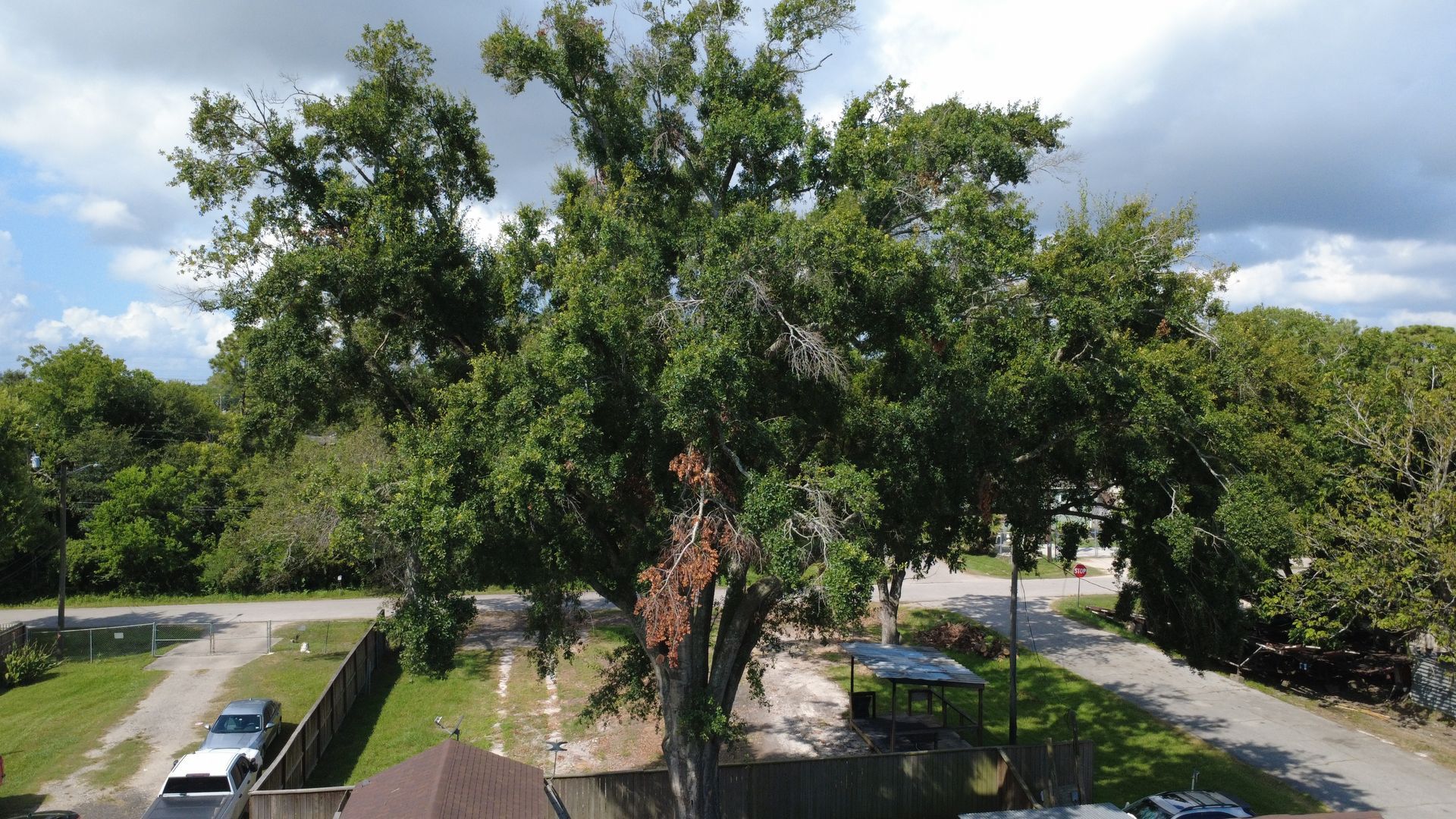
*The photo above was captured by one of our arborists, Shane Krajnik TX-352315A, during an aerial drone inspection of a tree's canopy.*
How To Spot a Widow Maker:
Widow makers are known for hiding inconspicuously in a tree's canopy; that's what makes them so notoriously dangerous. It's important to note that not all widow makers come from deadwood; many actually come from a living branch that has broken off in a storm or due to a canopy disturbance. This results in a hanging branch, with brown leaves still attached (flagged).
This type of widow maker is the most obvious, as it'll stick out like a sore thumb in your tree's canopy. The photo above is a great example, the branch is hanging in a downward direction with brown, dead leaves, which is a stark contrast to the rest of the tree's green canopy.
The other, and often harder to spot, type of widow maker is one that is made of deadwood. This is because when the tree's canopy is lush, it may appear to blend in and look like another regular branch. A great way to be able to identify a widow maker is to first understand what deadwood looks like, the other and more obvious way to spot one is to look at the direction the branch is positioned. Widow makers have fallen from the canopy, so they will always either be pointed down or in a downward-facing position, which is not the natural growth pattern of the tree.
More on deadwood in the blog above!
Liriope’s Muse - Expert Tree Care Tips