
Arborist Services in Galveston, TX
Coastal Tree Risk Assessment, Structural Evaluation, and Plant Health Care in Galveston, Texas
Galveston, TX sits on a barrier island along the Gulf Coast, where wind exposure, marine air, and coastal soil conditions influence long-term tree performance. Tree care in this environment requires structural awareness, species sensitivity, and preservation planning, not routine canopy thinning.
We provide arborist-led services in Galveston focused on documented evaluation, coastal resilience, and long-term canopy stability.
Local Tree and Property Conditions in Galveston, TX
Galveston is a barrier island community exposed to tropical systems, elevated wind events, and salt-laden air. Repeated wind loading can influence canopy architecture over time, particularly in mature trees located near homes and historic structures.
Many residential properties, especially in established areas near the Strand Historic District and surrounding neighborhoods, include mature canopy planted decades ago. These trees often grow in sandy coastal soils that drain differently than inland clay-dominant environments. Root anchorage behavior and moisture retention patterns must be evaluated within that context.
Public green spaces such as Menard Park and the Seawall corridor reflect the city's coastal exposure and open wind patterns. Trees in these areas experience environmental conditions that differ significantly from inland suburban environments.
Because Galveston combines marine exposure, wind load history, and mature residential canopy, professional evaluation must consider structural reliability and preservation planning rather than appearance alone.
Evaluation Philosophy in Coastal Environments
In Galveston, structural assessment often centers on:
• Attachment integrity
• Canopy balance under wind load
• Root anchorage in well-drained coastal soils
• Target exposure near historic or densely spaced homes
Trees may appear stable during calm weather but respond differently under sustained wind stress. Recommendations prioritize documented defect mitigation and preservation when feasible.
Broad canopy thinning is not promoted as a routine storm-prevention strategy.
Priority Services in Galveston, TX
Coastal Tree Risk Assessment:
Wind exposure and repeated storm history make structural evaluation especially important. We assess attachment points, decay indicators, canopy balance, and proximity to structures before recommending mitigation.
Preservation-Focused Structural Pruning:
Objective-based pruning may include branch tip reduction or correction of specific defects. Structural pruning is performed only when necessary to improve attachment strength or mitigate documented risk.
Plant Health Care in Coastal Conditions:
Coastal soils and marine exposure can influence long-term vitality. Plant health care plans are designed to support function and resilience rather than stimulate artificial growth. Root-zone condition and soil performance are evaluated within the context of barrier island drainage patterns.
Removal Guidance and Planning:
Removal is recommended only when structural reliability cannot be reasonably mitigated. In historic and tightly spaced neighborhoods, planning must account for access limitations, property protection, and regulatory considerations.
We assist property owners in understanding tree disposition planning when applicable.
Recent Work in Galveston, TX
Case Study #10100: Lethal Bronzing Risk Identification - Palm Beach, Galveston
Property Context:
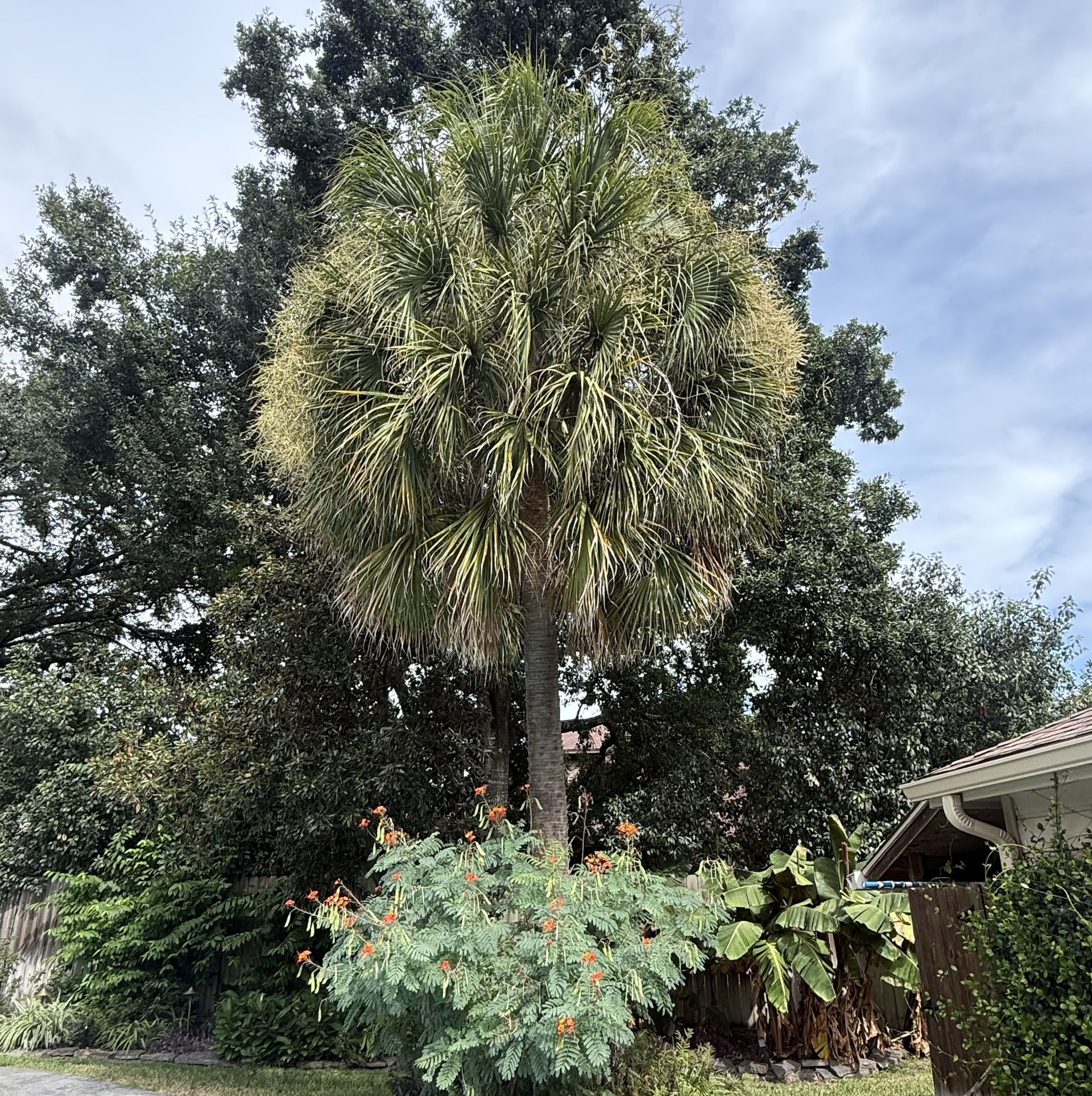
At a property in the Palm Beach area of Galveston, multiple Florida sabal palms across the site were showing decline patterns consistent with a lethal bronzing event. Due to the density of palms in the surrounding area, the situation presented neighborhood level risk rather than a single property problem.
Evaluation Findings:
Assessment documented symptoms consistent with lethal bronzing, a fatal palm disease associated with phytoplasma infection and spread by the American palm cixiid, which is commonly described as leafhopper-like in homeowner conversations. The evaluation emphasized that palms cannot recover once the spear leaf is lost, and that response timing is critical. For background on symptom progression, transmission, and management principles, reference our guidance here: https://www.ericputnambcma.com/understanding-lethal-bronzing-what-you-need-to-know-to-protect-your-palms
Recommended Resolution:
Based on the disease ecology, isolated treatment at a single site is unlikely to provide durable protection if surrounding palms remain untreated and vectors are active. The recommended resolution was a coordinated, area-wide program designed as a community effort, including:
- Community wide planning for consistent treatment timing across Palm Beach and adjacent areas
- A shared management strategy focused on reducing spread risk through coordinated vector pressure reduction and protection of at-risk palms
- Neighborhood level monitoring and rapid identification of new symptomatic palms to guide next actions
- Clear communication with property owners and stakeholders on why individual, uncoordinated action has limited value for this issue
Status:
No treatment was performed at this property. This case study documents what was observed and outlines the recommended city-wide, community coordinated response required for meaningful management of lethal bronzing in this area.
Case Study #10322: Fusarium Wilt of Palm Identification - Pirates Beach, Galveston, TX
Property Context:
At a property in the Pirates Beach area of Galveston, Florida sabal palms across the entire site presented with decline patterns consistent with Fusarium wilt. The distribution suggested a property-wide issue rather than an isolated single-palm problem.
Evaluation Findings:
Assessment findings were consistent with Fusarium wilt, a fatal fungal disease (Fusarium oxysporum) that blocks a palm’s water-conducting tissue, causing leaves to yellow, wilt, and die, typically starting with older fronds and progressing upward until the terminal bud is killed. The presentation commonly includes one-sided leaflet death on a frond and rapid loss of vigor; when examined internally after failure, stem tissue may show reddish-brown staining on cross section.
Recommended Resolution:
Because there is no cure once a palm has been inoculated, the recommended response is prevention-focused and containment-focused across the entire property:
- Avoid unnecessary pruning, and do not move from symptomatic palms to healthy palms with the same tools or crew sequence
- Sanitize pruning equipment between palms, dirty pruning equipment is a documented spread risk
- Use clean mulch practices, dirty mulch is listed as a spread risk
- Removal precautions for confirmed infected palms, use handling practices that minimize spore spread through sawdust during removal
- Replanting restrictions, do not replant a new palm within 20 feet of a previously removed infected palm because Fusarium can persist in soil for decades
- Monitoring and mapping, document symptomatic palms and monitor nearby palms for early symptom development to reduce accidental spread through maintenance activities
Status:
No treatment was performed at this property. This case study documents field indicators consistent with Fusarium wilt in Pirates Beach, Galveston, and outlines the site-wide containment and prevention approach required to reduce additional losses and limit spread risk.
Case Study #6813: Over Pruning Exposure and Salt Damage Mitigation - Midtown, Galveston
Property Context:
At a residence in the Midtown area of Galveston, live oak trees in both the front and back yard had been over-pruned. Following the pruning, the trees began showing symptoms consistent with salt exposure, which is a common stressor in coastal environments where wind-driven salt spray and salt deposition occur.
Evaluation Findings:
Assessment documented canopy reduction that had removed protective foliage mass and increased canopy and twig exposure to salt load. Observable symptoms were consistent with salt damage, including foliage stress and decline patterns aligned with coastal salt influence. The evaluation determined that the combination of over-pruning and coastal exposure increased vulnerability by reducing the canopy’s ability to buffer salt deposition and environmental stress.
Intervention:
A condition-based recovery plan was implemented to support canopy restoration and reduce ongoing exposure impacts. Management prioritized protecting remaining functional foliage, avoiding further canopy reduction, and supporting controlled regrowth. Plant health care support and monitoring were used to encourage steady new growth and help reestablish canopy density that can serve as a protective barrier against salt load.
Outcome (Observable):
The live oaks produced new growth that helped rebuild canopy density and improve protection against salt exposure. Subsequent monitoring showed improved canopy function and a more resilient crown structure, consistent with reduced salt impact as protective foliage returned.
Communities We Serve in Galveston
Eric Putnam BCMA Inc. provides arborist-led tree care, Plant Health Care, and professional tree evaluations throughout Galveston. Our Galveston service area includes properties in communities such as:
- Beachtown
- Cedar Lawn
- Denver Court
- East End Historic District
- Evia
- Fish Village
- Palm Beach
- Pirates Beach
- Sea Isle
- Silk Stocking Historic District
* If your neighborhood is not listed, contact our office to confirm service availability for your property *
Nearby Cities We Serve
Eric Putnam BCMA, Inc. also provides professional tree care and arborist services in communities near Galveston. Select a city below to learn more about our services in that area.

Request an Arborist Evaluation in Galveston, TX
If you are concerned about wind exposure, canopy balance, or long-term tree stability in Galveston, request a professional arborist evaluation. Our approach is preservation-first, documentation-driven, and aligned with coastal environmental realities.
Book an appointment below
Get a quote
Contact Us
Liriope’s Muse - Expert Tree Care Tips