
Liriope’s Muse: Tree Care Tips from a Master Arborist
TRUSTED TREE CARE SERVICES SINCE 1970
Liriope's Muse: Palms, Parrots, and Pine Trees? Florida’s Botanical Identity Crisis
Recently, I traveled to Odessa, Florida to visit some family and admire the lush tropical scenery. I’ve always had a deep appreciation for Florida’s unique and vibrant landscape, rich with biodiversity and verdant splendor. Sitting just above the equator, the state enjoys a near-tropical climate that creates ideal conditions for its lush variety of plant life and ecosystems.
(To learn more about the foreign vegetation wonders that thrive in Florida, check out this blog from my previous travels)
Now when you think of Florida vegetation, you probably immediately think of palm trees, citrus trees, and tropical flowers, while those are quite abundant throughout the Sunshine State, another tree that is rather abundant but tends to fly under the radar is the Norfolk Island Pine.
When you look at the horizon of central Florida, scattered amongst the numerous palms, tropical beauties, and mango trees are Norfolk pines. They are vastly taller than the rest of the vegetation surrounding them, and they sort of stick out like a sore thumb. And it kind of makes you wonder, how did these large, lush, Christmas-giving trees find their way into Florida’s landscape?
In this blog, we’ll explore what makes the Norfolk pine so unique, how it found its way into Florida’s landscapes, and why it continues to thrive - quietly towering above the rest - as a distinctive, often overlooked presence in a state known for palms, citrus, and tropical color.
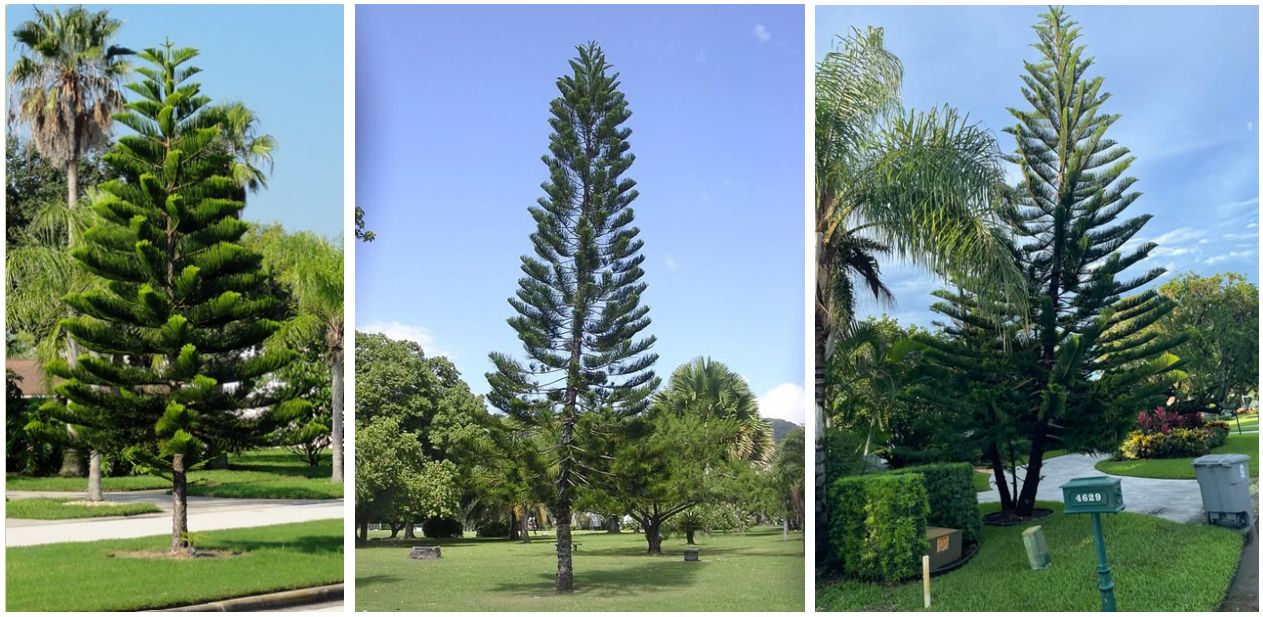
The Norfolk Pine (Araucaria heterophylla), also called the Norfolk Island Pine, is native to Norfolk Island, a remote subtropical island located just off the coast of Sydney, Australia, and nestled between New Zealand and New Caledonia. It’s not native to North America, and in fact, it can’t survive outdoors anywhere in the U.S., except in Florida, where the climate is warm and humid enough to support it year-round, closely resembling the tree’s native environment.
Despite its misleading name, the Norfolk Pine is not a true pine but a tropical conifer belonging to the Araucariaceae family, a prehistoric family of conifers incredibly varied and widespread during the Jurassic and Cretaceous time periods. However along with the extinction of the dinosaurs, the Araucariaceae family lost most of their members. Today, there are only about 41 species remaining in the family.
The Norfolk Pine features a striking pyramidal form, with evenly spaced, horizontal branches arranged in symmetrical whorls around a single, straight central trunk adorned with evergreen pine-like foliage. There are typically 5 branches in each whorl. This coniferous tree is capable of reaching heights over 200ft and trunks 10 feet in diameter if grown outdoors in a suitable environment(in Florida, they typically only reach heights of 60-80ft in height). And though it can grow very large and sturdy, this tree is very sensitive to the cold, as it can begin to sustain freeze damage at just below 40 degrees, so you don’t typically see these beauties any further north than Orlando.
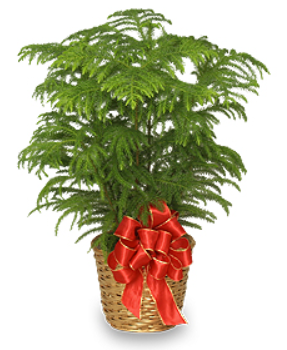
You may be quite familiar with the Norfolk pine already, as it graces nearly every hardware store’s garden section during the Christmas season across the United States. Unfortunately, though, many are bought for the season and discarded with the rest of the decorations after, or are not properly cared for and die soon after being bought.
Indoors, it makes for the perfect shelf plant year-round. Its maintenance needs are relatively low, aside from needing lots of light and a fair amount of humidity. Norfolk pines are very slow growing, typically taking about a decade to reach a height of just 6-8ft, making them the perfect addition to one’s living room or communal space! These trees also make the perfect living Christmas trees; they can grace your home in the winter months and stay on your porch in the warmer months. (to read more about living Christmas trees and the tradition they can bring to your family, check out this blog)
In conclusion, the Norfolk Island Pine is a striking and unusual addition to Florida’s landscape. Towering above the palms and nestled among tropical fruit trees, it brings a distinct vertical elegance to the region’s natural scenery. Though not a true pine, its symmetrical form and prehistoric lineage make it a fascinating part of Florida’s diverse plant palette, and certainly a tree worth noticing.
Sources:
To learn more about home care for Norfolk Pines, check out this site
To learn more about the Norfolk Pine in Florida, check out what the University of Florida has to say about them
Liriope’s Muse - Expert Tree Care Tips