
Liriope’s Muse: Tree Care Tips from a Master Arborist
TRUSTED TREE CARE SERVICES SINCE 1970
Liriope's Muse: Is Your Tree Mulched Correctly? (A 30-second check That Could Save Your Trees Life)
Proper mulching is like medication, if done correctly it can be very beneficial to the health of your tree, but if done incorrectly, it can be detrimental to the health of your tree and even lead to its demise. Just how taking medication as directed can be curative and helpful, it can also be harmful and possibly deadly if taken incorrectly.
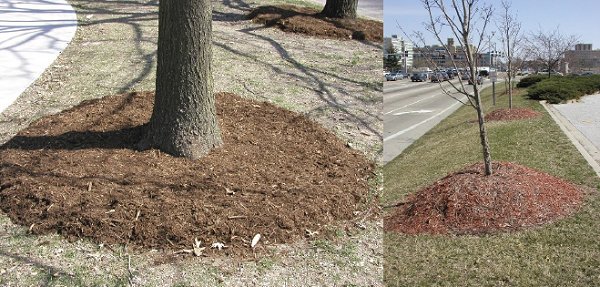
*The tree in the left of the image is mulched property, it is in a donut shape extending 4 feet from the trunk. The root flare is still exposed. The image on the right shows an improperly mulched tree. The mulch is in a Volcano-like shape stacked up against the trunk of the tree. It is also using a red-dyed mulch*
Mulching can be a valuable asset to trees, but it is only a newer thing. Depending on your age, you may remember a time in which mulch was never piled around the base of trees (in the late 70s and before). It was not even found at hardware stores or garden centers; it was simply not a “thing”.
The rise of mulching as we know it today came as a result of the Clean Air Act of 1970. Previous to this law, green industry and milling waste such as sawdust, mulch, and tree bark were burnt for disposal. However, due to the concerns of pollution and the ban on burning as a means of disposal, the wood industry had to find an alternative way to dispose of this green waste.
This is when The National Forest Service (NFS) stepped in and proposed the first idea of mulching these wood scraps, they reported that tree bark and decaying sticks were a useful source of humus in the forest. (Suggesting that adding the scraps to the base of trees and around plants wouldn’t be a bad idea, and can actually benefit them) And so began the American obsession.
Mulch started as a way to properly dispose of green industry waste and quickly became a fad. Factories began creating mulch for the sole purpose of gardening and landscaping. The demand for mulch was high and surpassed the byproducts produced by the mills, so factories started using old pallets, construction site waste, and trees (often diseased) to create their mulch. This changed the purpose of mulching from a helpful way to dispose of waste to a way of beautifying your yard at the expense of your plants. Not to mention the harsh chemicals often used to dye the mulch black or the iconic red many are fond of.
(To learn more about mulching origins and the unsanitary nature of mulch yards, check out this blog!)
How does mulching benefit trees if it was not meant for them in the first place?
Well, mulching can be a very valuable tool in your tree care. Trees for millennia have experienced a natural form of mulching via leaf litter and broken branches that accumulate around the base in wild and undisturbed environments.
When appropriately applied, mulch can help:
- Moisture Retention: Mulch acts as a protective barrier against evaporation caused by heat, wind, or low humidity conditions, which significantly reduces water loss from the soil. This ensures more consistent moisture levels for healthy root development and water conservation. Mulch also collects more water during rains for the tree.
- Weed Suppression: The mulch blocks sunlight from reaching the soil's surface, which inhibits the growth and germination of weeds. This benefits the tree because it minimizes competition for water, light, and essential nutrients for the tree, and you as the homeowner, as you won’t need to spend nearly as much time weeding!
- Soil Temperature Regulation: Mulch works as an insulator to soil, buffering it from extreme temperature fluctuations (Hot or Cold). It keeps the soil cooler in the summer and warmer in the winter, which protects the trees' delicate root system from heat stress or frost damage and provides optimal growing conditions year-round.
- Soil Health and fertility: organic CLEAN mulches, such as pine bark chips, pine needles, or pine nuggets, decompose over time and release valuable nutrients into the soil. This process enriches the soil, improves its structure, and fosters a thriving soil microbiome/ecosystem.
- Protection: Mulch can be installed as a buffer zone around the tree to help prevent mower and string-trimmer damage to the trunk and root flare.
- Compaction Control: Mulch is often used during construction or in high-foot-traffic areas to help protect a tree’s critical root zone from soil compaction. It acts as a cushion that disperses the weight of people and equipment, reducing the pressure transferred into the soil and helping preserve pore space for healthy root function.
As you can see, mulching can be a great asset to your tree if applied properly.
Now the 30-second check to make sure your tree is mulched properly:
Walk up to the tree in question and do these quick checks in order. If you only remember one rule: mulch should be a donut, not a volcano.
1) Finding the trunk & root flare
Stand close and look at the base of the trunk.
- You should be able to see the root flare, this is the point where the trunk widens and transitions into major roots.
- If the trunk goes straight into mulch like a fence post (or the base looks “buried”), the tree is mulch-volcanoed and the trunk is at serious risk of rot and girdling roots.
Why it matters: This dense, over-applied mulch, exposes your tree to constant moisture that can cause the bark to rot and separate from the rest of the tree disrupting the tree’s translocation, or movement of nutrients and water through the tree. The high mulch level can also confuse the tree into thinking it is the soil level making them produce more roots, except these roots grow directly from the bark instead of the root base. These are called adventitious roots. These roots can eventually grow into thick roots that will choke or strangle the base of the tree, ultimately killing it.
2) Looking for a “Donut gap”
Look for a clear space around the trunk.
- The mulch should be pulled back at least 3 inches from the trunk on all sides, and the mulch ring should start outside that gap and spread outward.
- If mulch is touching the trunk (even “just a little”), it’s too close.
Goal look: bare soil (or visible root flare) right at the trunk, then mulch begins like a donut.
3) The depth check
For this check, you’ll need to get your hands a little dirty, as you’ll be using your fingers like a measuring tool.
- Ideal depth: 2–4 inches of mulch.
- If you have 1 inch or less, you’re not getting the full benefits.
- If it’s over 6 inches, it can reduce oxygen to roots, trap moisture, and encourage adventitious rooting.
Quick hand trick:
- The distance between each knuckle on your fingers is about 1 inch, so don’t be shy, stick your hand in there! Your tree’s life could be at stake!
4) Mound width check
Look at how far the mulch extends outward; you don’t need a measuring tape for this one!
Remember: the wider, the better!
- Aim for at least 3 feet in diameter for small/young trees, but for mature trees, go as wide as space allows – ideally out toward the dripline (or the outermost edge of the canopy).
- A skinny 6-inch ring around the trunk doesn’t help much and often tempts people to pile it higher.
Why it matters: Most of the tree’s absorbing roots are in the upper 6 inches of the soil and spread far beyond the trunk. In fact, some trees' root systems can spread out more than 3 times the length of the canopy! So the wider the better.
5) What’s underneath?
For this check, if you cannot remember, you’ll need to excavate into the mulch in a small area to find what’s underneath.
- Under mulch should be soil, maybe natural leaf litter, and some grass.
- If you see landscape fabric or plastic, it should be removed immediately! That’s a common culprit for poor water/air movement and funky moisture patterns that can lead to anaerobic soil conditions and root rot.
Rule of thumb: mulch works best when it can “breathe” and slowly break down into the soil.
6) Material & smell check..
Take a quick look, scrape away the top few inches, and sniff (seriously). As arborists, our sense of smell is a very important tool in diagnosing plant disorders and diseases.
- What we are looking for: clean wood chips, bark, or pine needles that are: natural brown, varied chip sizes, and smell like fresh wood/earth.
- What we don’t like to see: Unnatural uniform chips and dyed mulches contaminated with trash (plastic, rusty nails)
- If it smells sour, like chemicals, or like vinegar/fermentation, it MUST be removed immediately as it is posing a serious and possibly fatal risk to your tree!
Why it matters: The sour and fermented smell is a telltale sign of anaerobic conditions in the mulch and soil. These conditions can cause toxic compounds to build, provide the perfect breeding ground for pathogens and harmful fungi, and starve the tree’s roots of oxygen, which is fatal. The smell of chemicals is another smell that should not be emanating from your mulch, it should be replaced and discarded immediately as it could be leaching toxic chemicals into the root zone.
How to correct improper mulching:
First and foremost, there should be no weed cloth or plastic beneath the mulch. If there is, remove it immediately. Next, if there is a noxious odor emanating from the mulch pile, or if it is visibly dyed and unnatural looking, dispose of it immediately.
Once you’ve established that the mulch is rather healthy, the next step would be to excavate the mulch from around the trunk. The mulch should be a minimum of 3 inches from the trunk in all directions. Next you should spread the piled mulch out as far as possible, remember: the further the better for the tree! Lastly, form it into a donut/berm shape (making it highest in the middle and tapering inward and outward). Again, not to exceed 3-6 inches in depth! And that’s it!
I hope you were able to learn something new about mulching with this blog, and I hope you’ll share it with your neighbors, friends, or family who may unknowingly have mulch volcanoes around their trees! And remember: mulching is an essential part of tree care and can be greatly beneficial to your tree if done accurately!
Happy New Year and happy mulching, I wish all your trees the best of health in this new year!
Liriope’s Muse - Expert Tree Care Tips