
Liriope’s Muse: Tree Care Tips from a Master Arborist
TRUSTED TREE CARE SERVICES SINCE 1970
Liriope's Muse - Rose Rosette Virus (RRV): A Preliminary Case Study in Symptom Reversal and Recovery Response
Hello all, thank you for taking the time to read this blog! I want to preface, this will be sort of a long read as it is going to detail our journey to having possibly found a working treatment to the devastating Rose Rosette Virus(RRV) and if you aren’t familiar with the virus, ill link some great resources so that you can learn more about it devastating effects on roses around the world.
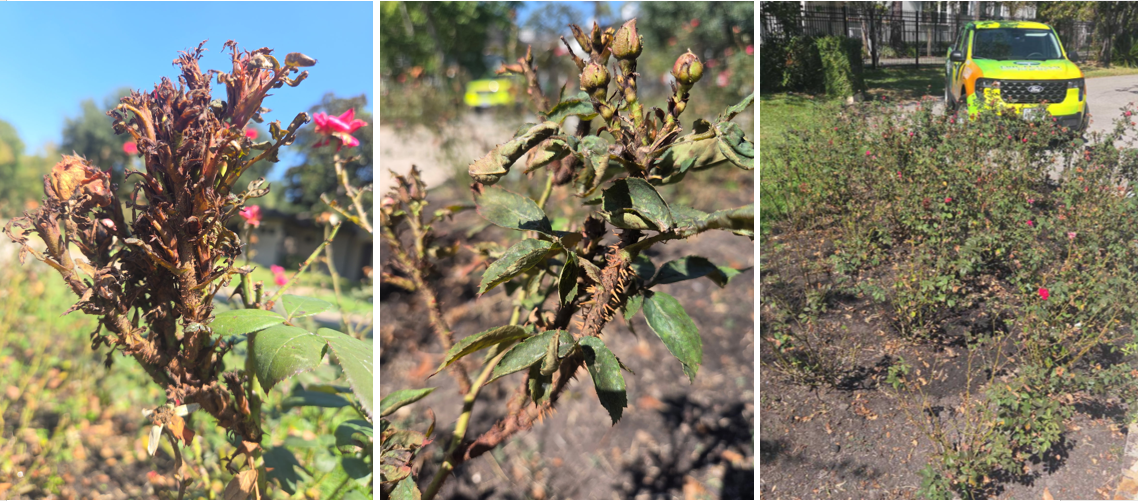
*The photos above were taken on site by our arborist prior to treatment. The bushes are clearly sick and presenting with the RRV*
We were called out November 17th to assess a regular customer of ours rosebushes, upon inspection it was clear they were suffering from some sort of epinastic growth. Initially, the arborist identified it as herbicide damage (Rose Rosette Virus is often very commonly mistaken for herbicide damage) and a mite or aphid infestation as these bugs are microscopic and cannot be seen with the naked eye but do the same type of damage.
At the time of this inspection, we did not typically work on ornamental bushes, especially roses and weren’t familiar with all of the diseases that may plague them but were willing to try our best and treat this customer’s bushes because they were a loyal customer of ours and they cherished their rose bushes.
So we formulated a treatment plan to treat the rosebushes for the herbicide and mite/aphid damage and it went as follows:
Tank 1 (25 Gal): Pesticide/Miticide and Biostimulant treatment was applied via broadcast spray.
· 25 Gal of water
· 0.5 lb of Humic Acid
· 0.5 Qt of molasses
· 1 packet of Merit 75 WSP
· 0.5 lb of Orthene 97
· 0.25 Qt of Tengard SFR (acaricide)
Our Arborist prescribed Merit 75 WSP and Orthene 97 as systemic pesticides to kill any pests that may try and feed on the plant (A systemic pesticide is readily absorbed by the plant and translocated through its vascular system, making the plant’s tissues toxic to insects that feed on it while not harming the tree) and Tengard SFR as a contact pesticide to kill any present mites/aphids on the plant.(Also not harmful to the tree)
Humic Acid and Molasses make up our biostimulant treatment (Black Gold), which the pesticides were mixed into. Humic acid has an immeasurable amount of benefits, but to scratch the surface (and specifically in this case), adding humic acid to the soil grows the fungi and bacteria in the soil's microbiome exponentially. These fungi and bacteria help make nutrients in the soil available to the plant that weren’t previously. It also grows the plants mycorrhizae (or fungus roots), which encourages new root growth, improves water and nutrient uptake, defends the plants' roots from harmful pathogens/fungi, boosts the soil structure, and enhances drought stress resistance, leading to healthier, more resilient plants with lots of growth and high yields (of flowers and fruit). Humic acid reduces the saline conditions within the soils due to irrigation and excessive chemical fertilizer use. It also changes the anaerobic (lacking oxygen) soil conditions to aerobic (with oxygen), making for more favorable conditions that support healthy fungal growth, nutrient uptake, and the soil food web. Humic acid is able to achieve these seemingly impossible feats via its ability to change the soil's ionic makeup. (For an easy read about humic acid, click here; for a more scholarly paper, check out this one.)
Molasses is the yin to humic acids yang. The molasses feeds the healthy bacteria in the soil, unlike humic acid, which mainly feeds the fungi. These bacteria are the ones responsible for nitrogen cycling and oxygen production. This combination creates completer and more concentrated microbial nutrients, more powerful than mulch, leaf litter, and compost. Together they work in perfect unison feeding the soil food web and supporting the plants they surround.
Water works as the perfect carrier, activating the products and allowing for the biostimulant and pesticides to penetrate down through the soil and be absorbed by the plant.
Tank 2 (25 Gal): Fertilization treatment applied via rootzone injection
· 25 Gal water
· 3.75 lb of Dogget 32-7-7
The arborist prescribed a nitrogen-heavy fertilizer treatment to be applied at a 10% rate, not because there was a deficiency of nitrogen in the soil, but to stimulate quick new growth so that the rose could outgrow the epinastic growth. The treatment was applied via rootzone injection in a 1-foot grid, with only a few ounces being released per injection site.
(It is very few and far in between that our arborists at Eric Putnam BCMA, Inc. choose to prescribe a chemical fertilizer treatment; it has to be a special case, such as these roses.)
Prescribed Pruning:
Our arborist prescribed the customer to prune out all damaged, epinastic growth on the rosebush to conserve energy and redirect resources toward healthy new growth supported by the fertilizer and biostimulant treatments. Left in place, this tissue functions as a metabolic sink, drawing carbohydrates and nutrients away from recovery and productive growth in an already stressed plant.
**Disclaimer: This was performed before we had the knowledge that the rose bush was infected with RRV, as there is a strict no-pruning advisory in place. However, after these findings, it may be possible to change that !
After we treated the customers' shrubs, we just kind of moved on, hoping we’d resolved the issue and possible pest damages, and went on about serving other trees. About 6 weeks after the treatment, roses were again brought to our attention. This time, it was an entire neighborhood whose rose bushes were in very poor condition. A condition very similar to the customer’s roses we had recently treated. So, we began investigating various common rose diseases and came across the lethal Rose Rosette Virus. Upon research, the outlook seemed grim. Every peer-reviewed paper and research institution article that we came across told us that it is an incurable disease and that not only will the rose die from this but we should uproot it and as much of its root system as possible and dispose of it in the trash or via burning immediately.
Eric, our Board Certified Master Arborist, went out to inspect the roses in the neighborhood after getting a rather deep understanding of the virus and after speaking in depth with the landscaper in charge of all of the roses, he concluded that this case was ironically a case of herbicide misuse but this experience called into question the initial customer's rose bushes. So, Eric reviewed the site images and went back to the customer's house and confirmed that the roses did, in fact, have the Rose Rosette Virus. At the time of his revisit, it had been about two months and on his arrival, the rose bushes were THRIVING! Upon close inspection of the new growth, there were no physical symptoms present, and the rose bush had completely flowered out for the first time in months, and had not flowered out healthily and to the customer's satisfaction in years!
Our theory is if the roses still had the virus then the new growth would present with symptoms, but the brand new growth was healthy and exhibited no signs of epinastic growth whatsoever!
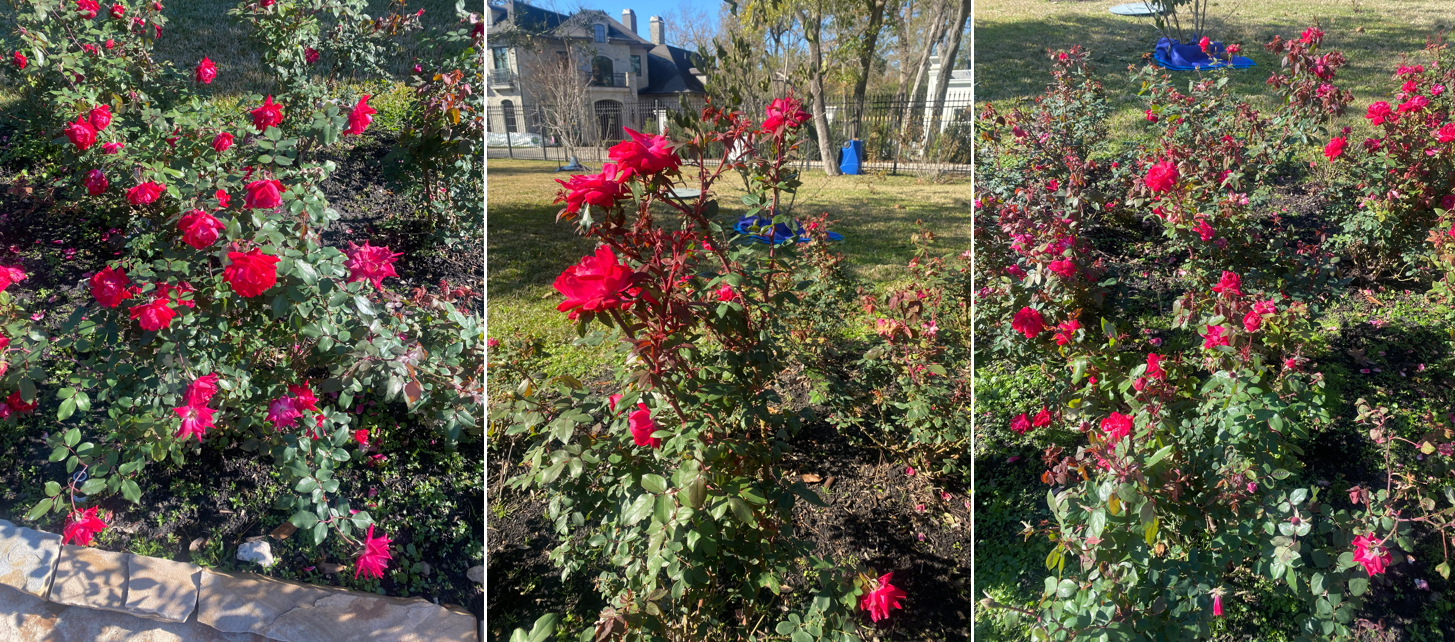
*The photos above were taken 2 months after we completed the treatment, the new growth is healthy and not showing any signs of the RRV and the bush is blooming bountifully!*
Here are some articles we found to be very informative and helpful in our research on RRV, we hope they can teach you something too:
South Carolina Clemson University HGIC: https://hgic.clemson.edu/factsheet/rose-rosette-disease-frequently-asked-questions-how-to-identify-it/
DEFRA of the UK: https://planthealthportal.defra.gov.uk/assets/factsheets/Pest-Factsheet-Rose-Rosette-Virus.pdf
Oklahoma State: https://extension.okstate.edu/fact-sheets/rose-rosette-disease.html
To companies and other agriculture organizations:
We’d be glad to partner with you, wherever you are located to test this promising treatment on roses suffering from this virus worldwide to save as many rose bushes as possible! Call our office and ask for Gabi Krajnik (ISA Certified Arborist TX-378271A and author of this blog!) at (832) 385-1836 and I’d be happy to answer any questions you may have regarding why we did our treatment the way that we did and how you too can try it out on your local diseased bushes.
The infected roses are fated to be removed and destroyed anyway, so why not give it a chance?! You not only will be possibly saving your rose bushes but also allowing roses to remain in your landscape
Liriope’s Muse - Expert Tree Care Tips