



Liriope’s Muse: Tree Care Tips from a Master Arborist
TRUSTED TREE CARE SERVICES SINCE 1970
Liriope's Muse - Spring Tree Buying Guide: How to Choose Healthy Nursery Stock and Plant It Right
Spring is in our midst and trees are beginning to adorn the garden section of just about every big box store, choosing the right one and planting it properly can set it up to thrive for generations. In this blog, we will discuss how to select strong nursery stock and how to properly plant them to ensure their survival, production, and longevity in your landscape.
#1 Don’t buy from a big box store!
Try to find a local nursery with a good reputation; their only job is to tend and care for their nursery stock. They’ll weed out any failing plants, monitor and prevent pests, regularly maintain and prune as needed, ensure each tree gets adequate water, re-pot the tree if it becomes too large for its pot, and, overall, will take much better care of their nursery stock.
Now, big-box stores such as HEB or Walmart have to make sure their produce is fresh, their shelves are stocked, their customers are happy, and their floors are shiny. They aren’t as concerned about their nursery stock as they should be; it is just another product to them. They sit in the garden sections, under-watered, under-cared for, and nearly ignored for months. These box stores are also likely to sell you plants that are not equipped to survive/thrive in your climate without warning, so it is important to do research on each tree before purchasing if you decide to use a big box store.
So, while an apple tree from Home Depot may be cheaper than one from a local nursery, the lower price often reflects a difference in quality and care. Trees sold through big-box stores are typically mass-distributed and may not receive the level of watering, pruning, monitoring, and overall attention needed to develop into strong, healthy specimens. By contrast, trees from reputable local nurseries are often better maintained and more carefully selected, making them a wiser long-term investment for homeowners who want lasting success.
#2 Research the tree
It is important for you to research a tree before purchasing it, both to ensure it is well-suited to your climate zone and to understand its specific care and maintenance requirements. Not every tree will thrive in every environment, and a tree that is poorly matched to the site will struggle from the very beginning.
Taking the time to learn about a tree’s mature size, sunlight needs, water requirements, soil preferences, and long-term maintenance can help you make a more informed decision and greatly improve the tree’s chances of long-term success in your landscape.
#3 Find a tree with a strong and healthy growth structure
To ensure longevity and a productive future for your tree, you must choose one with an appropriate growth structure for that species. So, familiarize yourself with the growth structure of that tree before you choose one.
For example, when selecting a pine or a cypress, you’d want to look for stock that has a strong dominant central leader. However, when looking for a tree such as a loquat or redbud, finding stock with multiple stems is not an issue.
A pine with codominant stems is a dangerous tree and will fail at some point in the future, so it's essential that one with a single strong stem is chosen. Now, a single-stemmed peach tree is not ideal to support an abundance of fruit production. In other words, the “ideal” tree structure depends heavily on the species, and what is considered a strength in one tree may be a drawback in another. So do your research, finding a tree with the proper growth structure is the first step in ensuring the longevity of the tree in your landscape.
#4 Look at the roots
The roots are the tree's lifeline; if the roots are unhealthy, the tree will be unhealthy. So it is essential that you choose stock with healthy roots to ensure their survivability and longevity. To identify healthy roots, you are going to have to get your hands dirty and look closely at the base of the tree.
Firstly, identify whether the stock is containerized or container-grown. For a healthier and stronger tree, we recommend choosing a container-grown tree. (Containerized trees are trees that have been grown in the ground and then removed and potted. When this happens, the tree usually loses about 90% of its root system.)
Second, identify the structural roots. They should not be buried under more than an inch of substrate; most ideally, they should be visible from the surface. If you have to excavate more than an inch of substrate to find the structural roots or root flare, the tree is buried far too deeply and should be avoided. Another easy way to identify if there is extra soil is to grab the trunk and gently move it in a circular motion. If a gap forms between the soil and the trunk, this is an indication that the soil level is too high.
Third, assess the root ball. Ensure that the roots are not bound too tightly, as this can cause girdling roots and long-term health issues for the tree in the future. Make sure the roots are relatively loose or can be loosened easily.
And lastly asses their health, this step is much easier for a trained eye, but the main thing you need to look for is necrosis. This presents as black roots (not blackened by the soil) with a foul odor emanating from them. So don’t be afraid to give the root ball a sniff! Our noses are a very important tool for diagnosing in the arboriculture field. It should smell earthy and ‘brown’; if it smells of alcohol or rot, then avoid that tree.
#5 Assess the overall vigor
This step requires a thorough visual assessment. Carefully inspect the tree for any signs of poor health or physical damage, such as broken branches, missing bark, flagging branches with dead leaves still attached, or leaves that appear discolored, distorted, or otherwise abnormal. These issues can all indicate that the tree is already under stress or in poor health before it is even planted.
Sourcing a strong, healthy tree from the right place and selecting one that suits your landscape is essential, but it is only half of what determines whether the tree will thrive for generations. Proper planting is just as important as choosing the right tree, as even the healthiest nursery stock can still struggle and even fail if it is not planted correctly from the start
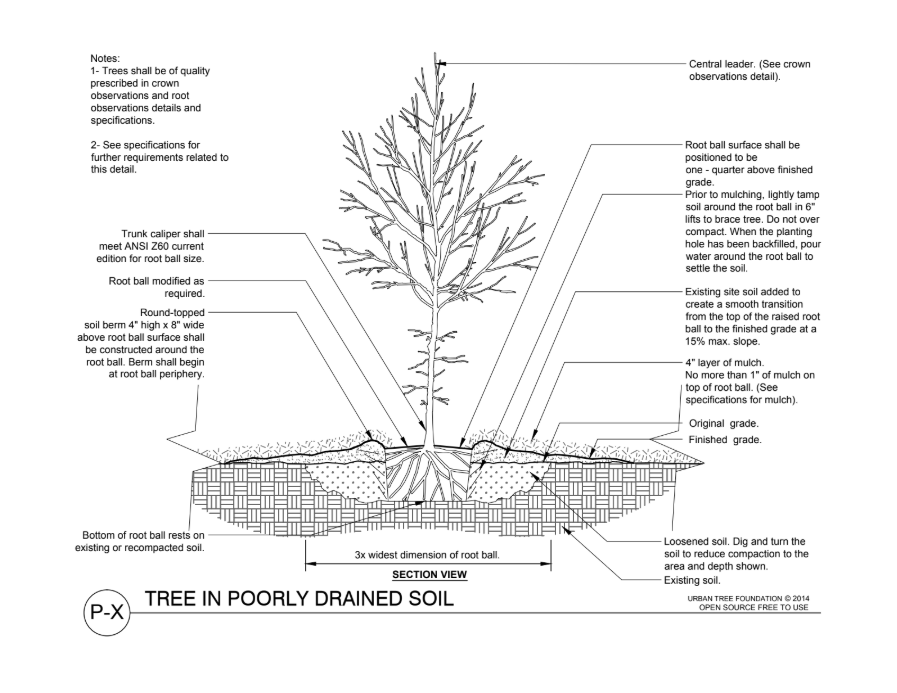
*Above is the ISA's planting guide. More specifically, poor-draining soils, which is especially relevant in the Greater Houston area
since most of the soils are clay/gumbo*
How to properly plant your new tree:
So, you’ve done your research and you’ve found a strong healthy tree (or trees!) to add to your landscape, amazing! Before any digging is done, always call 811 to make sure there are no underground hazards, such as pipes or fiber-optic cables, that you could possibly run into. (This process takes 24-48 hours to have someone come check out your planting site and is free.) After you receive the all clear, it’s time to plant!
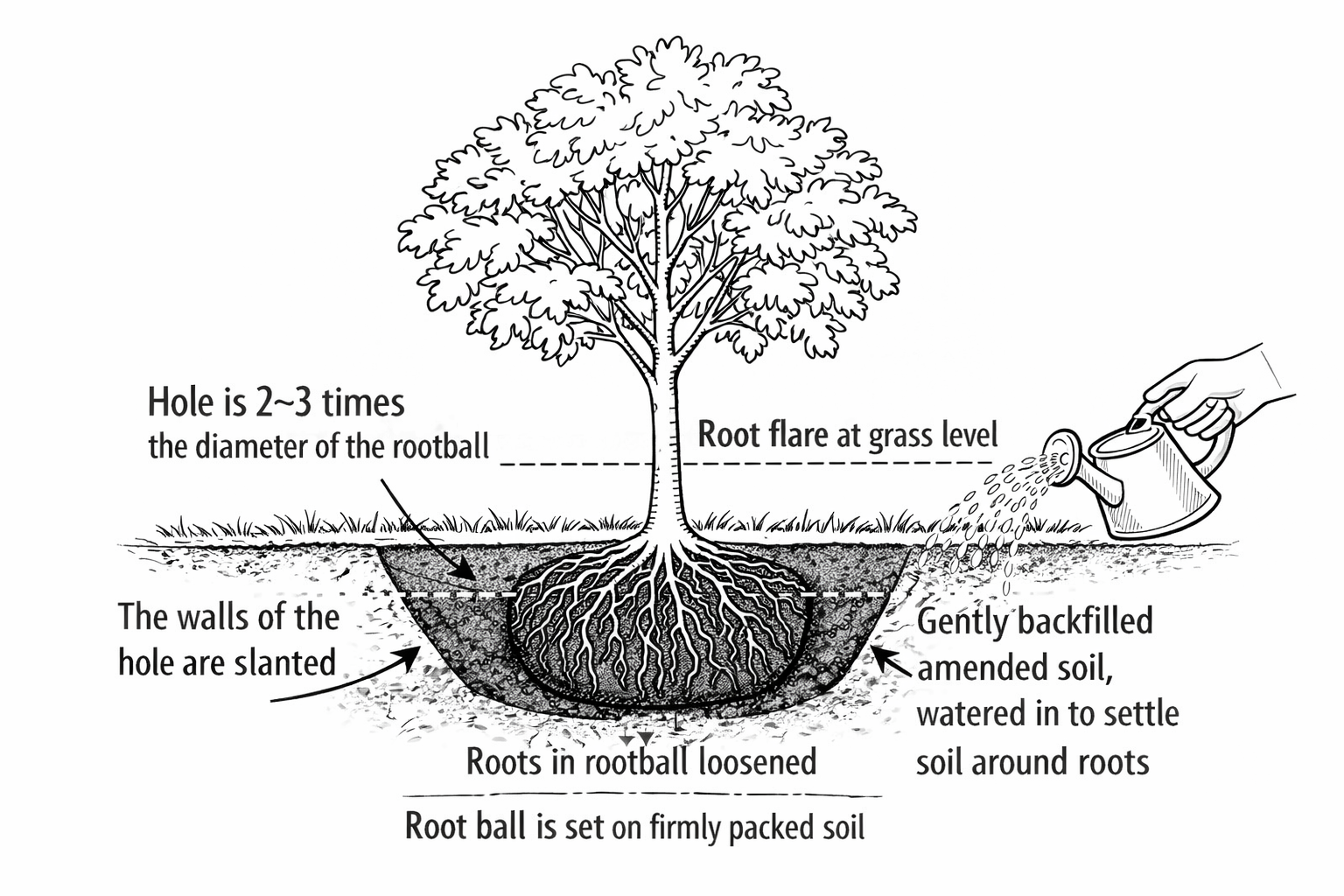
According to the International Society of Arboriculture (ISA) Best Management Practices for Tree Planting and the ANSI A300 Part 6 Tree Planting Standard, proper planting begins with identifying and exposing the tree’s root flare, which is the point where the trunk widens, and the first structural roots emerge. The planting hole should be dug two to three times wider than the root ball but no deeper than the root ball itself, ensuring the root flare sits slightly above the surrounding soil grade once planted. (You may eyeball this step, but actually measuring the root ball is helpful here, too)
The tree should then be removed from its pot, and the roots loosened before being placed in the center of the digging hole. You can loosen the roots by creating a claw-like shape with your hand and scratching around the sides and bottom of the root ball until the roots appear loose and shaggy. The excavated native soil should then be used to backfill the hole while firming it to eliminate large air pockets, but gently enough to avoid compacting it. (If your soil is clay/gumbo-like, like in most of the greater Houston areas, we recommend lightly amending it with some sand or topsoil before back-filling to enhance drainage and root growth) After planting, the tree should be watered thoroughly to settle the soil into place and hydrate the root ball, and a routine watering plan should be established. Whether via an automatic irrigation system or manually watering, proper and regular irrigation in the trees' first 2 years is another crucial step in ensuring it's survival and establishment for generations to come.
Proper planting following these standards helps establish a stable root system and greatly improves the tree’s chances of long-term health and success in the homeowner’s landscape.
If you have any questions about the tree species you’ve chosen, how to select the right one, what its maintenance/irrigation needs are, and tips on proper planting, please don’t hesitate to call our office (832) 385 – 1836 and ask to speak with and arborist, there is always one in office and they’d be more than happy to answer your questions!
Gabi Putnam
ISA Cerit. TX-378271A
*Picture below are some visual diagrams that you may find helpful on your
planting journey*


Liriope’s Muse - Expert Tree Care Tips