
Liriope’s Muse: Tree Care Tips from a Master Arborist
TRUSTED TREE CARE SERVICES SINCE 1970
Liriope's Muse - The 3 Types of Tree Rot: How to Identify Risk and Know When to Remove
There are 3 primary types of decay in trees: Brown rot, white rot, and soft rot, all of which are majorly caused by basidiomycetes and some species of ascomycetes. As wood decays, structural components (cellulose, hemicelluloses, and/or lignin) are degraded, its appearance and texture change, and strength is lost. The type of wood decay is generally determined by which components are degraded.
Before we delve into the types of wood decay and how they affect a tree, it is important to first understand the chemistry and composition of the wood. Wood is primarily comprised of three major structural compounds: cellulose, hemicelluloses, and lignin. Each of these plays a different role in the life of the tree, and the way decay fungi attack them is what determines the type of rot that develops.
Cellulose is the main structural framework of wood. It is made up of long, tightly bound chains of glucose molecules that form strong fibers within the cell walls. You can think of cellulose as the steel reinforcement of the tree’s wood. It gives wood much of its tensile strength, meaning its ability to resist pulling, stretching, and bending forces. In practical terms, cellulose helps a tree remain flexible enough to move in the wind without immediately snapping. When cellulose is broken down by decay organisms, the wood rapidly loses strength and becomes far less capable of supporting the canopy and resisting failure.
Hemicelluloses are also carbohydrates, but they are structurally different from cellulose. They are shorter, more branched, and less organized molecules that surround and bind with cellulose fibers in the cell wall. Hemicelluloses act almost like a filler or matrix that helps connect the cellulose framework together. They play a major role in the wood’s moisture balance, flexibility, and internal bonding. Because hemicelluloses are less chemically stable than cellulose, they are often among the first components to be altered during the decay process. Their breakdown weakens the internal integrity of the wood and can make it easier for fungi to continue colonizing and degrading the remaining structure.
Lignin is the third major component, and it is very different from the other two. Unlike cellulose and hemicelluloses, which are sugar-based compounds, lignin is a highly complex, dark, aromatic polymer that acts almost like a natural glue. It fills the spaces between cellulose fibers and gives wood its rigidity, compressive strength, and resistance to collapse. Lignin is what allows a tree to stand upright and support massive loads over time. It also helps make wood more resistant to water movement through the cell walls and slows down biological attack. In many ways, lignin is the compound that makes wood “woody.” When lignin is selectively destroyed, the wood can become pale, stringy, and fibrous because the cellulose framework remains behind. When cellulose is removed instead, the remaining lignin-rich wood often becomes dry, brittle, and crumbly.
Together, these three components create a material that is remarkably strong, lightweight, and biologically functional. A living tree depends on this balance for both mechanical support and vascular function. Decaying fungi do not simply “rot wood” in a general sense; they target these components in different ways. That is why understanding cellulose, hemicelluloses, and lignin is essential before discussing the major types of wood decay. The specific compound being degraded largely determines whether the wood becomes stringy, spongy, brittle, or crumbly, and ultimately how dangerous that decay may be to the tree's structural stability.
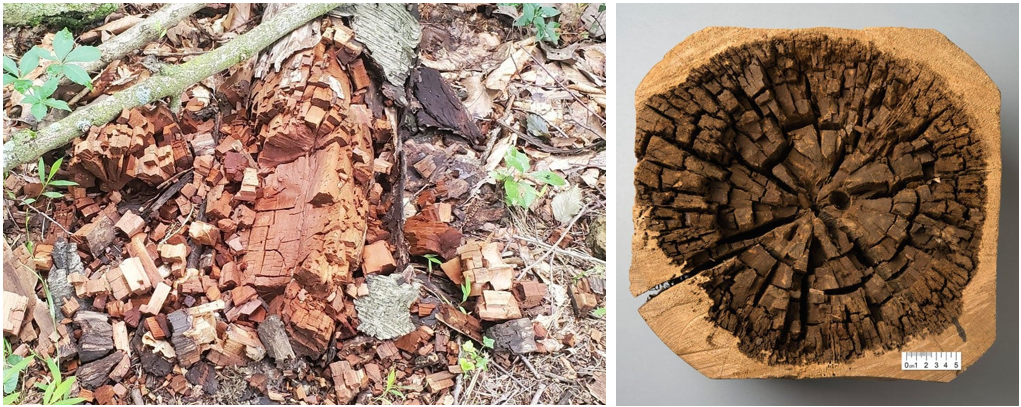
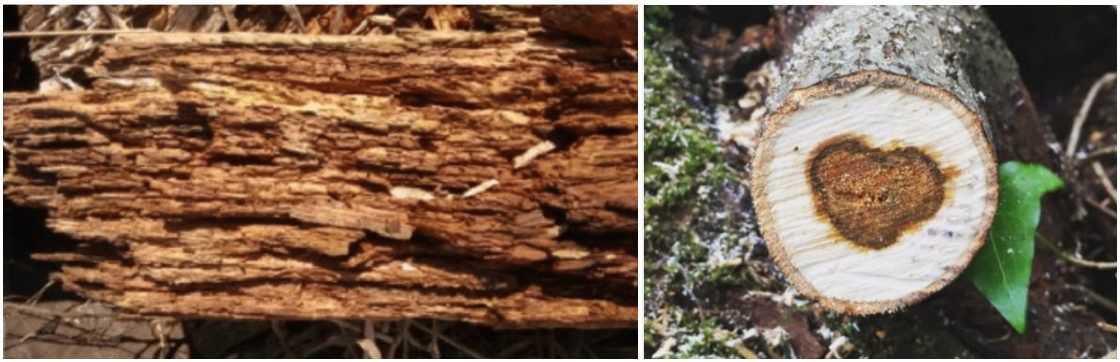
*Pictured above are two photos of brown rot, the photo on the left by Penn State Extention showns the brittle and crumbly structure
caused by the decomposition, and the photo on the right by ResearchGate shows a decayed cross-section of a trunk*
Brown Rot
Brown rot is often one of the most structurally concerning forms of decay because it primarily attacks cellulose and hemicelluloses, the components that give wood much of its tensile strength and flexibility, while leaving much of the lignin behind. Because the darker lignin remains, the wood usually turns brown, dry, brittle, and crumbly, and it commonly breaks into the classic cubical cracks associated with advanced brown rot. From a mechanical standpoint, this is a big deal: when cellulose is removed, wood can lose strength quickly even before there is dramatic visible hollowing.
Most brown rot fungi are Basidiomycetes. They attack wood using a combination of enzymatic and nonenzymatic chemistry, including oxidative reactions that rapidly depolymerize cellulose and hemicellulose in the wood matrix. In practical arboriculture, brown rot is often treated as a serious warning sign because wood affected by it can become deceptively weak while still retaining a fair amount of outward form. A tree with localized brown rot does not always need immediate removal, but brown rot in the trunk, root flare, buttress roots, or major scaffold attachments is never something to casually ignore. If the decay is associated with conks, cavities, cracking, or high-value targets, removal may become urgent.
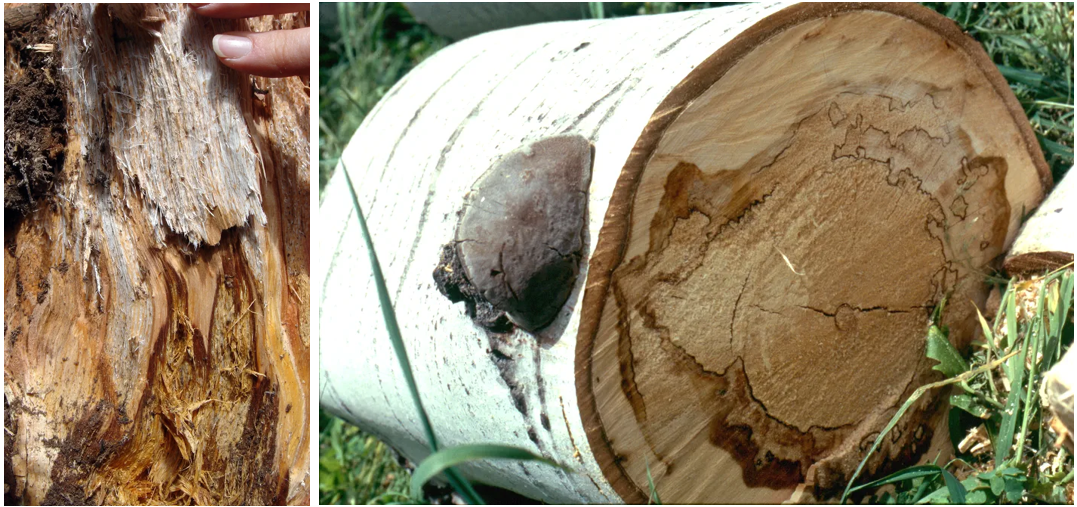
*Pictured above are two photos of white rot, the photo on the left by forest pathology shows the soft stringy, and whitened structure
caused by the decomposition, and the photo on the right by forest pathology shows a decayed cross-section of a trunk*
White Rot
White rot is different because it is the decay class best known for attacking lignin, the compound that gives wood much of its rigidity and compressive strength. Many white rot fungi also degrade cellulose and hemicellulose as the decay progresses. Depending on the fungus, the process may be selective delignification, where lignin is removed faster, or simultaneous rot, where lignin and carbohydrates are degraded together. The resulting wood often becomes pale, bleached, stringy, soft, or spongy.
Most white rot fungi are also Basidiomycetes, although some outliers occur in the Ascomycetes. Arborically, white rot is important because it can cause extensive internal decay in the trunk, roots, or major limbs. Some white rots hollow wood over time, and a tree may continue standing on a residual shell of sound wood for years. That means white rot is not automatically an immediate removal sentence. However, it can still be extremely serious, especially when associated with root decay, butt rot, trunk conks, rapid progression, or a thinning residual wall. Certain white rot fungi can also invade living sapwood, kill cambium, and in some hosts progress aggressively.
*Pictured above are two photos of white rot, the photo on the left by ResearchGate shows the soft yet crumbly decayed structure caused by the decomposition, and the photo on the right by Independent Tree shows a decayed and squishy-centered cross-section of a trunk*
Soft Rot
Soft rot is the third major decay class, and it is typically associated primarily with Ascomycetes rather than Basidiomycetes. It is different from the other two because it tends to produce more localized decay, often forming microscopic cavities within the secondary wall of wood cells. In broad terms, soft rot commonly affects cellulose and hemicelluloses first, though it can also degrade lignin in the immediate zone of fungal growth. It is often associated with very wet conditions, and it is known for thriving where conditions are too harsh or saturated for many other decay fungi.
In living trees, soft rot is generally considered slower and often less likely than brown or aggressive white rots to produce massive structural change quickly, but that does not mean it is harmless. Research shows that once soft rot becomes visually evident, substantial strength loss can still be present. So, as with the others, soft rot does not automatically mean “remove the tree now,” but it absolutely means the tree should not be dismissed without inspection, especially if the decay is in a critical area, the tree already has other defects, or it is located near a significant target.
Does Any Type of Rot Mean Immediate Removal?
No single decay type automatically means immediate removal in every case. The correct decision depends on the amount of decay, the location of the decay, the tree species, the size of the defective part, occupancy beneath the tree, and whether the tree has compensating sound wood or additional defects. That said, brown rot in major structural wood is often the most immediately concerning, because the wood can lose critical strength early. White rot can range from manageable to severe, especially when it affects roots or the lower trunk. Soft rot is often acts slower and is not an immediate concern in the beginning stages, but still significant when advanced or located in a critical zone.
Presence of fruiting bodies such as mushrooms, brackets, or conks are also important in the removal decision factor, because they often indicate that decay has been present for quite some time; in some cases, visible conks do not appear until many years after decay began, meaning the fruiting body is often a late symptom rather than an early one and points to a far more advanced case than initially thought.
Acceptable Risk
When choosing how to go about mitigating a tree with one or more of these types of rot, you must first identify what amount of risk is acceptable to you based on your property conditions. Acceptable risk is the level of risk a property owner is willing to tolerate after considering the tree’s condition, the likelihood of failure, and what could be struck if that failure occurs. No tree is completely risk-free, and not every decayed tree requires immediate removal. A tree with decay in a low-use area of a property, where there are no meaningful targets beneath it, may present a level of risk that some owners are comfortable accepting and monitoring over time. However, that same tree over a home, driveway, patio, play area, or other frequently occupied space may present a level of risk that is no longer reasonable. In other words, acceptable risk is not just about the presence of decay itself, but about whether the potential consequences of failure are something you are truly willing to live with.
Identifying Targets
When evaluating a decayed tree, one of the most important steps is identifying the targets that could be struck if the tree, or even just a large limb, were to fail. A target is anything of value within the potential fall zone of the tree.
This includes obvious things such as:
· your home
· garage
· driveway
· vehicles
· fences
· sheds
· patios
· pools
· and neighboring structures
It also includes things that aren’t occupying the space at all times such as:
· people
· pets
· play areas
· sidewalks
· walkways
· outdoor seating areas
· and any part of the property that is used regularly.
- Keep in mind that targets are not limited to what is directly under the trunk, large limbs can extend well beyond the base of the tree and may reach roofs, parked cars, or places where people frequently pass or gather. To properly identify targets, look at where the tree could reasonably fall, where major branches could land, and what is typically beneath or around it during daily use. The more valuable or frequently occupied the area is, the more serious that target becomes.
Wood decay is not something to panic about, but it is also not something to overlook. The type of rot matters, the location of the decay matters, and the targets beneath the tree matter. A decayed tree in a remote corner of a property may be an acceptable managed risk, while that same tree over a home or driveway may be an unacceptable hazard. The goal is not simply to ask whether a tree has rot, but to ask what kind of rot it has, how that decay is affecting structural integrity, and what could happen if it fails. When you understand those factors, you can make better, safer, and more defensible decisions about whether a tree should be preserved, monitored, reduced, or removed.
Preservation First, Removal Last
At Eric Putnam BCMA, Inc., removal is always considered a last resort. Our top priority is preserving trees whenever it can be done responsibly, because mature trees provide value, beauty, shade, and environmental benefits that simply cannot be replaced in any meaningful timeframe. We believe every tree deserves to be evaluated carefully and professionally before removal is recommended. In many cases, proper pruning, monitoring, support systems, soil care, or other mitigation measures may allow a tree to remain in place safely for years to come. When removal is recommended, it is not because it is the easiest option; it is because, after weighing the tree’s condition, structural integrity, targets, and overall risk, preservation is no longer the responsible path.
If you are concerned about the health of your tree or safety of your property and loved ones, give us a call and we can have a certified arborist give you a consultation on the health of your tree soon!
Resources I found helpful during my research:
https://forestpathology.org/general/wood-decay/
https://www.fpl.fs.usda.gov/documnts/pdf2018/fpl_2018_kirker002.pdf
https://extension.psu.edu/brown-rot-in-wood
https://www.researchgate.net/figure/Brown-rotted-wood-decay-from-the-collection-of-Holzforschung-Muenchen-Technical_fig3_346421380
Liriope’s Muse - Expert Tree Care Tips