
Liriope’s Muse: Tree Care Tips from a Master Arborist

TRUSTED TREE CARE SERVICES SINCE 1970

Liriope's Muse: The mystery in the BCMA’s front yard

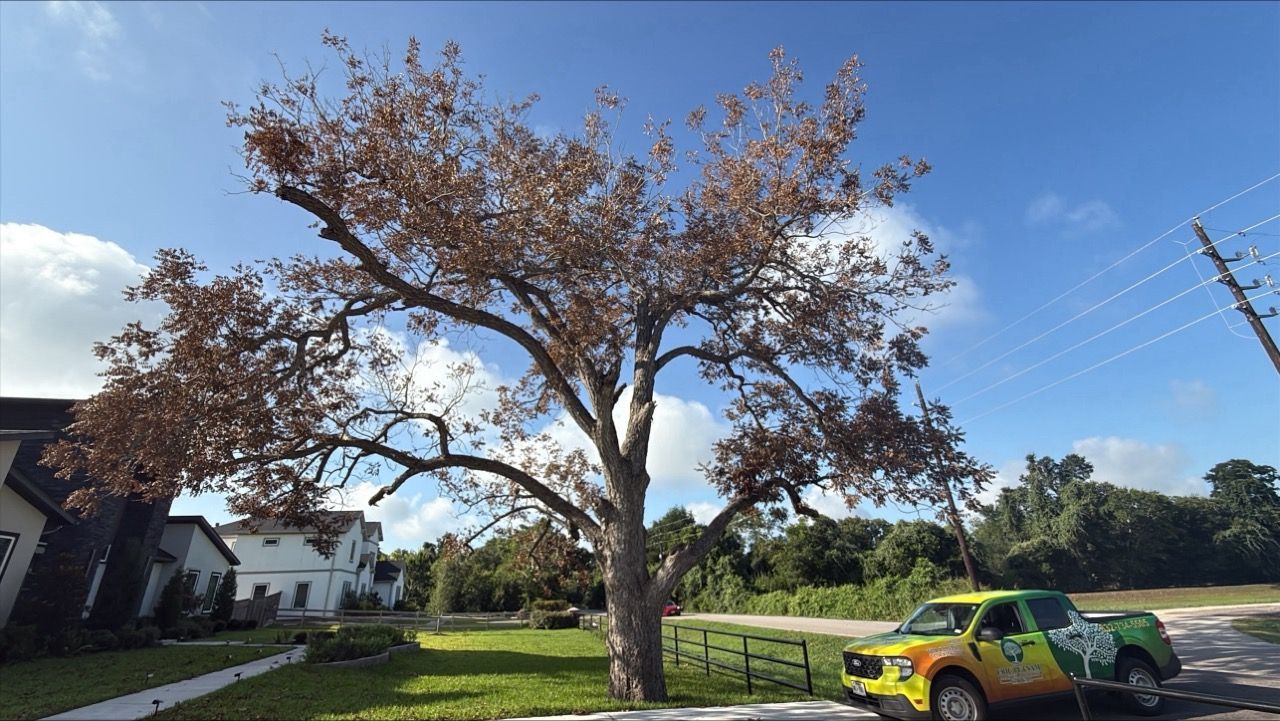
Eric, our BCMA and founder, has two red oak group  trees in the front yard of a neighborhood house he just recently moved to. When he moved there, the trees were all still in their dormant window, but as time went on, other similar red oak group trees began leafing out all around town, and even across his neighborhood, yet his had not. So immediately, he knew something was wrong with it.


The yard had shown obvious signs of previous herbicide use when Eric first moved in, but that is to be expected of any neighborhood property, so he wasn’t too alarmed. However immediately upon his moving in, he ordered a biostimulant treatment to be administered across his entire property to help give the plants a little boost into their spring growth and help break down any residual herbicides.


After the biostimulant treatment, his Azelea bushes flowered in abundance, his lawn became the greenest on his street, and the red oak group trees even began to leaf out, except it was abnormal. He noticed that about 1/3 of the trees' canopies were deadwood, the leaves were taking a while to develop, mature, and were not true to form. (Up until this point, with 50+ years of experience in the local oaks, Eric has only been able to classify the trees to be some sort of red oak group tree but hasn’t been able to identify exact species, even after leafing out due to its unusual and distorted growth. We’ve used modern identification algorithmic software that are very accurate and also haven’t been able give a straight identification either.)


When leaves first emerge during spring leaf flush, they are often smaller, thinner, softer, and lighter in color than mature foliage. As the leaves continue to expand and develop chlorophyll, they typically darken in color and become firmer in texture. For most red oak group trees, this transition generally occurs over approximately 2 to 4 weeks after leaf emergence, however the two in Eric's front yard took much longer to fully develop. And this is an ongoing issue with all of the new growth, too.


Noting this symptom, he removed all of the deadwood and hoped for the best. Initially, he had just assumed that this was a hormonal disturbance from residual herbicide remaining in the soil, as previously discovered. So, he continued to monitor them and that’s when he noticed random branches beginning to flag (leaves suddenly die and brown but still remain connected to the branch in an otherwise green canopy), perplexed by the abnormal array of symptoms, he would remove the flagged branches as they came up and continued to monitor the tree. So, he began sharing his concerns with his 3rd generation tree guy, ISA Certified Arborist and son-in-law, Shane Krajnik at their weekly family dinners who was equally as amused and curious by these trees.


These two experienced tree guys would spend about 20 minutes each evening, perplexed by these trees, trying to figure out what could possibly be plaguing these poor trees, while the 4th-generation tree gal ran circles around their feet.


Their most recent visit was something different: while the ladies were preparing dinner, all 3 generations were out at the trees, trying to get to the bottom of what was causing them to slowly die off. Shane was closely observing and tugging on one of the flagged leaves when the twig it was connected to snapped off in his hands. Upon inspection, he found a small gallery hole bored through the center of the twig and inside was a larva of some sort. When he looked at the other end of the branch (still connected to the tree) he noticed another larva and immediately a lightbulb went off for them. They began snapping off the other flagged branches, between the living and dead wood, and found more larvae, eggs, and even fully mature beetles. They then began looking closer at the afflicted branches and those that appeared healthy and were able to identify entrance wounds.


The culprit? The Black Twig Borer, in the family of ambrosia beetles, is one of the few known to attack otherwise healthy trees! More information in next week's blog:


Liriope’s Muse – Arborist Observation: The Black Twig Borer


This was the first case of the Black Twig Borer that Eric has identified in our service area, though it is a type of Ambrosia Beetle which we see very often so it didn’t come to be much of a surprise to him. The borer infestation is not what caused the hormonal issues in the tree, that came from the chronic herbicide use in the yard for most of the tree’s lives.

As noted many times on this platform, trees are not entirely defenseless; they have a natural chemical ability (allelopathic chemicals) to defend themselves against disease and ward off pests. However, when a tree is stressed these defense systems are weakened and they become more susceptible to a secondary issue… such as a fungal pathogen, or in Eric’s case a tree boring pest.
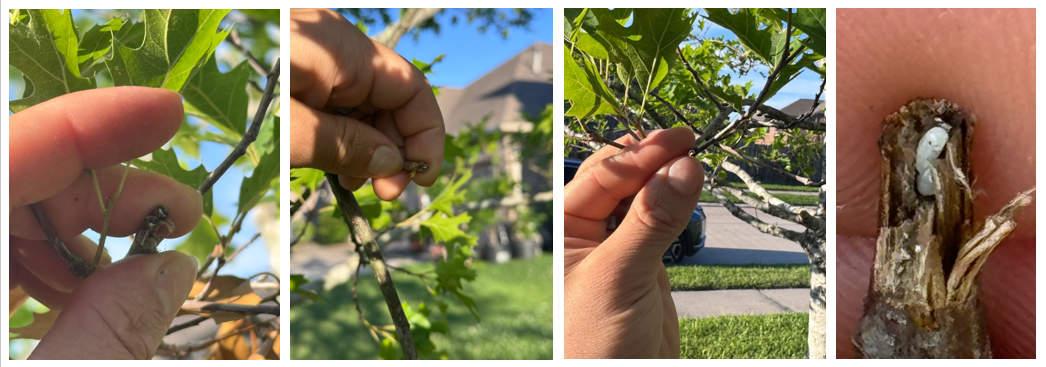
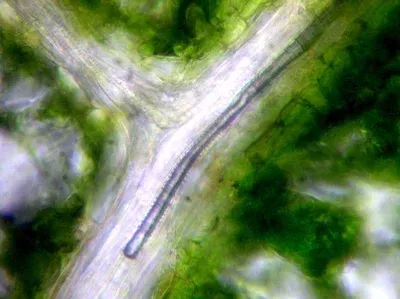
The photos above were captured to show the live and active borer larvae, that the arborists found in galleries

hidden in the twigs.
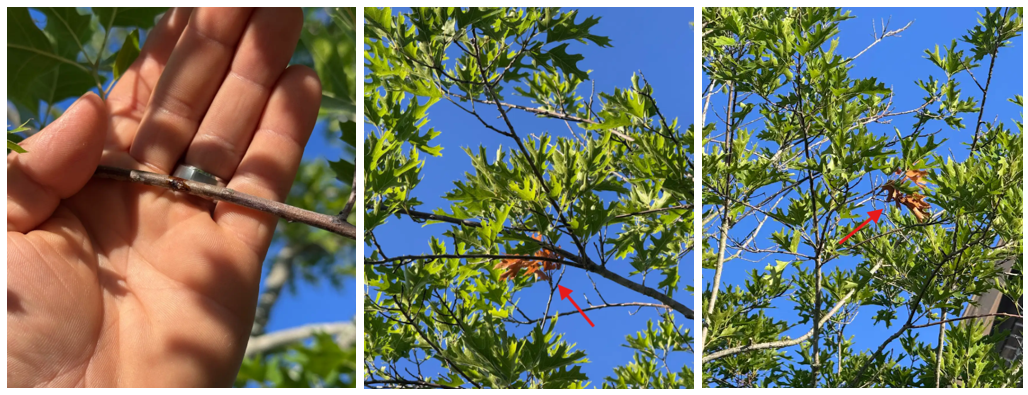
The photo above to the left shows a borer entrance hole into the twig, and the photo in the middle and to the right have

red arrows pointing to the random flagging in the canopy caused by these borers
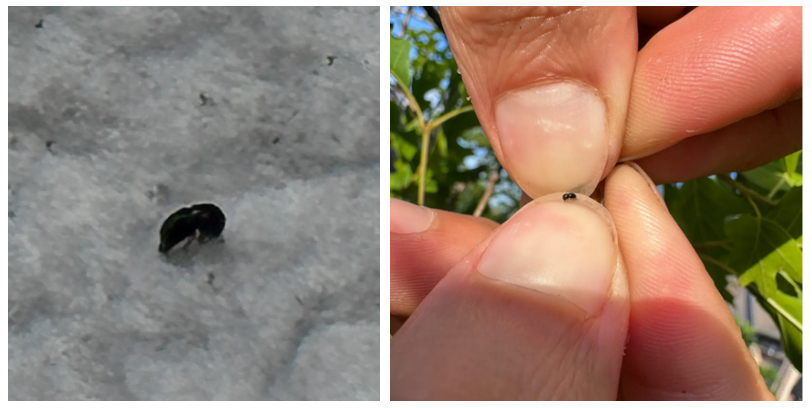
The photos above show a live Black Twig borer, Xylosandrus compactus, a type of Ambrosia Beetle.


A caution to all homeowners:

Eric is a highly educated and experienced arboricultural professional, and even he was ‘stumped’ by this case and wanted to use it as an opportunity to educate and raise awareness. If you take one thing from this blog, other than to spend more time with family, it's to keep a close eye on your tree and not ignore flagging! If you notice your tree(s) beginning to flag, take a closer look. Break the twig off (its already dead and wont hurt the tree) and look at the center. Maybe even break it into a few pieces as you may not break it in the right place the first time – a good tip here is to grab on to the twig tip, or flagged leaves, and tug on it, wherever it breaks usually is a sign of its weakest point and might be where a gallery hole can be found. Look closely at the galleries, are there any larvae, eggs, or mature bugs? Closely observe afflicted, and non-afflicted branches for entrance wounds (pictured above), this’ll solidify that your tree has an active borer infestation!


In short, flagging can be caused by a number of factors, such as drought, disease, pest infestations, and more. So, it is not something that should be taken lightly and always requires some formof arborist intervention. So, if you notice flagging or find an active borer infestation in your tree(s) contact your local ISA Certified Arborist promptly!


*this statement is not meant to fear monger but rather spread awareness of the potential severity of the situation*

Liriope’s Muse - Expert Tree Care Tips
By Eric Putnam April 24, 2026
Having 6 ISA Certified Arborists and 8 more team members on track for certification, we are actively building one of the most highly educated arborist teams in the country.
By Eric Putnam April 17, 2026
This is blog 2 covering the toxic allelopathic relationship between trees and grasses. In this blog, we focus on trees in distress and how that affects things.
By Eric Putnam April 10, 2026
This blog covers 3 real accounts given by our arborists, detailing real tree murders they’ve witnessed. Reader discretion advised.
earn the 3 types of decay, how they affect strength, and when a tre
By Eric Putnam April 3, 2026
Brown rot, white rot, and soft rot explained by a Certified Arborist. In this Blog, learn how decay affects trees, risk, targets, and when removal may be necessary.
By Eric Putnam March 27, 2026
A practical guide to choosing the right backyard tree for a swing and installing it in a way that protects long-term tree health.
By Eric Putnam March 13, 2026
What does it really take to become an expert? Explore the 10,000 hour rule and how decades of experience shape the skill and judgment of a professional arborist.
By Eric Putnam March 6, 2026
Learn how to select quality nursery trees and plant them the right way to improve survival, long-term growth, and lasting value in your landscape.
By Eric Putnam February 27, 2026
Blog 3 in our Arborist Observation series. In this first blog, we delve into our experience with Asian Cycad Scale in our Greater Houston Service area.
By Eric Putnam February 20, 2026
Ever wonder what a day for an arborist looks like at Eric Putnam BCMA, Inc.? Well wonder no further, I’ll break it down for you!
https://ask-nature.sfo3.digitaloceanspaces.com/wp-content/uploads/2020/05/31130348/european_mistleto
By Eric Putnam February 13, 2026
Recently, our arborists have noticed an uprise in mistletoe cases across the greater Houston area. Read this blog to learn more about these romanticized vampires.
By Eric Putnam January 30, 2026
In this blog I detail our journey to having possibly found a working treatment to the devastating Rose Rosette Virus(RRV) .
January 16, 2026
While visiting family in Odessa, Florida, I was captivated by the towering Norfolk Pine - an unexpected gem in the tropical landscape. Learn more!
By Eric Putnam January 9, 2026
Blog 2 in our Arborist Observation series. In this blog, we cover the deadly Laurel Wilt.
By Eric Putnam January 2, 2026
Mulching can be a valuable asset to trees if applied properly, in this blog you'll out to if your trees are properly mulched. And how to fix them if not!
By Eric Putnam December 26, 2025
In this blog, we break down the real signs your tree may need pruning, without falling into the common traps of “storm pruning” or routine canopy thinning.
By Eric Putnam December 19, 2025
Nothing beats the look of a beautifully lit tree during the holidays. But every year, we see the same issue: trees that end up with bark wounds, broken limbs, girdled branches, or stressed foliage because decorations were installed too tightly.
By Eric Putnam December 12, 2025
Winter is a critical time for root development, and the right amount of moisture can make a big difference in your trees’ health, read this blog to learn more!
By Eric Putnam December 5, 2025
In this blog we will explore 5 reasons why you should replace the traditional Christmas tree, or that dusty one made of plastic in your attic, for one that can grow with your family, build tradition, and enrich your lives!
By Eric Putnam December 1, 2025
If you’ve ever noticed a dark, powdery coating on the leaves of your trees, shrubs, or even the plants and patio furniture beneath them, you’re likely seeing black sooty mold. Check ut this blog to learn more !
By Eric Putnam November 14, 2025
This is the first blog in our newest series called Arborist Observations. In this first blog, we delve into our experience with whiteflies in our Greater Houston Service area.
By Eric Putnam November 10, 2025
Thanksgiving isn’t just about the food on our plates or the people at our table, it’s also a perfect time to appreciate the nature around us and the native wildlife it supports! In this blog I delve into a few Houston area native plants and why each deserves a place in our gratitude list!
By Eric Putnam October 31, 2025
TRICK! Read this blog to find out why!
By Eric Putnam October 21, 2025
The roots are arguably one of the most important part of the tree, read this blog to learn how you can protect them during construction!
By Eric Putnam October 3, 2025
In this blog, we delve into the silent killer that lurks at the base of your trees... Ganeoderma.
By Eric Putnam September 19, 2025
As the seasons shift and the long days of summer give way to crisp fall mornings, one of nature’s most stunning displays begins: the changing of the leaves. Read this blog to learn more!
By Eric Putnam September 12, 2025
This September 28th, communities across the country will celebrate Plant a Tree Day, check out this blog to learn more about how you can too!
By Eric Putnam September 5, 2025
Recently, in the greater-houston area, there has been a large lace bug presence draining the life from sycamores and elms. Check out this blog to learn more !
August 22, 2025
In this blog, I delve into the roots of this blog and the origin of it's name !
By Eric Putnam August 11, 2025
Our promise is simple: we only recommend what’s truly necessary and right for the long-term health and safety of your trees, nothing more.
By Eric Putnam August 1, 2025
HOA rules may be killing your trees & costing you thousands. Learn the dangers & how we can defend your trees.
By Eric Putnam July 28, 2025
Not all invasive trees are villains—some offer ecological benefits. A balanced, site-specific approach is key to responsible tree management in Texas. read this blog to learn more!
By Eric Putnam July 18, 2025
We are not only tree experts, we are passionate advocates for responsible tree care — helping you keep your trees and your coverage.
By Eric Putnam July 4, 2025
Have you ever wondered what kind of tree matches your personality? Whether you're strong and steady or free-spirited and bold, this lighthearted quiz will help you discover the tree that reflects your unique traits—with roots that run deeper than you might expect.
By Eric Putnam June 30, 2025
While often used to prevent tree roots from interfering with sidewalks and foundations, they can cause significant damage. This blog explores how root barriers disrupt natural root systems, lead to structural instability, and interfere with soil and water dynamics.
By Eric Putnam June 20, 2025
What started as an extra tree from a Sears sale turned into one of Humble’s most famous oaks. With a working faucet built right through its trunk, this live oak has become a local landmark — and its story is as wild as the tree is resilient.
By Eric Putnam May 20, 2025
Today is World Bee Day, and while most people think of flowers when they think of bees, we want to take a moment to talk about how important trees are in keeping our pollinators healthy and thriving.
By Eric Putnam May 9, 2025
We’ve seen a noticeable uptick in pine tree deaths across the Greater Houston area, and one culprit is showing up again and again: the Black Turpentine Beetle. Learn more about these pests in this weeks blog!
By Eric Putnam May 2, 2025
Lethal bronzing is a deadly palm disease spread by the American palm cixiid. This blog explains how to identify symptoms, understand the insect’s life cycle, and use insecticides, grass management, and preventive care to protect your palms.
By Eric Putnam April 25, 2025
Trees can suffer from health problems. If left unchecked, minor issues can turn into major risks. In this blog we delve into the importance of tree risk assesment.
By Eric Putnam April 18, 2025
At Eric Putnam BCMA, Inc., we’re proud to introduce our newest suite of services: Tree Cataloging, Surveying, and Inspection—designed to support residential, commercial, and municipal clients in making informed, confident decisions about their trees.
By Eric Putnam April 11, 2025
PHC isn’t just about treating pests or diseases. It’s about looking at the entire system a tree is living in—soil conditions, site history, climate compatibility, moisture levels, pruning practices, and even nearby construction activity. As a Board-Certified Master Arborist, I’ve found that educating property owners about PHC is one of the most important steps in creating healthy landscapes and resilient trees.
By Eric Putnam April 4, 2025
Borer infestations are a serious threat to trees, often going unnoticed until significant damage is done. From sawdust to sap, your tree could be sending distress signals. Read our latest blog to find out what to look for and when to call a certified arborist!
By Eric Putnam March 21, 2025
Urban trees can face harsher conditions than forest trees. This can result in shorter lifespans and greater maintenance needs for urban trees. Understanding these differences is key to keeping urban trees healthy and thriving. Learn more in this blog!
By Eric Putnam March 14, 2025
Discover the incredible survival secrets of the resurrection fern, a plant that can lose 97% of its water and spring back to life after rain. Learn how this remarkable epiphyte thrives on trees, its role in ecosystems, and what it teaches us about resilience in nature.
By Eric Putnam March 7, 2025
With its sprawling canopy, storm resistance, and unique botanical traits, the live oak stands apart—even sparking debate about its classification. Is it a white oak or a red oak? Let’s explore the fascinating history, biology, and significance of this iconic tree.
By Eric Putnam February 28, 2025
At Eric Putnam BCMA, Inc., we take a sustainable approach to tree care as eco arborists, ensuring that our work benefits both trees and the ecosystems they support. But what exactly does an eco arborist do, and how do they differ from traditional arborists? Let’s explore!
By Eric Putnam February 21, 2025
Give your trees the boost they need with our organic, all-natural biostimulant service. Contact us today to schedule your bi-annual application and watch your landscape thrive!