
Arborist Services in Rosharon, TX
Tree Risk Assessment and Structural Stability Planning in Rosharon, Texas
Rosharon, TX includes rural acreage properties, expanding master-planned communities, and agricultural landscapes across southern Brazoria County and the southern edge of the Greater Houston region. Tree management in Rosharon frequently involves evaluating structural reliability within canopy influenced by open prairie exposure, clay-based soils, and the transition from agricultural land use to residential development. Communities such as Meridiana, Sierra Vista, and residential areas located along Highway 288 contain a mix of newly planted landscape canopy and mature native trees retained during development. Nearby waterways associated with the Brazos River watershed influence environmental conditions that affect soil moisture patterns and long-term tree stability across the region.
Many properties in Rosharon include larger lots or open residential layouts where trees develop broad canopy spread as they mature. As canopy expands toward homes, driveways, fencing, and recreational spaces, periodic structural evaluation helps ensure attachment integrity and canopy balance remain appropriate. We provide arborist-led services in Rosharon focused on documented structural assessment, preservation-first planning, and long-term tree health stability.
Local Tree and Property Conditions in Rosharon, TX
Rosharon’s landscape reflects a transition between historic agricultural land and rapidly expanding residential development along the Highway 288 corridor. Many newer neighborhoods were constructed on previously open land where canopy trees were later introduced through landscape planning.
Common species planted throughout the area include live oak, cedar elm, and other shade trees selected for performance in Gulf Coast environments. Trees planted in open residential landscapes often develop wider canopy distribution than those growing in forested settings.
Soil conditions across Rosharon commonly consist of clay-rich coastal prairie soils typical of southern Brazoria County. These soils can retain moisture following heavy rainfall and may be sensitive to compaction during construction or landscaping activity.
As neighborhoods such as Meridiana and Sierra Vista continue to mature, canopy expansion toward homes, sidewalks, and street corridors may require periodic structural evaluation to maintain long-term stability and compatibility with surrounding infrastructure.
Evaluation Philosophy in Rosharon
Professional arborist evaluation in Rosharon must consider canopy structure, root anchorage performance, soil characteristics, and proximity to nearby structures or property access areas.
Assessment frequently focuses on:
• Structural stability within developing residential canopy
• Root performance in clay-influenced prairie soils
• Early identification of structural defect progression
• Canopy distribution relative to homes, driveways, and outdoor spaces
Trees that appear visually vigorous may still develop structural concerns as canopy expands over time. Recommendations are based on documented findings and site-specific environmental conditions.
Priority Services in Rosharon, TX
Tree Risk Assessment:
Risk assessment in Rosharon commonly addresses canopy extending over homes, driveways, sidewalks, and neighborhood streets typical of expanding residential communities. Structural inspection evaluates attachment strength, defect formation, and weight distribution across major limbs.
Where mitigation remains feasible, corrective pruning or structural reduction may be recommended based on documented findings.
Plant Health Care and Root-Zone Management:
Subdivision development patterns can influence long-term soil performance. Root-zone assessment may be indicated where compaction, grading, or altered drainage affects vitality. Plant Health Care in League City focuses on improving functional resilience in the root environment when conditions warrant intervention. The objective is stability and sustainable performance, not artificial canopy stimulation.
Structural Pruning:
Structural pruning is applied when documented imbalance, defect progression, or canopy interference with nearby structures is identified. Broad canopy thinning is not recommended as a routine preventive practice.
Recommendations prioritize maintaining structural stability while preserving canopy health.
Removal Planning and Tree Disposition Guidance:
Removal is recommended only when structural reliability cannot be reasonably mitigated or when defect progression creates unacceptable risk relative to nearby structures or access areas.
Planning includes evaluation of property access, surrounding infrastructure, and protection of adjacent landscape elements during removal operations.
Environmental Considerations in Rosharon
Rosharon’s position within the coastal prairie region exposes trees to open wind patterns and seasonal weather systems moving inland from the Gulf Coast. Trees growing in open landscapes often experience greater wind loading compared with trees growing within dense forest environments.
Clay-based soils common throughout the area may also experience moisture fluctuations during extended wet and dry cycles, which can influence root-zone stability and long-term tree health.
Periodic arborist evaluation helps identify developing structural concerns early while preservation-first management options remain feasible.
Recent Work in Rosharon, TX
Case Study #7186: Lightning Strike Treatment With Borer Suppression - Suncreek Estates, Rosharon
Property Context:
At a residence in the Suncreek Estates area of Rosharon, live oak trees in the back yard required post strike support following lightning damage. The treatment scope included all affected live oaks and the surrounding soils and grasses to ensure effective root-zone coverage.
Evaluation Findings:
Assessment recognized that lightning strikes can disrupt vascular function and create internal injury that increases the likelihood of secondary stress. Post strike trees are also more susceptible to follow-on pest pressure, particularly wood-boring insects that commonly arrive after lightning events and can accelerate decline if not suppressed.
Intervention:
A lightning strike treatment program was performed for all back yard live oaks, including surrounding soils and grasses. Systemic insecticides, specifically imidacloprid and permethrin, were applied to above-ground and below-ground plant parts to suppress wood-boring insects that commonly arrive after a lightning strike. A surfactant was added to improve uptake and integration throughout the tree tissues. This was paired with a biostimulant treatment that included complete fertilization of the trees, applied at 3x strength to provide enhanced support for recovery from lightning related stress.
Outcome (Observable):
Following treatment, baseline condition was documented for comparison and future performance tracking. The objective of this intervention was to reduce post strike borer pressure, support root-zone and canopy function, and improve overall resilience and recovery potential of the live oaks over time.
Case Study 7015: Palm Biostimulant Treatment - Grasslands, Rosharon
Property Context:
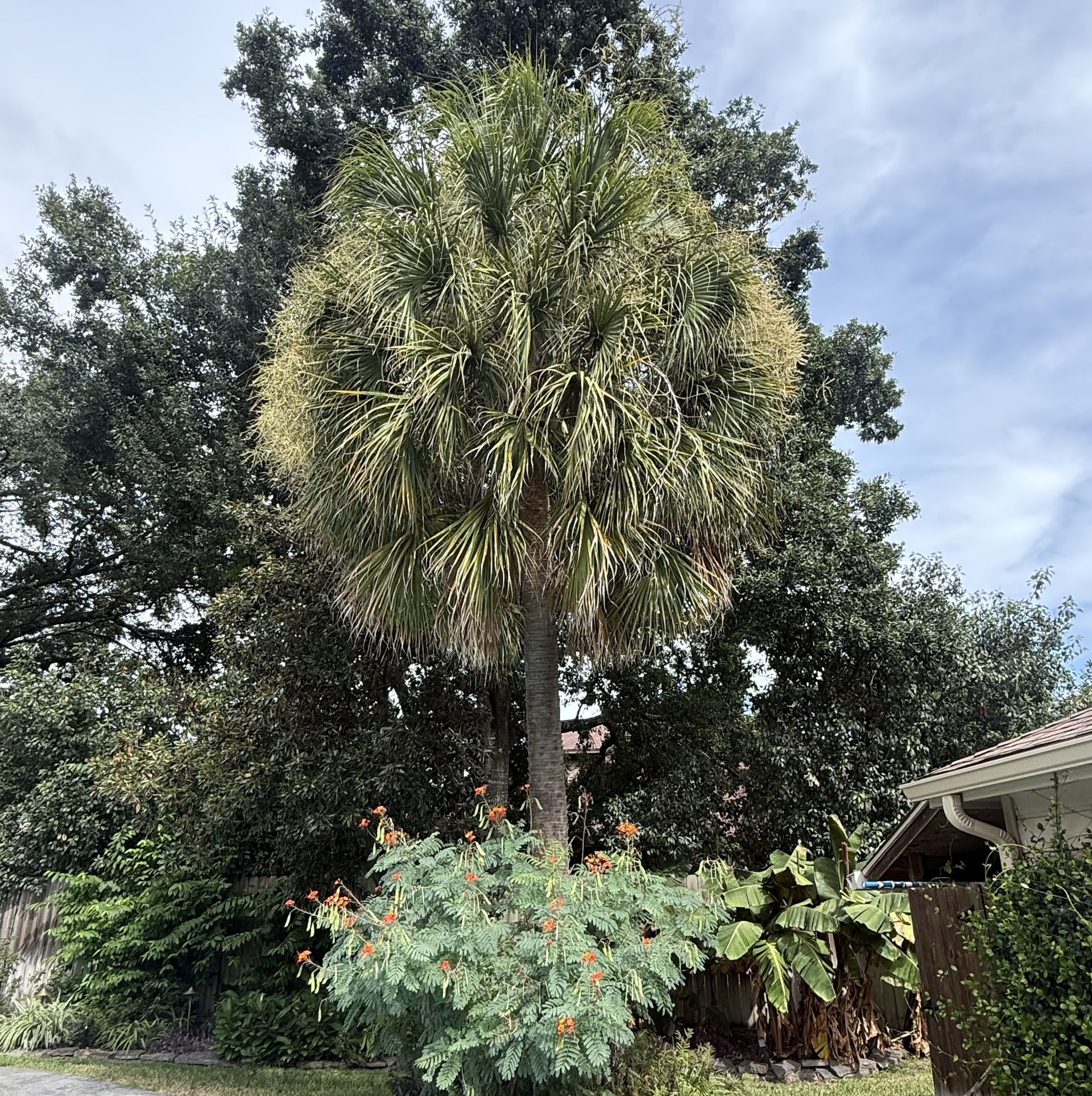
At a residence in the Grasslands area of Rosharon, three palm trees in the back yard were identified as needing supportive care to improve vitality and maintain stable performance. The recommended scope included the palms and the surrounding soils and grasses to ensure effective coverage of the root zone.
Evaluation Findings:
Assessment supported the need for proactive support focused on root-zone function and overall palm performance. Because the terminal bud is the single growing point in palms, treatment placement and coverage around the crown area was prioritized to support overall function and reduce stress during active growth periods.
Intervention:
An organic palm biostimulant treatment was recommended for the three back yard palms, including the surrounding soils and grasses for effective root-zone coverage. Per arborist instructions, the treatment is to be applied with heavy spray coverage around the terminal bud of each palm to ensure thorough contact in the crown region while also supporting below-ground function through the treated root zone.
Outcome (Observable):
This case study documents a treatment recommendation. Observable outcomes are expected to be documented after treatment implementation, with the goal of improved vigor, improved growth response, and more stable overall palm performance over time.
Communities We Serve in Rosharon
Eric Putnam BCMA Inc. provides arborist-led tree care, Plant Health Care, and professional tree evaluations throughout Rosharon. Our Rosharon service area includes properties in communities such as:
- Caldwell Crossing
- Caldwell Ranch
- Huntington Place
- Lincoln Place
- Magnolia Bend
- Pradera Oaks
- Sierra Vista
- Southern Colony Expansion
- Sterling Lakes North
- Stewart Heights
* If your neighborhood is not listed, contact our office to confirm service availability for your property *
Nearby Cities We Serve
Eric Putnam BCMA Inc. also provides professional tree care and arborist services in communities near Rosharon. Select a city below to learn more about our services in that area.

Request an Arborist Evaluation in Rosharon, TX
If you have questions regarding canopy stability, structural defects, or long-term tree health in Rosharon, request an evaluation with a certified arborist. Recommendations are based on documented findings and site-specific conditions.
Book an Appointment
Get a quote
Contact Us
Liriope’s Muse - Expert Tree Care Tips