

Arborist Services in Richwood, TX
Tree Risk Assessment and Structural Stability Planning in Richwood, Texas
Richwood, TX is a compact Brazoria County city where tree management is shaped by subdivision development, city parks, drainage corridors, and the highway connections that tie the city to the larger Brazosport area. Official city materials point to corridor references such as 2004 and 288B, while municipal documents and park information also show how much of Richwood’s day-to-day landscape is organized around neighborhood streets, public facilities, and small-to-mid-scale residential lots rather than large rural tracts.
That local pattern matters because Richwood includes both tighter built environments and open public spaces where canopy behaves differently. City records identify facilities and parks including Richwood Municipal Park, Bobby Ford Park, Larry Johnson Memorial Park, Dorothy Torrence Park, Freedom Park, and Ellis Park. In practice, that means arborist evaluation may involve trees near pavilions, walking areas, playgrounds, neighborhood streets, and homes, all within a relatively compact municipal footprint.
Richwood also has an active drainage and infrastructure context. City flood and drainage project materials reference stormwater improvements tied to Magnolia Lane, Audubon Woods Drive, Quail Run Drive, and an outfall to Ditch 1, identified as a tributary to Bastrop Bayou. That is important for arboriculture because local tree performance is influenced not just by canopy size, but by how water moves through the site, how long soils stay saturated, and whether root zones are restricted by development or repeated drainage problems.
Local Tree and Property Conditions in Richwood, TX
Richwood’s zoning map shows a mix of residential, business, commercial, industrial, highway, and creek or bayou features within the city. That tells you immediately that site conditions are not uniform. Some trees are growing on interior residential streets, while others are closer to roadway frontage, drainage channels, or mixed-use edges where target exposure is higher and rooting conditions may be more constrained.
The city’s own park and facility documents help clarify that pattern further. Richwood Municipal Park is located on Audubon Woods Drive and includes recreation-focused public space, while Bobby Ford Park sits on Oyster Creek Drive with a pavilion, fishing pier, playground, basketball area, and walking track. Those are very different arboricultural settings from smaller neighborhood parks such as Larry Johnson Memorial Park or Dorothy Torrence Park, where tree use patterns are lighter but available planting space may also be more limited.
Richwood’s recent drainage notices show that some local infrastructure concerns are specific, not theoretical. The 2024 flood and drainage materials reference proposed storm sewer work and outfall improvements in the city, including drainage tied to a tributary of Bastrop Bayou. Older city budget references also mention Glenwood Bayou subdivision and post-flood cleanup in Audubon Woods. Together, those records suggest that repeated water-management issues have been part of Richwood’s real site history, which can affect root-zone oxygen, soil stability, and long-term canopy performance.
Evaluation Philosophy in Richwood
Professional arborist evaluation in Richwood should focus on how the tree is functioning in its actual site, not on whether the canopy simply looks dense or uneven from the street. In a city with park uses, subdivision planting, drainage corridors, and roadway edges packed into a small area, recommendations should be based on documented structure and site response rather than on routine trimming habits or cosmetic expectations.
Assessment frequently focuses on:
- Structural attachment integrity in mature neighborhood canopy
- Root-zone performance where drainage, saturation, or compaction may influence stability
- Canopy distribution relative to homes, drives, park features, and walking areas
- Early identification of defect progression before failure occurs in a higher-target setting
A tree may appear healthy while still carrying a structural issue tied to below-grade conditions. The reverse is also true. A tree with an irregular canopy does not automatically justify aggressive reduction if the condition is stable and manageable.
Priority Services in Richwood, TX
Tree Risk Assessment:
Risk assessment in Richwood often involves mature limbs over homes, driveways, neighborhood streets, and public-use spaces such as Ellis Park, Bobby Ford Park, or Richwood Municipal Park. In some cases the concern is overextended lateral growth. In others it is whether drainage history or recurring wet conditions may be affecting root support below grade. The goal is to determine whether a tree should be monitored, mitigated, or removed only when structural reliability cannot be reasonably improved.
Plant Health Care and Root-Zone Management:
Plant Health Care in Richwood is often most useful when decline appears tied to site limitations rather than a simple canopy issue. Drainage work, stormwater outfalls, bayou-adjacent ditches, and subdivision buildout can all influence the root environment over time. Where intervention is warranted, the goal should be improved resilience and functional stability, not forced top growth.
Structural Pruning:
Structural pruning should remain objective-based. In Richwood, that may mean reducing a specific overextended limb, correcting imbalance, or addressing a documented weak attachment near a home, park path, pavilion, or roadway edge. Broad canopy thinning is not a default solution. Pruning should be used to manage load and improve structure while preserving useful canopy where feasible.
Removal Planning and Tree Disposition Guidance:
Removal should be recommended only when structural reliability cannot be reasonably improved or when target exposure makes continued retention unacceptable. In Richwood, planning also has to account for tight access, nearby structures, park amenities, and ground conditions that may already be sensitive to drainage or compaction.
Environmental Considerations in Richwood
Richwood’s environmental context is tied closely to drainage infrastructure and bayou-connected runoff paths. The city’s flood and drainage project documents explicitly connect local stormwater work to Ditch 1 and Bastrop Bayou, while the zoning map identifies creek and bayou features as part of the city landscape. That means root support and long-term structural performance should be evaluated in light of water movement and site drainage history, not just how the canopy appears during a dry stretch.
At the same time, Richwood’s park system and compact residential layout create a high number of sites where mature trees stand close to homes, recreation features, and neighborhood circulation. Periodic professional review helps identify structural concerns before they become urgent. Preservation-first management remains the priority whenever mitigation is feasible.
Recent Work in Richwood, TX
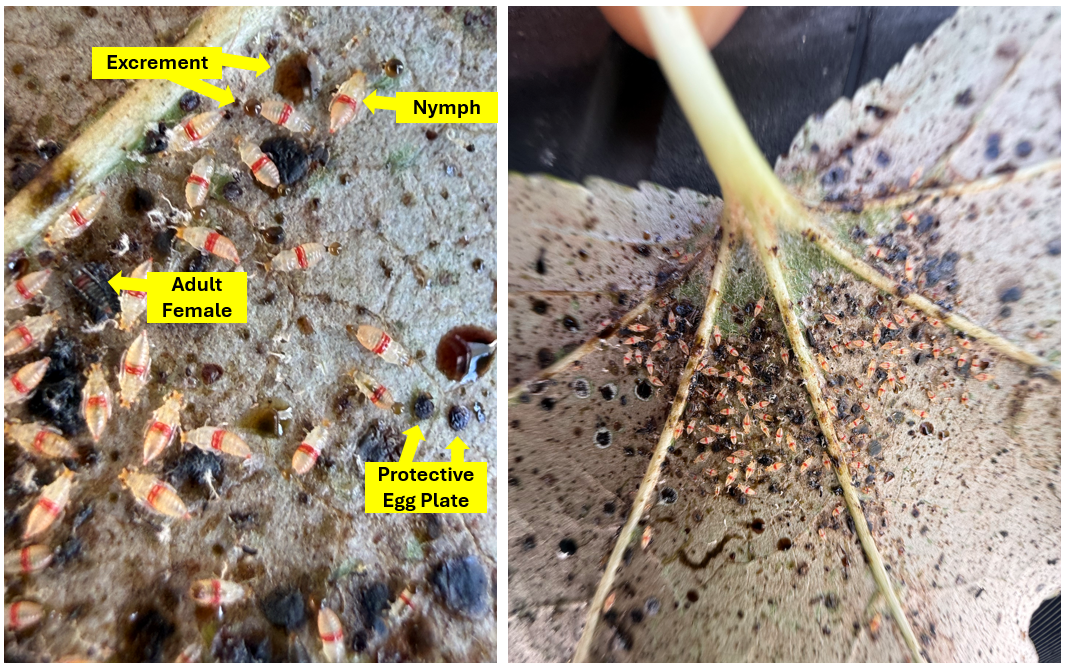
Case Study #1307: Wood-Boring Insect Treatment - Oakwood Shores, Richwood
Property Context:
At a residence in the Oakwood Shores area of Richwood, a tree on the property was identified as needing pest management due to suspected wood-boring insect pressure. The objective of the recommended treatment is to suppress borer activity and protect tree function before additional tunneling and feeding contribute to further decline.
Evaluation Findings:
Assessment documented indicators consistent with wood-boring insect activity and associated canopy stress. Findings supported active or elevated borer pressure contributing to reduced vigor and increased decline risk if left unmanaged, indicating the need for systemic suppression and thorough treatment coverage.
Intervention:
A wood-boring insect treatment was recommended using systemic insecticides, specifically imidacloprid and permethrin. The treatment is to be applied to all above-ground and below-ground plant parts to suppress borers damaging the tree. MSO is added to improve uptake by opening stomates in the cell walls, allowing the treatment to be fully integrated throughout the tree.
Outcome (Observable):
Following treatment, borer pressure was brought under control and the tree’s canopy condition stabilized. Subsequent monitoring documented improved vigor and reduced indicators consistent with ongoing borer activity, consistent with successful systemic suppression and recovery support.
Communities We Serve in Richwood
Eric Putnam BCMA Inc. provides arborist-led tree care, Plant Health Care, and professional tree evaluations throughout Richwood. Our Richwood service area includes properties in communities such as:
- Audubon Woods
- Flagridge Estates
- Glenwood Bayou
- Oakwood Shores
- Parkwood Terrace
- Plantation Village
* If your neighborhood is not listed, contact our office to confirm service availability for your property *
Nearby Cities We Serve
Eric Putnam BCMA Inc. also provides professional tree care and arborist services in communities near Richwood. Select a city below to learn more about our services in that area.

Request an Arborist Evaluation in Richwood, TX
If you have questions regarding canopy stability, structural defects, or long-term tree health in Richwood, request an evaluation with a certified arborist. Recommendations are based on documented findings and site-specific conditions.
Book an Appointment
Get a quote
Contact Us
Liriope’s Muse - Expert Tree Care Tips