

Arborist Services in Beach City, TX
Tree Risk Assessment and Structural Stability Planning in Beach City, Texas
Beach City, TX includes large residential tracts, shoreline-oriented properties, and open coastal landscapes along the western shore of Trinity Bay in Chambers County. Tree management in Beach City frequently involves evaluating structural reliability within canopy exposed to bayfront wind patterns, low-elevation coastal conditions, and property layouts that are generally more open than denser suburban neighborhoods. The city’s official history describes Beach City as occupying most of the western shore of Trinity Bay on a broad peninsula bordered by Trinity Bay to the east and the San Jacinto River to the west.
Areas along FM 2354, Lawrence Road, and Cedar Point reflect that pattern clearly. The city office is located on FM 2354, and the city’s own historical materials note that FM 2354 runs most of the way around the Cedar Point peninsula. The city has also highlighted Beach City Memorial Park as a current community feature, giving the area a mix of neighborhood access points, public-use space, and open residential frontage rather than a tightly gridded urban setting.
Because Beach City is spread across a broad bayfront community rather than a compact built-out town, arborist evaluation often focuses on how trees are performing within open exposure, larger lot configurations, and changing development patterns. Structural reliability, canopy balance, and root-zone performance all need to be judged in that context rather than by canopy appearance alone.
We provide arborist-led services in Beach City focused on documented structural assessment, preservation-first planning, and long-term tree health stability.
Local Tree and Property Conditions in Beach City, TX
Beach City’s local conditions are strongly influenced by coastal plain topography and low elevation. The city’s own history page states that the median elevation is about 20 feet, with some areas around 30 feet. In practical terms, that means tree performance may be influenced by moisture retention, shallow gradients, and storm-related saturation more than in higher inland sites.
The broader landscape around Beach City also remains partly semi-rural, marshy, and open. The city describes nearby marsh, prairie, and estuarine conditions around Trinity Bay and Cedar Point, which helps explain why many local trees develop with fewer canopy buffers and greater wind exposure than trees growing in tighter residential settings. Trees on larger properties often develop broader lateral spread and heavier end weight as they mature, which can increase the importance of evaluating structural attachment points and canopy balance over time.
Development and site change are also relevant in Beach City. Chambers County permitting requires review for residential and commercial development, including drainage criteria and flood-zone considerations, and the county specifically lists an interlocal agreement for permitting and development in Beach City. That matters for tree care because grading, drainage work, additions, and other site modifications can affect root-zone performance long before visible decline becomes obvious in the canopy.
Evaluation Philosophy in Beach City
Professional arborist evaluation in Beach City must account for canopy structure, root-zone performance, attachment integrity, and proximity to likely targets such as homes, garages, driveways, road frontage, and public-use spaces.
Assessment frequently focuses on:
- Structural stability within open-grown coastal canopy
- Root performance where low elevation, saturation, or drainage changes may influence stability
- Early identification of structural defect progression
- Canopy distribution relative to homes, access routes, and shoreline-oriented properties
A tree that appears full or healthy from a distance may still contain structural concerns that require mitigation. Recommendations are based on documented findings and observed site conditions rather than canopy appearance alone.
Priority Services in Beach City, TX
Tree Risk Assessment:
Risk assessment in Beach City often addresses canopy extending over homes, driveways, bay-facing yards, and roadside frontage along open properties. Structural inspection evaluates attachment integrity, defect formation, and weight distribution across major limbs.
Where mitigation remains feasible, corrective pruning or structural reduction may be recommended based on documented findings.
Plant Health Care and Root-Zone Support:
Root-zone evaluation may be indicated when vitality decline appears associated with drainage variability, flood-zone conditions, soil compaction, or disturbance from nearby development activity. Plant Health Care programs focus on improving long-term root performance and overall tree resilience when site conditions warrant intervention.
Structural Pruning:
Structural pruning is objective-based and applied when documented imbalance, defect progression, or canopy interference with nearby structures is identified. Broad canopy thinning is not recommended as a routine preventive practice. Recommendations prioritize maintaining structural stability while preserving canopy health.
Removal Planning and Tree Disposition Guidance:
Removal is recommended only when structural reliability cannot be reasonably mitigated or when defect progression creates unacceptable risk relative to nearby targets. Planning includes evaluation of property access, surrounding infrastructure, and protection of adjacent landscape elements during removal operations.
Environmental Considerations in Beach City
Beach City’s location along Trinity Bay exposes trees to coastal wind patterns, open shoreline conditions, and low-elevation site factors that differ from inland suburban environments. The city’s official history places Beach City on the broad Cedar Point peninsula between Trinity Bay and the San Jacinto River, with surrounding marsh and estuarine land still shaping the local environment.
Floodplain regulation also remains relevant. Beach City maintains a current flood damage prevention ordinance, and Chambers County permitting notes that projects in flood zones may require elevation-related review. Periodic structural evaluation helps identify developing concerns early while preservation-first management remains feasible in this open coastal setting.
Recent Work in Beach City, TX
Case Study #3134: Armyworm Treatment - North Point, Beach City
Property Context:
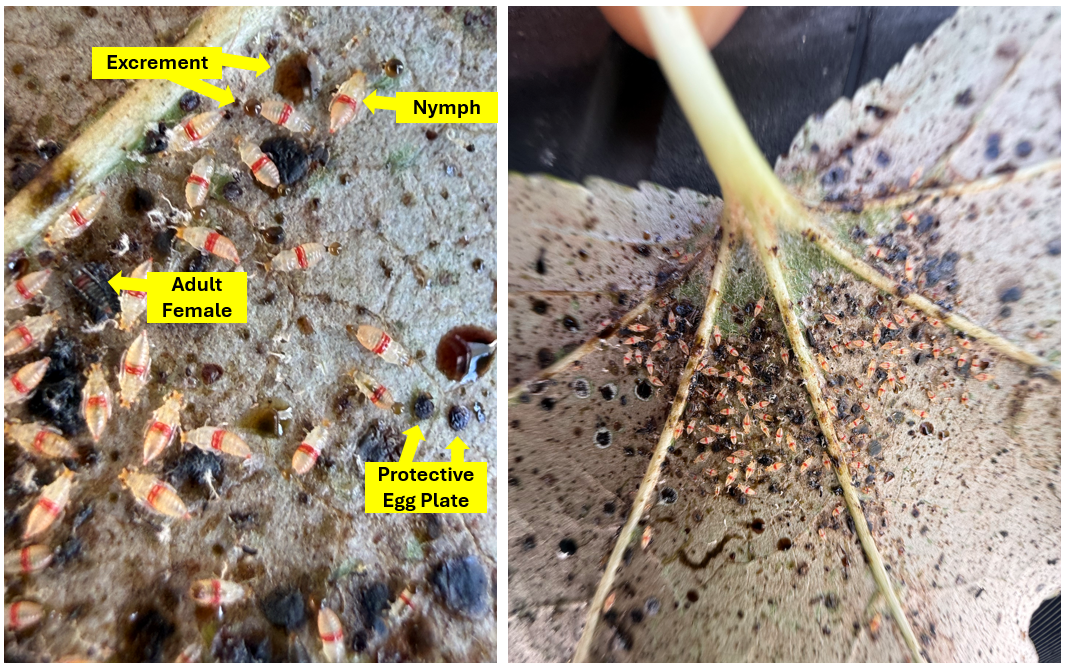
At a residence in the North Point area of Beach City, trees throughout both the front and back yard were identified as needing pest management due to active or suspected defoliating insect pressure. The recommended scope includes all trees across both yards and the surrounding soils and grasses to support effective treatment coverage.
Evaluation Findings:
Assessment documented indicators consistent with defoliation pressure associated with armyworms, bagworms, and or caterpillar activity affecting the property’s trees. Findings supported elevated risk for continued foliage loss and canopy stress if pest pressure was not suppressed in a timely manner, particularly when multiple trees across the site are involved.
Intervention:
An armyworm, bagworm, and caterpillar treatment was recommended for all front and back yard trees, including surrounding soils and grasses in accordance with arborist instructions. Systemic insecticides, specifically imidacloprid and permethrin, are to be sprayed on all above-ground and below-ground plant parts to suppress the defoliating insects damaging the trees. A surfactant is added to improve uptake by opening stomates in the cell walls, allowing insecticides to be fully integrated throughout the treated trees.
Outcome (Observable):
Following treatment, armyworm, bagworm, and caterpillar pressure was brought under control across the front and back yard tree population. Defoliation stopped progressing, and subsequent monitoring documented improved foliage condition and renewed growth response consistent with successful suppression and recovery support.
Case Study #3134: Wood-Boring Insect and Webworm Treatment - Airpark, Beach City
Property Context:
At a property in the Airpark area of Beach City, trees across the entire site required a comprehensive pest management response due to wood-boring insect pressure and webworm activity. The treatment scope included all trees on the property and the surrounding soils and grasses to ensure effective coverage across root-zone areas.
Evaluation Findings:
Assessment documented indicators consistent with wood-boring insect activity and webworm related defoliation pressure affecting the property’s tree population. Findings supported elevated risk for continued decline and canopy stress if both pest pressures were not addressed comprehensively across the site.
Intervention:
A combined wood-boring insect and webworm treatment was performed for all trees on the property, including surrounding soils and grasses in accordance with arborist instructions. Systemic insecticides, specifically imidacloprid and permethrin, were applied to all above-ground and below-ground plant parts to suppress borers damaging the trees. A surfactant was added to improve uptake by opening stomates in the cell walls, allowing insecticides to be fully integrated throughout the treated trees. This program was paired with a biostimulant treatment that included complete fertilization of the trees to support overall function and recovery.
Outcome (Observable):
Following treatment, borer and webworm pressure was brought under control and canopy condition stabilized across the property. Subsequent monitoring documented improved vigor and reduced indicators consistent with ongoing pest activity, consistent with successful suppression and recovery support.
Communities We Serve in Beach City
Eric Putnam BCMA Inc. provides arborist-led tree care, Plant Health Care, and professional tree evaluations throughout Beach City. Our Beach City service area includes properties in communities such as:
- Barrow Ranch
- Bay Place
- Bayridge
- Beach Haven
- Hidden Oaks Estates
- Sylvan Acres
- The Oaks at Houston Point
* If your neighborhood is not listed, contact our office to confirm service availability for your property *
Nearby Cities We Serve
Eric Putnam BCMA, Inc. also provides professional tree care and arborist services in communities near Beach City. Select a city below to learn more about our services in that area.

Request an Arborist Evaluation in Beach City, TX
If you have questions regarding canopy stability, structural defects, or long-term tree health in Beach City, request an evaluation with a certified arborist. Recommendations are based on documented findings and site-specific conditions.
Book an Appointment
Get a quote
Contact Us
Liriope’s Muse - Expert Tree Care Tips